Three politicians walked into a prediction market and bet on themselves. The punchline? They got fined less than the cost of a decent dinner.
Kalshi, the prediction market platform now valued at a staggering $22 billion, has just handed out what might be the most laughable “enforcement actions” in the short but chaotic history of crypto-adjacent financial markets. Three congressional candidates — spanning both parties and an independent — were caught red-handed trading on their own elections. Their collective punishment wouldn’t cover a weekend in a mid-range Airbnb.
The Three Offenders: A Bipartisan Embarrassment
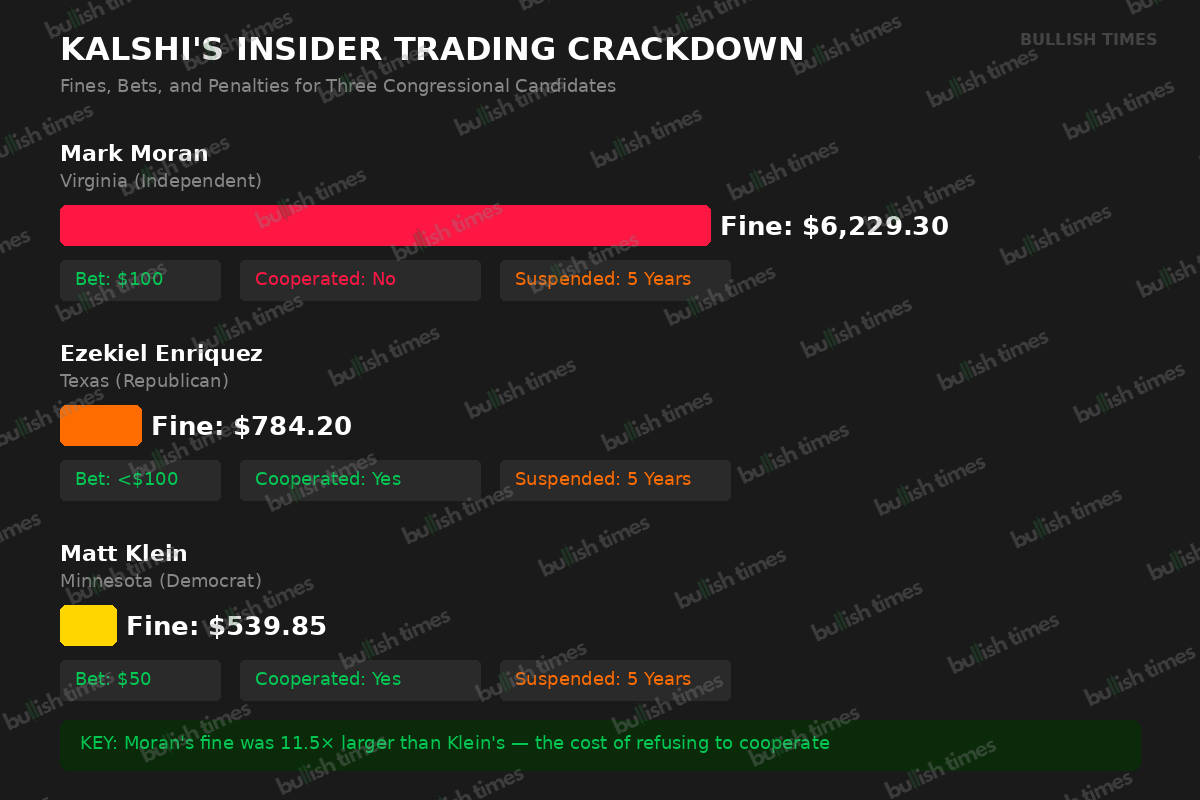
On 22 April, Kalshi published disciplinary notices naming three candidates who violated its rules against political insider trading. The accused are a bipartisan trio: Mark Moran, a Virginia independent running for U.S. Senate; Matt Klein, a Democratic state senator from Minnesota seeking a House seat; and Ezekiel Enriquez, a Texas Republican who ran (and lost badly) in a House primary.
The amounts wagered were almost comically small. Klein bet $50 on himself. Enriquez wagered slightly less than $100. Moran put $100 on his own candidacy across two separate markets. For context, anonymous whales on rival platform Polymarket have been making $400,000 profits on single geopolitical wagers — but sure, let’s focus on the state senator who risked fifty dollars.
A Parking Ticket in a $22 Billion Casino
Here’s where it gets properly absurd. Klein was fined $539.85. Enriquez got hit with $784.20. Moran, who refused to cooperate and essentially dared Kalshi to make an example of him, received the heftiest penalty: $6,229.30. All three were suspended from the platform for five years.
U.S. Representative Mike Levin, a California Democrat, put it best on social media: “That’s not a punishment. That’s a parking ticket.”
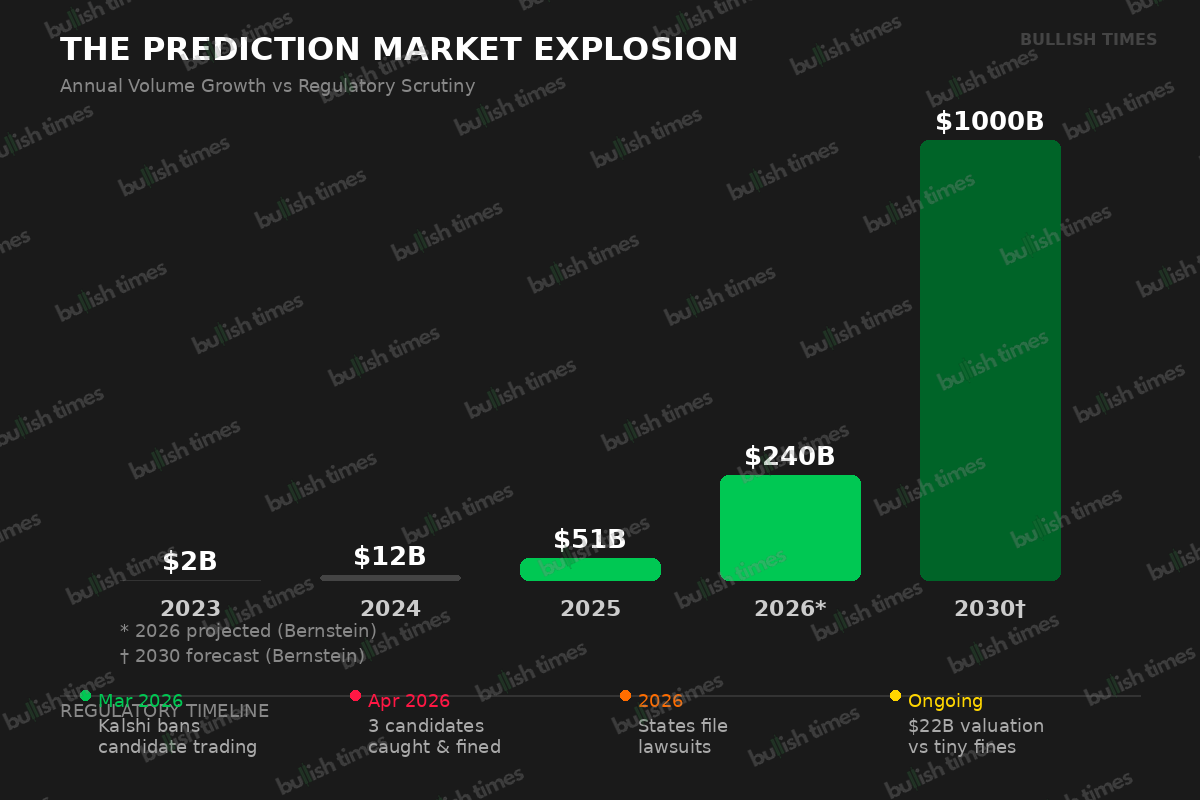
He’s not wrong. Kalshi raised $1 billion at a $22 billion valuation earlier this year. The combined volume across Kalshi and Polymarket has already surpassed $60 billion in 2026 alone. Bernstein projects the prediction market industry will hit $240 billion in annual volume this year and $1 trillion by 2030. Against that backdrop, a $6,229 fine for insider trading on a political election isn’t just inadequate — it’s insulting.
The agreements, it should be noted, are with Kalshi itself — not with the Commodity Futures Trading Commission (CFTC), the federal regulator ostensibly overseeing these markets. The CFTC is currently chaired by Michael Selig, widely regarded as friendly to the prediction market industry. No federal enforcement action has been taken.
The Moran Defence: Chaos Agent or Crusader?
Perhaps the most fascinating character in this saga is Mark Moran. Far from being ashamed, the Virginia Senate candidate appears to have engineered the entire incident as a political stunt. He told the Associated Press he placed the bets intending to get caught, specifically to draw attention to what he calls the “unjust sway” platforms like Kalshi have on elections.
“When I piss people off, when I upset people, and when I captivate their attention, that’s when they have to start listening,” Moran said.
He refused to sign a settlement that would have required him to post a statement on X, resulting in his significantly higher fine. On the platform, he went further, accusing Kalshi of “destroying young men” and comparing the company’s PR strategy to that of tobacco companies. He’s now vowed to “go after Kalshi and impose significant penalties on them” if elected to the Senate.
Whether you view Moran as a principled provocateur or an attention-seeking chaos agent probably depends on your priors about prediction markets. But his core point lands: if the maximum consequence for insider trading on a federally regulated prediction market is a $6,000 fine from the platform itself, the system is fundamentally broken.
The Bigger Picture: Who Polices a $240 Billion Market?
This incident exposes a gaping hole in the regulatory framework for prediction markets. Kalshi and Polymarket have grown from niche curiosities into mainstream financial infrastructure in barely two years. The Trump administration has been openly supportive, with the CFTC taking a light-touch approach even as states file lawsuits and senators draft legislation.
In March, following bipartisan congressional pressure, both Kalshi and Polymarket announced new rules banning candidates from trading on their own races. The three enforcement actions this week are the first test of those rules — and the results are underwhelming.
Consider the asymmetry: an anonymous Polymarket trader pocketed $400,000 from a single wager on the Venezuelan presidency in January. Meanwhile, a Minnesota state senator gets fined $539 for betting fifty dollars on himself. The message being sent is clear: the rules exist, but the consequences are trivial.
Matt Klein, to his credit, has become a cosponsor of Minnesota legislation that would ban most prediction market wagering on elections. He called his bet “a mistake” and apologised, arguing the experience proved these markets need far stronger regulation. There’s an irony there — a politician who broke the rules now championing the rules — but at least he’s pointing in the right direction.
The prediction market industry is at an inflection point. With a $22 billion valuation, $1 billion in fresh capital, and projections of trillion-dollar annual volumes within four years, these platforms are no longer scrappy startups. They’re systemically important financial infrastructure that can move markets, influence elections, and generate enormous profits for those with inside information.
The question isn’t whether insider trading will happen on prediction markets. It already is. The question is whether anyone with actual enforcement power — the CFTC, the DOJ, Congress — will impose consequences that matter. Because right now, the deterrent for manipulating a $240 billion market is a fine you could pay with what’s left in your campaign petty cash.
Kalshi says it’s “hard at work monitoring markets 24/7.” Based on this week’s penalties, the markets have very little to fear. This is a developing story.