A Google engineer with a raccoon fetish and access to the world’s most valuable search data just became the poster child for everything wrong with prediction markets. Meet “AlphaRaccoon” — the man who turned confidential Google data into $1.2 million on Polymarket, and now faces up to 50 years in prison.
Michele Spagnuolo, a 36-year-old Italian national working as a Staff Information Security Engineer at Google in Zürich, was arrested this week on federal charges of commodities fraud, wire fraud, and money laundering. The Department of Justice alleges he exploited his access to Google’s internal data systems to place near-perfect bets on Polymarket’s “Year in Search” prediction contracts — and walked away with a $1.2 million profit before the FBI caught up with him.
The AlphaRaccoon Playbook
The scheme was breathtakingly simple. Every year, Google publishes its “Year in Search” list — the most-searched topics, people, and events. It’s a cultural moment. It’s also, apparently, an insider trading goldmine if you happen to work at Google.
According to the DOJ complaint filed in the Southern District of New York, Spagnuolo had access to a Google software tool that displayed “confidential, nonpublic data” tracking real-time search trends. This data was marked “Google Confidential — NDA Required.” He allegedly used it to identify exactly which public figures would — and wouldn’t — appear on the final Year in Search list before its public release on 4 December 2025.
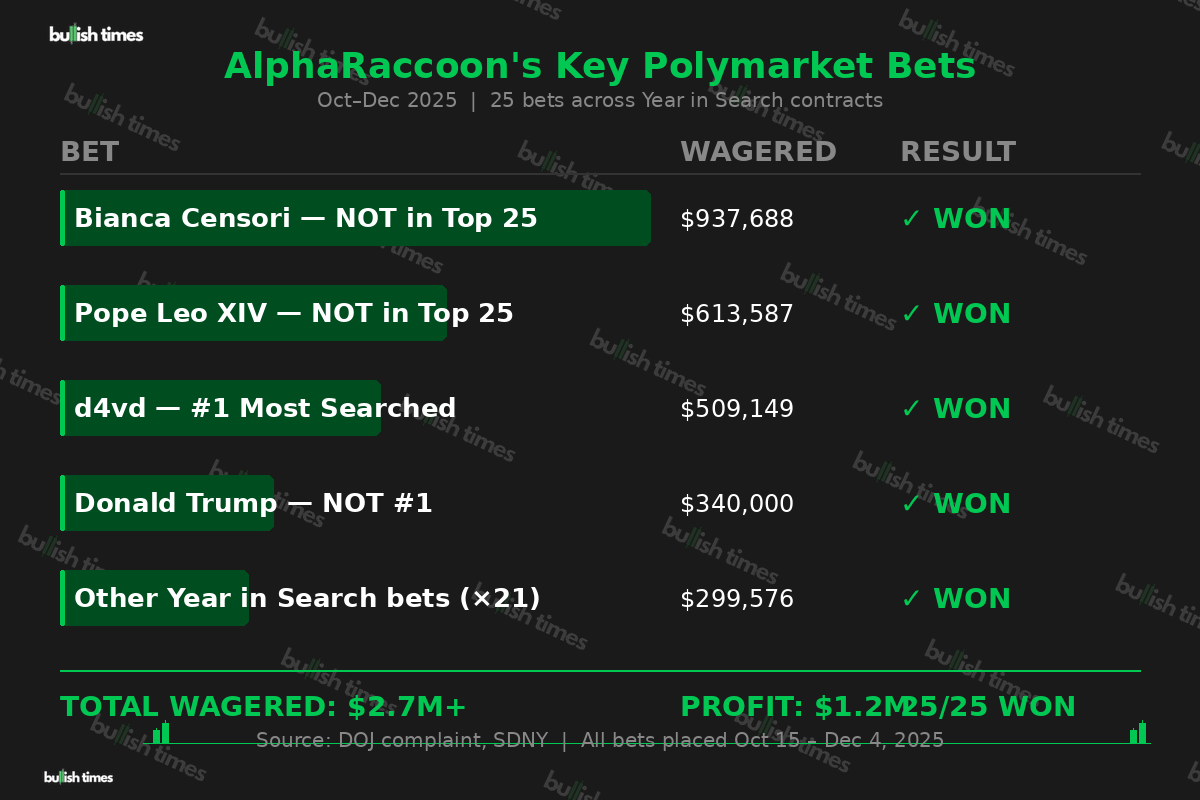
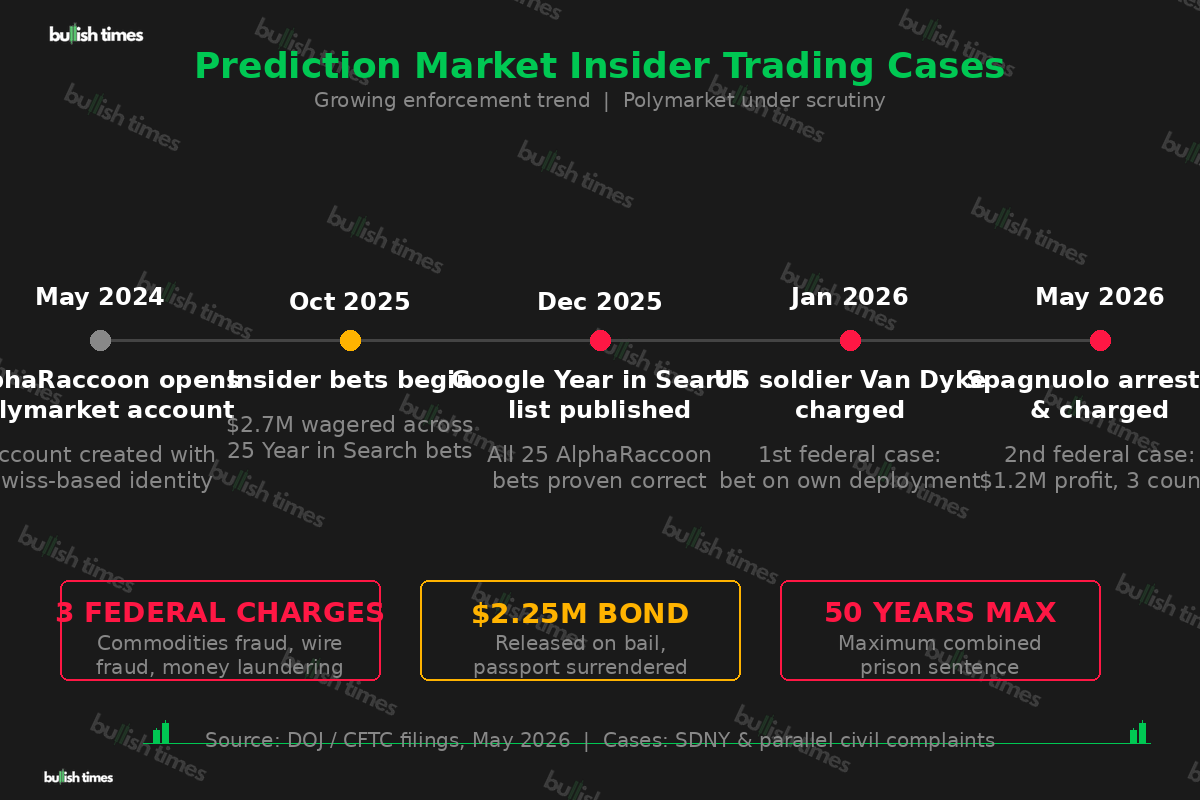
Trading under the alias “AlphaRaccoon,” Spagnuolo opened his Polymarket account in May 2024 and began placing bets in October 2025. Over the next seven weeks, he wagered approximately $2.75 million across at least 25 separate contracts. His largest single bet: $937,688 that Bianca Censori would not appear in Google’s Top 25 most-searched people. He was right.
The Audacity of Near-Perfect Accuracy
What makes this case so damning isn’t just the profit — it’s the perfection. Spagnuolo went 25 for 25. In prediction markets, nobody goes 25 for 25. Not on long-shot bets, not on contracts where the implied probability was well below 50%.
Consider the d4vd bet. The singer — later charged with murder in the death of 14-year-old Celeste Rivas Hernandez — had near-zero implied odds of being the number one most-searched person on Google. Spagnuolo wagered $509,149 that he would be. He was right. That’s not luck. That’s not even skill. That’s having the answer sheet.
He also bet $613,587 against Pope Leo XIV making the Top 25, and $340,000 against Donald Trump being the single most-searched person. Both correct. Both based, prosecutors allege, on data he accessed through Google’s internal tools.
The DOJ was blunt: “Unlike the counterparties to his trades, Spagnuolo knew the outcome of these events before they occurred.”
Follow the Money — Through the Blockchain
After his winning streak, Spagnuolo didn’t simply cash out. According to the complaint, he transferred approximately $5 million to an external cryptocurrency wallet and then attempted to launder the proceeds through a series of token swaps and transfers. The FBI, working with blockchain analytics, traced the wallet back to a payment processor account registered in Spagnuolo’s name.
Google confirmed Spagnuolo has been placed on administrative leave. “We’re working with law enforcement on their investigation,” a company spokesperson said, adding that the employee had accessed “marketing material using a tool available to all employees” — but that using such confidential information for personal trading represented “a serious breach of our policies.”
Polymarket, for its part, said it cooperated with the DOJ investigation and that the platform “has industry-leading tools and controls in place to detect and deter market manipulation.” Whether those tools actually caught AlphaRaccoon, or whether it took old-fashioned federal investigation, remains an open question.
The Prediction Market Reckoning
Spagnuolo’s arrest marks only the second federal prosecution for insider trading on a prediction market. The first came in January 2026, when US Army soldier Steven Van Dyke was charged with placing bets on his own military deployment on Polymarket. But the AlphaRaccoon case is far more significant — both in scale and in what it reveals about prediction market vulnerability.
Prediction markets like Polymarket have boomed since correctly calling the 2024 US presidential election. They’ve been celebrated as superior forecasting tools, truth machines that aggregate collective wisdom better than polls or pundits. But this case exposes an uncomfortable truth: when one participant has privileged information, the “wisdom of the crowd” becomes the “fleecing of the crowd.”
US Attorney Jay Clayton didn’t mince words: “Today’s charges reinforce a decades-old message — corporate insiders cannot use confidential business information to turn a profit in our markets.” The CFTC filed a parallel civil complaint, signalling that regulators intend to treat prediction markets with the same seriousness as traditional financial instruments.
What Happens Next
Spagnuolo was released on a $2.25 million bond and ordered to surrender his passport. He faces a maximum of 50 years in prison across the three charges — though legal experts note that first-time white-collar defendants rarely receive maximum sentences.
The bigger question is what this means for Polymarket and the prediction market industry. If a single Google employee with database access can extract $1.2 million with near-zero risk of detection by the platform itself, how many other AlphaRaccoons are lurking? How many corporate insiders at Apple, Meta, Amazon, or any Fortune 500 company are quietly monetising privileged information through crypto-native betting platforms that sit outside traditional regulatory frameworks?
Polymarket processes hundreds of millions in monthly volume. Its contracts cover everything from geopolitics to celebrity gossip. Each one is a potential insider trading vector for anyone with non-public information about the outcome.
The prediction market revolution promised radical transparency. AlphaRaccoon delivered a reminder that in markets — crypto or otherwise — information asymmetry is the oldest edge in the book. The only question now is whether regulators can move fast enough to close the gap.
This is a developing story. Spagnuolo’s next court appearance is pending. Google’s internal investigation is ongoing.