A $336 million blockchain backed by Meta alumni and FTX Ventures just went offline three times in 48 hours — and the team admitted it saw the second crash coming before it shipped the patch.
Sui, the Layer-1 chain built by Mysten Labs, suffered three consecutive mainnet halts between 28 and 29 May, racking up roughly 16 hours of total downtime. The Sui Foundation’s post-mortem, published on Sunday, is unusually candid — and unusually damning. It confirms the team knowingly deployed an interim fix with a recognised probability of causing another outage. The network duly obliged.
What Actually Happened
The chaos traces back to a single culprit: version 1.72 of Sui’s software, which introduced a feature called Address Balances. Designed to simplify how users store funds and pay gas fees, the upgrade created new code paths that clashed with Sui’s existing gas-charging logic.
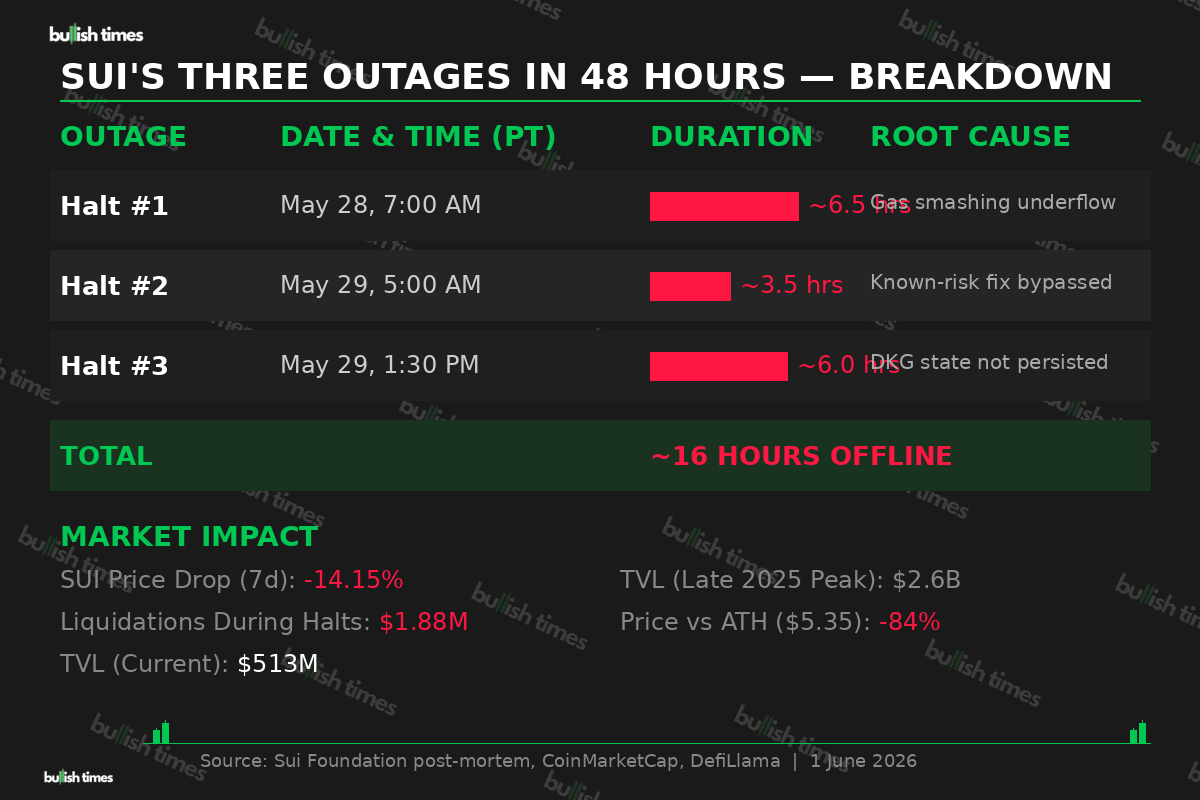
The first halt began at 7:00 AM PT on Thursday, 28 May. A bug in the “gas smashing” process — where input coins are combined to pay transaction fees — produced a negative balance delta when a transaction was cancelled for insufficient funds. The settlement system crashed, and block production stopped dead. It took six and a half hours to restore the network.
Here is where the story turns from unfortunate to indefensible. The core team proposed a quick fix: simply skip gas smashing when a transaction is cancelled with an InsufficientFundsForWithdraw error. But Sui’s own report states plainly that the team “accepted the risk accompanying this fix to bring the network back as quickly as possible.” The known shortcoming? If the error code was masked by a different cancellation reason, the fix would be bypassed entirely — and the same crash would happen again.
That is exactly what occurred at 5:00 AM PT on Friday. Halt number two lasted three and a half hours.
The Third Halt Nobody Saw Coming
If the first two outages were embarrassing, the third was a genuine surprise — even to the team. Five hours after the Friday morning recovery, at approximately 1:30 PM PT, the scheduled epoch change failed to complete, freezing the chain for a third time.
This halt had nothing to do with gas charging. It was triggered by a previously unknown bug in how validators preserve the state of their Distributed Key Generation (DKG) protocol across restarts. When validators rebooted to install Friday morning’s patch, insufficient numbers were ready for DKG, so it disabled itself. Normally, that would be fine. But the failure status was never written to disk. Each validator that restarted came back unaware that DKG had already failed.
Transactions requiring randomness could neither execute nor be cancelled. The queue backed up. The epoch could not close. The network froze for another six hours.
Across all three halts, the Sui Foundation insists no user funds were at risk and no committed transactions were rolled back. The chain simply stopped processing new transactions — cold comfort for the DeFi protocols, gaming applications, and institutional pilots that Sui has spent the past year courting.
The Diem Hangover
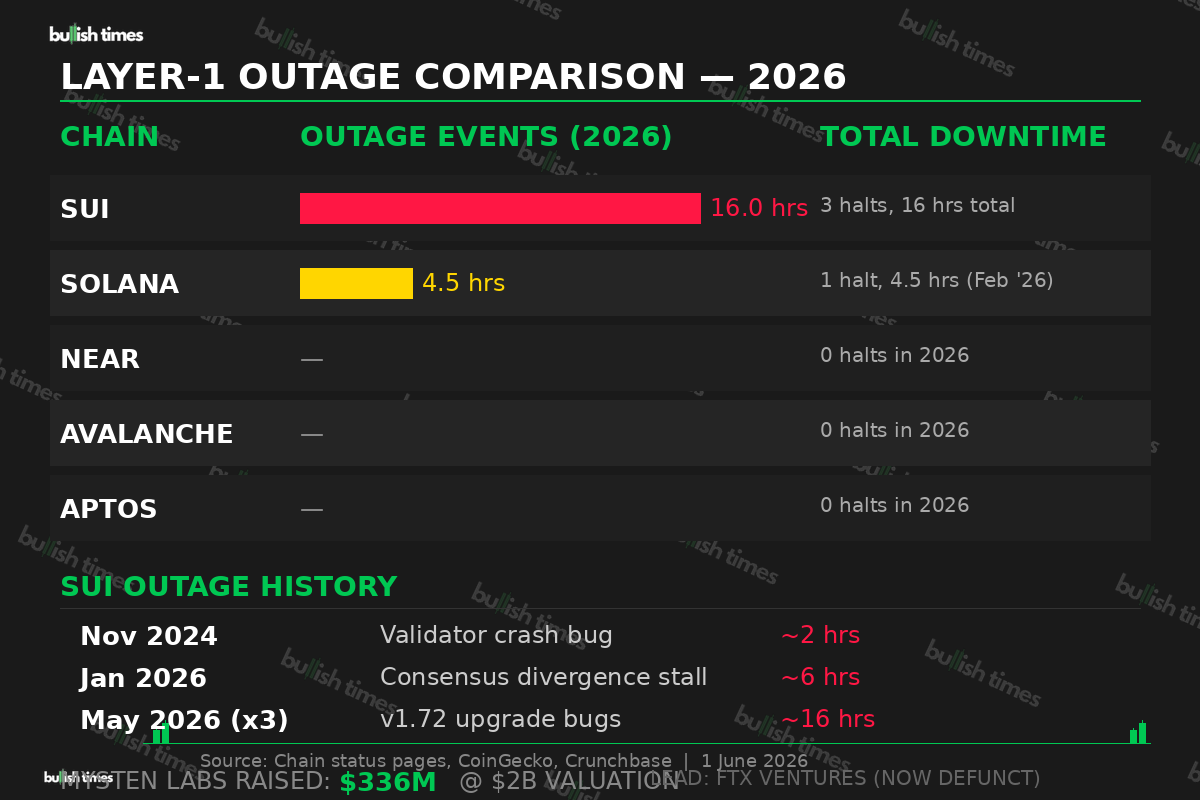
Mysten Labs was founded in 2021 by alumni of Meta’s shelved Diem (formerly Libra) cryptocurrency project. It raised $336 million across two funding rounds — the $300 million Series B was co-led by FTX Ventures, a detail that has aged about as well as you would expect. Investors include a16z, Coinbase Ventures, and Binance Labs. The company was valued at $2 billion.
The pitch was compelling: a high-performance Layer-1 blockchain purpose-built for the scale that Meta had envisioned. Sui launched its mainnet in May 2023 and quickly attracted developers with its Move programming language and parallel transaction execution. By late 2025, total value locked across Sui’s DeFi ecosystem hit $2.6 billion. The SUI token peaked at $5.35 in January 2025.
Today, the picture is markedly different. SUI trades at roughly $0.87 — down 84% from that all-time high. TVL has collapsed to $513 million, an 80% decline from the peak. The token shed 14% in the seven days following the outages alone, and $1.88 million in leveraged SUI positions were liquidated during the halts.
More troubling than any single week’s price action is the pattern. Sui experienced a six-hour consensus divergence stall in January 2026 and a validator crash bug in November 2024. Three major outage windows in 2026 alone puts Sui in uncomfortable company — drawing direct comparisons to Solana’s notorious reliability struggles during 2021 and 2022.
The Bigger Question: Can You Ship Fast and Stay On?
The Sui Foundation’s post-mortem deserves credit for its transparency. It acknowledges that gas-charging logic has “grown complex enough that edge cases are hard to rule out by inspection alone” and pledges to invest in failure containment so that a future bug drops the problematic transaction rather than the entire network.
But transparency does not equal competence. The core architectural critique remains unanswered: why does a single edge-case transaction have the power to halt an entire Layer-1 blockchain? Ethereum, for all its scalability woes, has never suffered a full mainnet halt. Solana eventually outgrew its outage era — but it took years, and the reputational scars arguably suppressed SOL’s valuation for an entire cycle.
The v1.72 Address Balances feature was supposed to make Sui more accessible — gasless stablecoin transfers, simplified fund management, fewer friction points for new users. Instead, it introduced the very code paths that brought the network to its knees. The features designed to attract mainstream adoption created the instability that repels it.
For the institutions and developers evaluating Sui as infrastructure for real applications — payments, gaming, DePIN — the question is no longer whether the bugs can be fixed. They can. The question is whether a chain that has now halted four times in six months can be trusted with production workloads that demand five-nines uptime.
One curious footnote from the post-mortem: the Sui Foundation disclosed that AI agents with access to production state helped accelerate diagnosis across all three incidents. The robots are learning to fix the robots. Whether the humans can learn to stop shipping known risks is another matter entirely.
SUI is trading at $0.87 at the time of publication. The next upgrade cycle will determine whether this was growing pains or a structural reliability problem that $336 million could not solve.