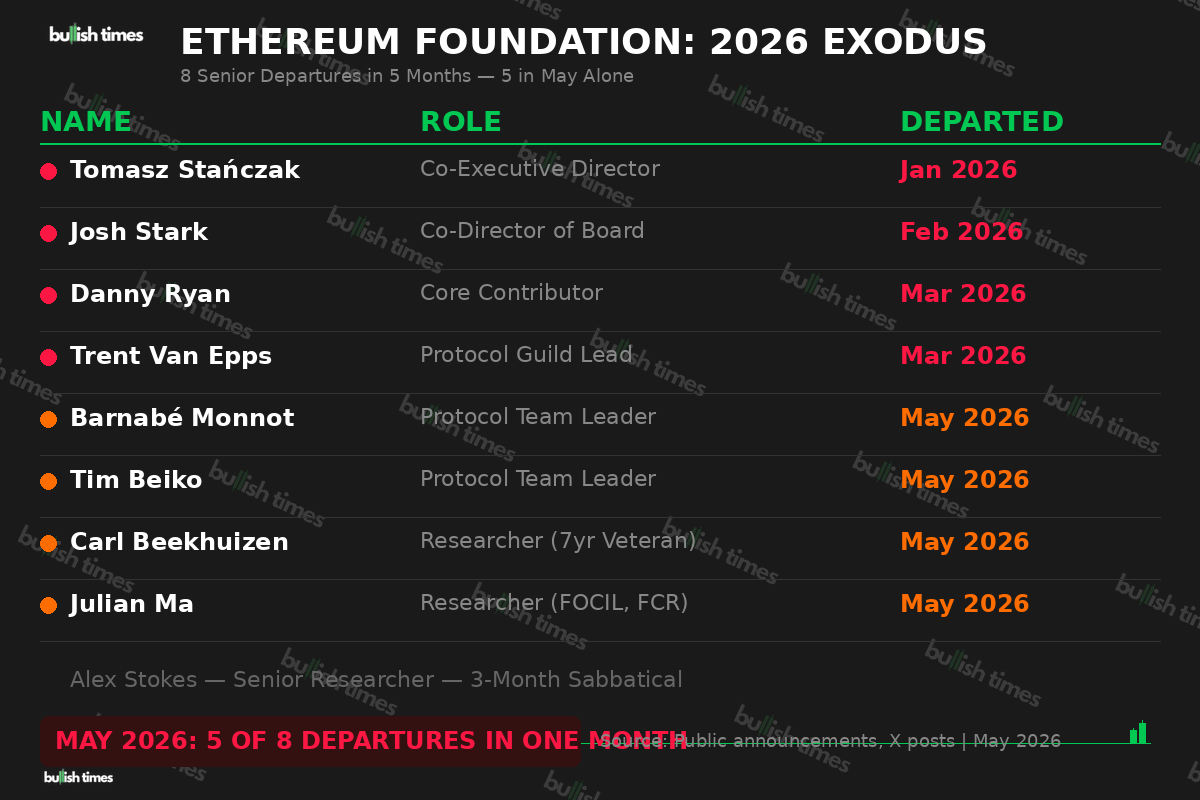
The Ethereum Foundation is haemorrhaging talent at a rate that would alarm any organisation — let alone one stewarding a $255 billion network. Eight senior researchers and leaders have walked out in 2026, five of them in May alone, and now the most vocal ETH evangelist in crypto has dumped every last token.
Something is deeply wrong in Ethereum’s house, and Vitalik Buterin’s response — shrinking the Foundation into a “smaller ship” — has only poured fuel on the fire. A former top researcher is calling for a $1 billion rescue fund. The Bankless co-founders have liquidated their positions. And Galaxy Digital has published a damning analysis warning this could be the turning point for Ethereum’s decline.
The Exodus Nobody Can Ignore
The numbers are brutal. Since January 2026, the Ethereum Foundation has lost co-executive director Tomasz Stańczak, board co-director Josh Stark, Protocol Guild lead Trent Van Epps, protocol team leaders Barnabé Monnot and Tim Beiko, and researchers Carl Beekhuizen and Julian Ma. Senior researcher Alex Stokes has taken a three-month sabbatical. Danny Ryan, once widely tipped as a future Foundation leader, departed earlier and co-founded Etherealize, an institutional outreach initiative.
Beekhuizen was a seven-year veteran instrumental in building the Beacon Chain and shepherding Ethereum’s transition to proof-of-stake. Ma spent four years developing critical infrastructure including FOCIL and the Fast Confirmation Rule. These are not peripheral figures — they are the architects of Ethereum’s most important upgrades.
The Foundation has appointed Will Corcoran, Kev Wedderburn, and Fredrik as new co-leads, but the Glamsterdam upgrade — originally scheduled for June — has already been delayed to Q3 due to “coordination challenges.” When your coordination is challenged because everyone coordinating has resigned, the euphemism writes itself.
The $1 Billion Rebellion
Perhaps the most explosive development came from Dankrad Feist, the researcher who co-created Danksharding — the scaling design underpinning Ethereum’s entire Layer 2 strategy. Feist left the Foundation last year to join Stripe’s blockchain project Tempo. Now he is calling for a completely independent $1 billion organisation to replace the Foundation entirely.
“The EF now holds less than 0.1% of all ETH. There is no flow of Ethereum staking or fee revenues to it,” Feist wrote on X. “If we want to get Ethereum back to winning, the community needs to create an organisation that’s economically aligned with it.”
His proposal demands a board accountable to ETH holders, revenue from staking and transaction fees, and — in his words — a leader “who is competent and wants to fight.” The implication is clear: the current leadership is neither.
The catalyst for much of this fury is the Foundation’s controversial March mandate, a 38-page document that established the CROPS framework (censorship resistance, openness, privacy, security) and explicitly distanced the organisation from any responsibility for ETH’s market value. The document featured allusions to the Milady NFT collection and language that alienated holders watching their investment bleed. “We are NOT a marketing agency… We are NOT a casino… We are NOT opportunists,” the mandate declared.
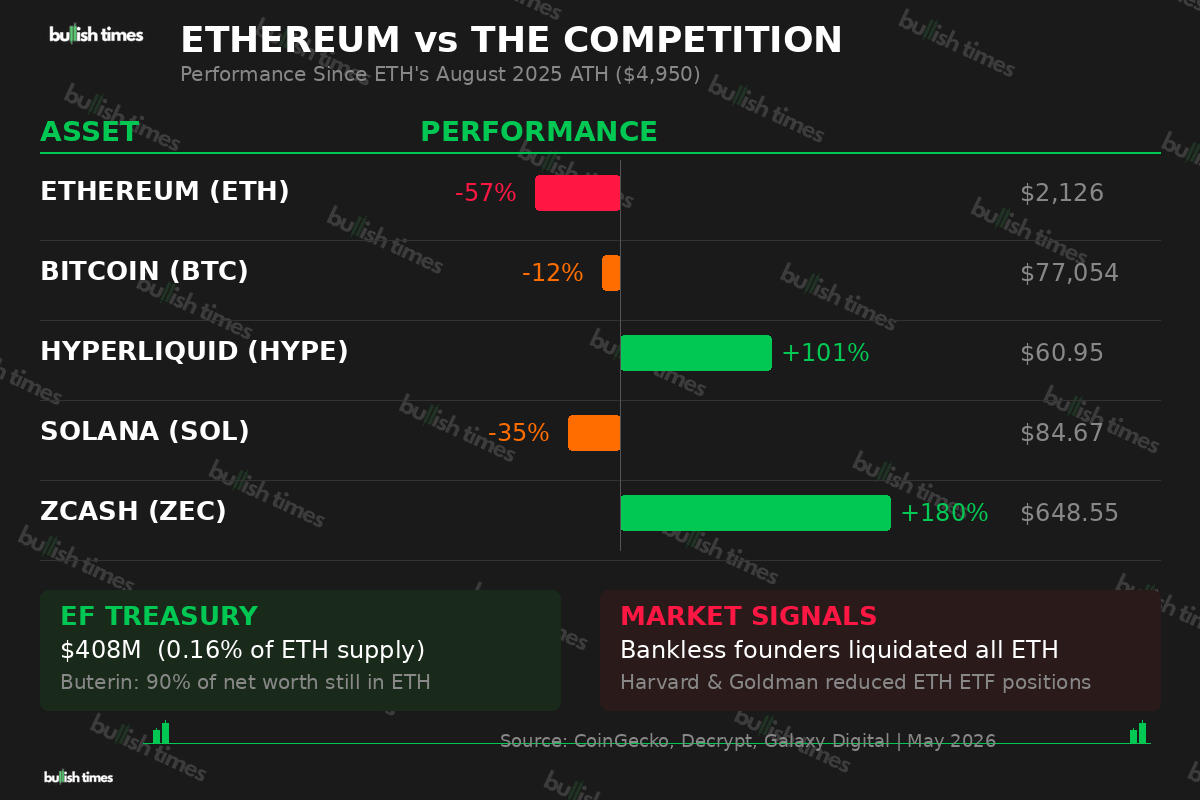
For holders who have watched ETH plunge 57% from its August 2025 all-time high of $4,950 to roughly $2,126, the message landed like a slap.
When the True Believers Abandon Ship
Nothing crystallised the crisis quite like David Hoffman’s announcement. The Bankless co-founder — a man who once publicly stated that 99% of his personal wealth was allocated to ETH — confirmed he has liquidated every single token. His co-founder Ryan Sean Adams declared “the end of the first era” of Bankless.
When the person who built their entire brand on unwavering Ethereum conviction sells everything, the signal is deafening.
Institutional sentiment is equally grim. Harvard University and Goldman Sachs have reduced or liquidated their Ethereum ETF positions. Smart-money wallets tracked by on-chain analytics firms are net sellers. ETH spot ETF outflows in 2026 have surpassed $945 million.
Galaxy Digital’s analysis is equally damning. The firm argues the market wants “a leading public chain that is proactive, commercialised, and continuously generates wealth,” whilst the Foundation insists on being “a neutral, open-source, and unbiased underlying infrastructure.” The core demands, Galaxy concludes, are “incompatible.”
Buterin’s Gamble: Smaller Ship, Bigger Storm
Vitalik Buterin’s response has been characteristically philosophical and maddeningly detached from market reality. On Sunday, he announced the Foundation will become a “smaller ship,” describing it as “one node, with a defined purpose, alongside other nodes” rather than Ethereum’s central steward.
He disclosed that 90% of his personal net worth remains in ETH and that the Foundation controls around $408 million — roughly 0.16% of total supply. He welcomed his own diminishing influence. “My own power within the Ethereum Foundation will continue to decrease, which is honestly what I want,” he wrote.
For critics, this is precisely the problem. Prysm client developer Potuz stated bluntly that the intensive resignations are “a typical manifestation of the Ethereum institutional system being influenced by interests and deviating from its original intentions.” The Foundation’s neutral stance — admirable in theory — is leaving a $255 billion ecosystem without a champion whilst Solana, Hyperliquid, and Zcash aggressively court developers, capital, and narrative momentum.
What Happens Next
The coming weeks will determine whether Feist’s $1 billion proposal gains traction or remains a social media thought experiment. The delayed Glamsterdam upgrade — targeting a gas limit increase to 200 million — will test whether new leadership can execute without the departed veterans. And the market will render its own verdict: ETH is currently consolidating between $2,400 and $2,600 with resistance at $2,700, but smart-money flows suggest further downside risk.
Ethereum has survived existential crises before. But as Galaxy Digital pointedly noted, Solana recovered from its post-FTX collapse by “unifying narrative, focusing on core tracks, firm execution, and rapid repair of weaknesses.” Ethereum’s Foundation is doing the opposite — fragmenting its narrative, broadening its philosophy, and watching its best people walk out the door.
The fat protocol thesis is dead. The question now is whether Ethereum dies with it, or whether the community can build something new from the wreckage — with or without the Foundation’s blessing.
This story is developing. Bullish Times will continue to track Ethereum Foundation departures and the community’s response to Dankrad Feist’s $1 billion proposal.