When a billionaire invests $75 million into the President’s crypto project, you’d expect loyalty. Instead, Justin Sun got a kill switch, frozen tokens, and now he’s fighting back with a federal lawsuit alleging criminal extortion.
World Liberty Financial (WLFI) — the DeFi protocol publicly backed by the Trump family — is facing its most explosive legal challenge yet. Justin Sun, TRON’s founder and one of crypto’s most polarising figures, has filed a federal lawsuit accusing WLFI insiders of weaponising smart contract controls to extort him out of his $75 million stake.
The Investment That Turned Toxic
In late 2025, Sun made a $75 million investment into WLFI, acquiring a substantial portion of governance tokens. The deal was celebrated as a vote of confidence in the protocol’s mission to “democratise finance.” But court filings paint a very different picture of what happened behind the scenes.
According to Sun’s legal team, WLFI’s smart contracts contain an admin-controlled “kill switch” — a function that allows insiders to freeze, claw back, or render worthless any tokens held by specific addresses. Sun alleges this mechanism was deliberately triggered against his holdings after he raised concerns about the protocol’s governance structure.
72% Insider Allocation: Democracy in Name Only
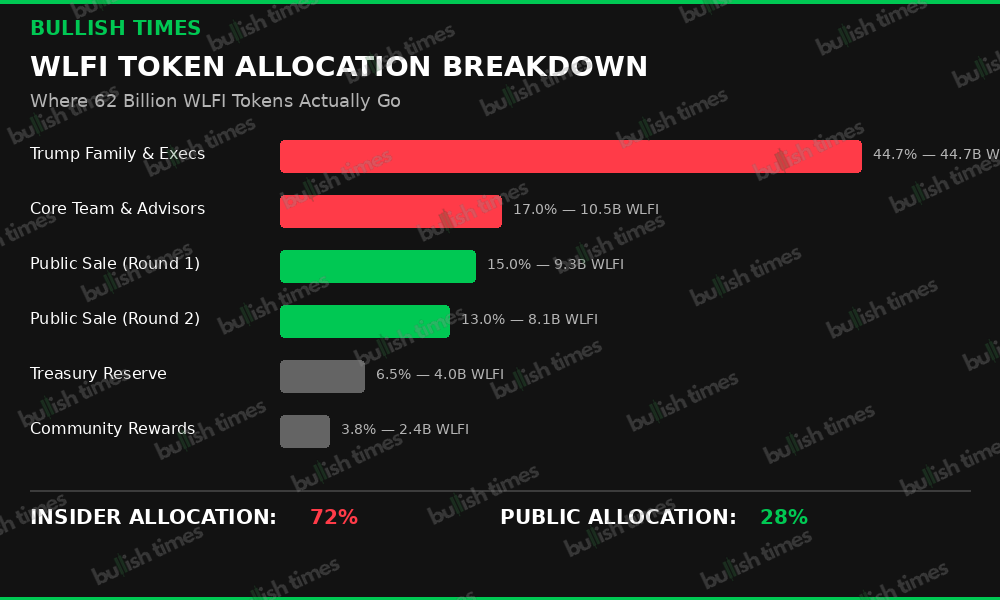
The lawsuit shines a spotlight on WLFI’s token distribution — and the numbers are damning. Court documents reveal that approximately 72% of all WLFI governance tokens are held by insiders, affiliates, and team-controlled wallets. Just 28% were made available to public participants.
For a protocol that markets itself on “decentralised governance,” the concentration of power is striking. With nearly three-quarters of voting power locked up by insiders, any external investor — even one as large as Sun — is effectively a minority stakeholder with no meaningful governance influence.
This imbalance, Sun argues, is precisely what enabled the alleged extortion. When he pushed for greater transparency around treasury management and insider compensation, the response wasn’t a governance vote — it was a smart contract freeze.
The Extortion Allegations
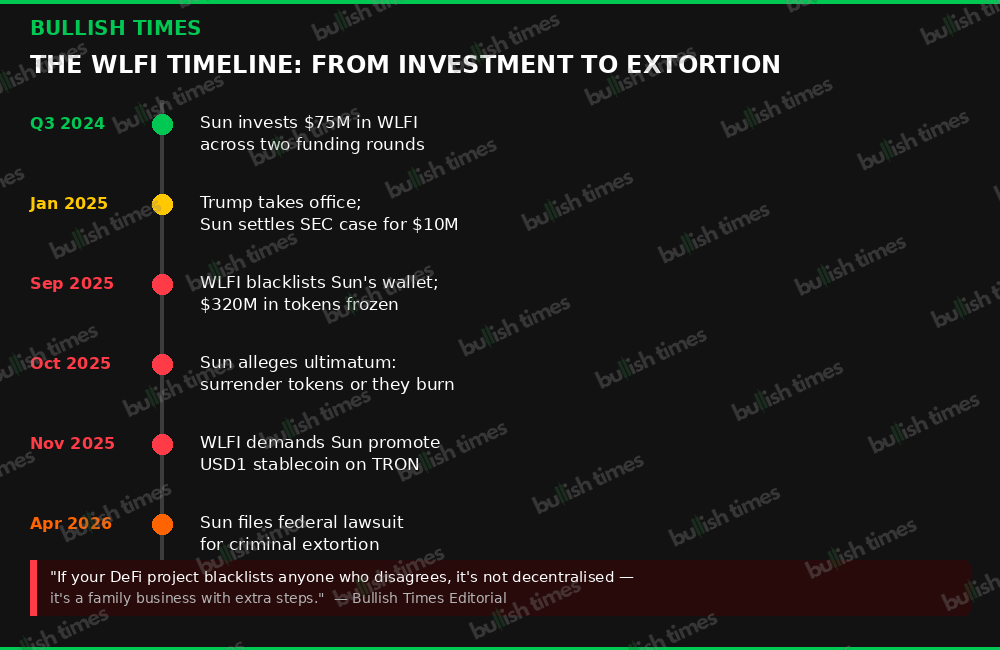
The federal filing details what Sun’s lawyers describe as a coordinated campaign of “economic coercion.” The sequence, according to court documents, unfolded as follows:
- Phase 1 — Investment (Late 2025): Sun commits $75M, receives governance tokens with standard vesting terms
- Phase 2 — Governance Concerns (Early 2026): Sun raises questions about insider compensation and treasury allocation
- Phase 3 — Threats (February 2026): WLFI insiders allegedly warn Sun to “align or face consequences”
- Phase 4 — The Freeze (March 2026): Admin functions triggered to freeze Sun’s token holdings
- Phase 5 — Federal Lawsuit (April 2026): Sun files federal complaint alleging criminal extortion and breach of fiduciary duty
The Kill Switch Problem
Perhaps the most consequential element of this case isn’t the personalities involved — it’s the precedent. Admin-controlled kill switches are more common in DeFi than most users realise. Many protocols retain emergency functions that allow core teams to pause contracts, freeze specific addresses, or override governance decisions.
These mechanisms are typically justified as security features — necessary safeguards against hacks or exploits. But the Sun case demonstrates how easily they can be weaponised for internal power struggles. If a protocol’s insiders can unilaterally freeze a $75 million position, what protection does any investor actually have?
What Happens Next
The case is expected to set significant legal precedent for DeFi governance disputes. If Sun’s allegations are upheld, it could force protocols across the industry to reconsider admin-controlled functions and insider token allocations.
WLFI has not yet filed a formal response, though sources close to the project describe Sun’s claims as “grossly mischaracterised.” The protocol’s legal team is expected to argue that the token freeze was a legitimate security action, not an act of extortion.
Regardless of the outcome, the case has already achieved one thing: it’s exposed the uncomfortable gap between DeFi’s promise of trustless governance and the reality of admin-controlled smart contracts. When 72% of tokens sit with insiders and a kill switch exists in the code, “decentralised” is doing a lot of heavy lifting.
This story is developing. Bullish Times will continue to cover proceedings as the case moves through the federal courts.