A guaranteed 25% monthly return is not a business model. It is a siren, and US prosecutors say thousands of crypto investors followed it straight into a $165 million wreck.
Edward Zimbardi, 59, of Flowery Branch, Georgia, is now back on American soil after being deported from Fiji. The case is only at the indictment stage, and he is presumed innocent unless proven guilty. But the allegations read like a compressed history of crypto’s ugliest retail failure mode: huge yield promises, private wallets, international flight and victims left trying to reconstruct the money trail after the pitch collapsed.
The story matters because this was not, on the government’s account, a sophisticated DeFi exploit or an obscure smart-contract failure. It was simpler and more brutal. Prosecutors say investors were sold “The Crypto Program”, an advertising-package investment that allegedly promised a guaranteed 25% monthly return.
The pitch was yield, the path was crypto
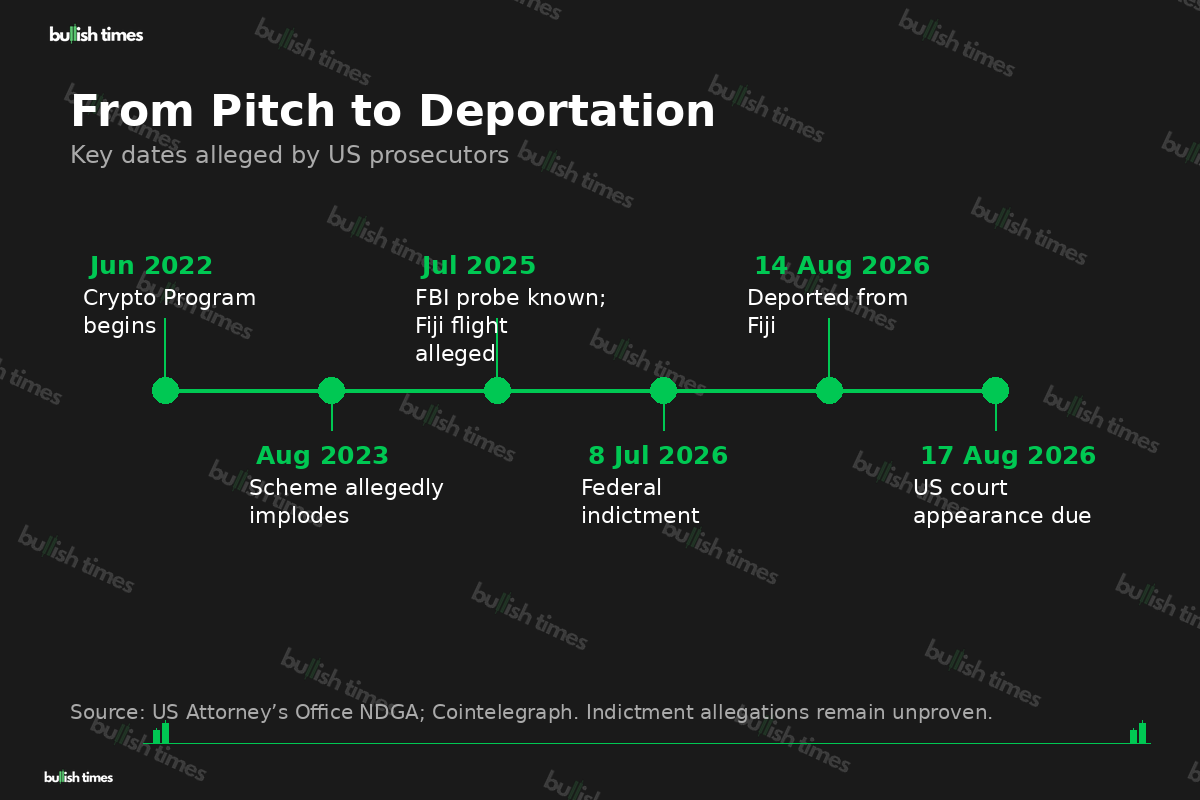
The US Attorney’s Office for the Northern District of Georgia says Zimbardi created and promoted The Crypto Program between June 2022 and August 2023. Investors were allegedly told they were buying online advertising packages, and were encouraged to pay by transferring cryptocurrency into wallets secretly controlled by Zimbardi.
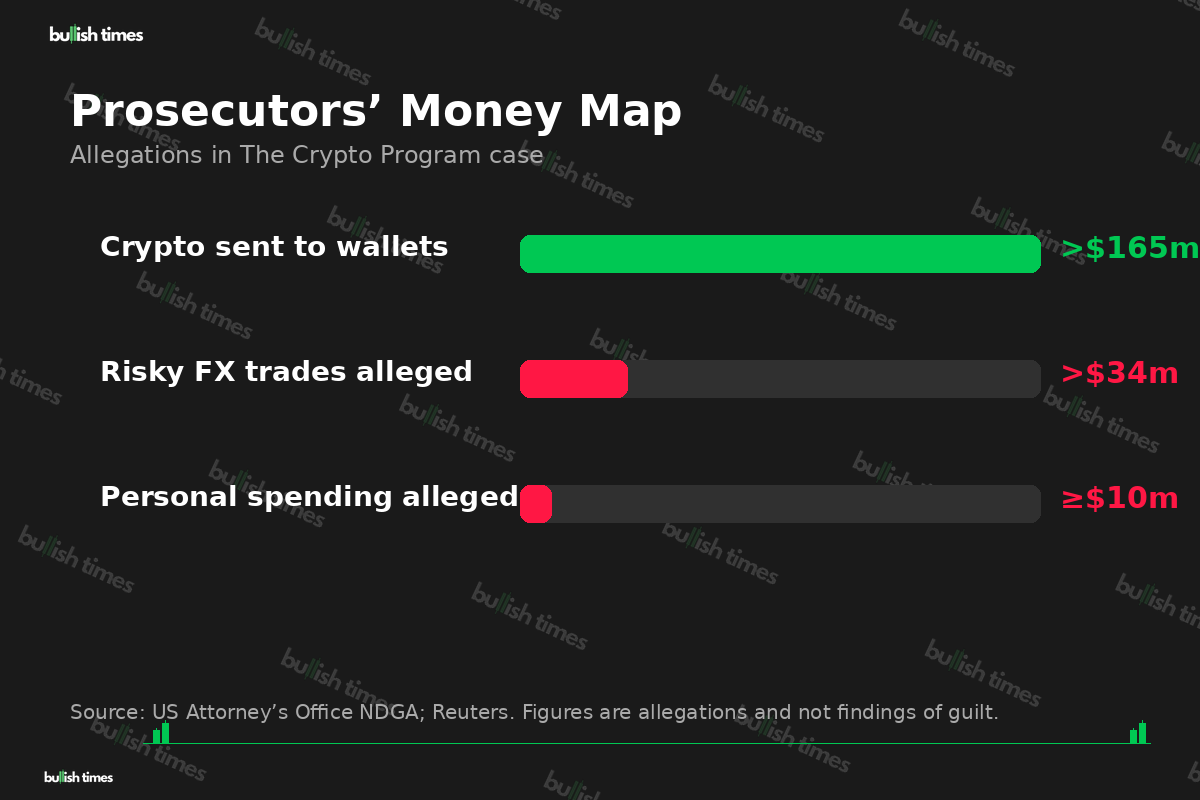
Together, prosecutors say, thousands of investors sent more than $165 million to those wallets. Reuters reported that the alleged fraud involved more than 6,000 investors and that the pitch included a 25% monthly rate of return on an initial $550 investment.
That is the first red flag and the whole story in miniature. A 25% monthly return compounds into something absurdly large. The only way such a number survives in retail marketing is by pushing urgency harder than arithmetic.
US Attorney Theodore S. Hertzberg said Zimbardi “allegedly tricked thousands of people to invest in his ‘Crypto Program’ with false promises of enormous returns.” He added that the money was allegedly spent on risky currency trades, payments to earlier investors and personal expenses.
The Fiji detail is not colour. It is the warning
The most cinematic detail is the Fiji deportation. It should not distract from the mechanics. According to prosecutors, The Crypto Program imploded in August 2023. Zimbardi then travelled to Hawaii, Fiji and other locations. In July 2025, after allegedly becoming aware of the FBI investigation, he fled to Fiji and lived there for more than a year.
The Justice Department says he cancelled plans to attend his son’s May 2026 wedding in Virginia after suspecting that FBI agents would try to arrest him there. On 14 August 2026, after Fijian authorities learned of the charges, he was deported to the United States in coordination with the FBI and the US Department of State.
That sequence is why this case has cut through. Crypto fraud stories often vanish into wallet addresses, shell entities and Discord archives. Here, the alleged ending is physical: a man accused of a $165 million crypto Ponzi scheme being brought back from the South Pacific to face wire fraud and money laundering charges.
FBI Atlanta Special Agent in Charge Marlo Graham said Zimbardi allegedly “preyed on trusting individuals” and “reportedly fled more than 7300 miles to the South Pacific.” The distance is memorable. The lesson is older: when the promised return is impossible, geography eventually becomes part of the pitch’s aftermath.
The counts are heavy, but the burden remains
Zimbardi was indicted on 8 July 2026 on 12 counts of wire fraud, 12 counts of money laundering and one count of money laundering conspiracy. Prosecutors said he was due to appear before a federal magistrate judge in Los Angeles, with the government arguing that he should remain detained pending proceedings in Georgia.
None of that is a conviction. The indictment contains charges, not findings. The government still has to prove its case beyond a reasonable doubt, and a federal public defender representing Zimbardi in Los Angeles did not immediately respond to Reuters’ request for comment.
But the alleged numbers already draw the outline of the case. More than $165 million allegedly moved from investors into secretly controlled wallets. More than $34 million was allegedly gambled on risky foreign-currency bets. At least $10 million was allegedly spent on personal expenses, including a house for his son, luxury vehicles and alimony payments.
Crypto did not invent the Ponzi. It made the funnel faster
The uncomfortable point is that the alleged fraud does not require crypto to be technically novel. It requires crypto to be useful: fast settlement, irreversible transfers, global reach and a market culture already conditioned to believe in violent upside.
That is why the Edward Zimbardi crypto Ponzi allegation deserves attention beyond the courtroom. It sits in the gap between old fraud and new rails. The promise was familiar. The payment method was modern. The result, according to prosecutors, was thousands of investors funding a scheme they believed was an advertising-package opportunity, not a secret wallet-controlled money pool.
There is also a regulatory lesson. Enforcement usually arrives after the money has moved, after the Telegram groups have gone quiet and after victims are told to submit information for restitution. The FBI is asking investors in The Crypto Program to provide victim information, but restitution is never the same as prevention.
The blunt takeaway is not that every high-yield crypto product is a crime. It is that any “guaranteed 25% monthly return” should be treated as a stress test of common sense before it becomes a matter for federal prosecutors.
This is now a criminal case, not a social-media rumour. The courtroom will decide guilt; the market should not need a verdict to recognise the warning sign.