BitMEX did not lose its relevance in one dramatic hack. It is being switched off in stages — and today traders lose the right to add new exposure.
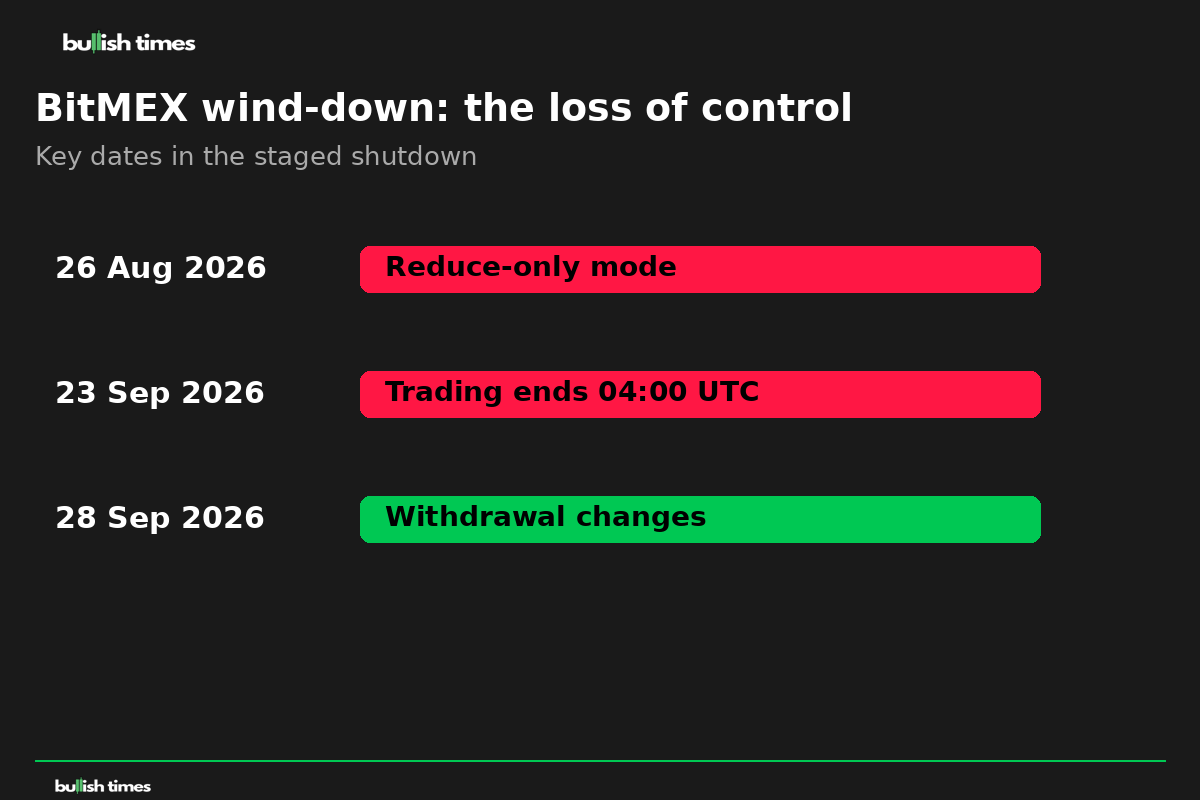
BitMEX, the derivatives exchange that helped define crypto leverage, enters reduce-only mode at 04:00 UTC on 26 August. The company has announced that trading will cease on 23 September at 04:00 UTC, closing an 11-year chapter and turning a familiar platform into a countdown clock.
The shutdown starts by taking away the future
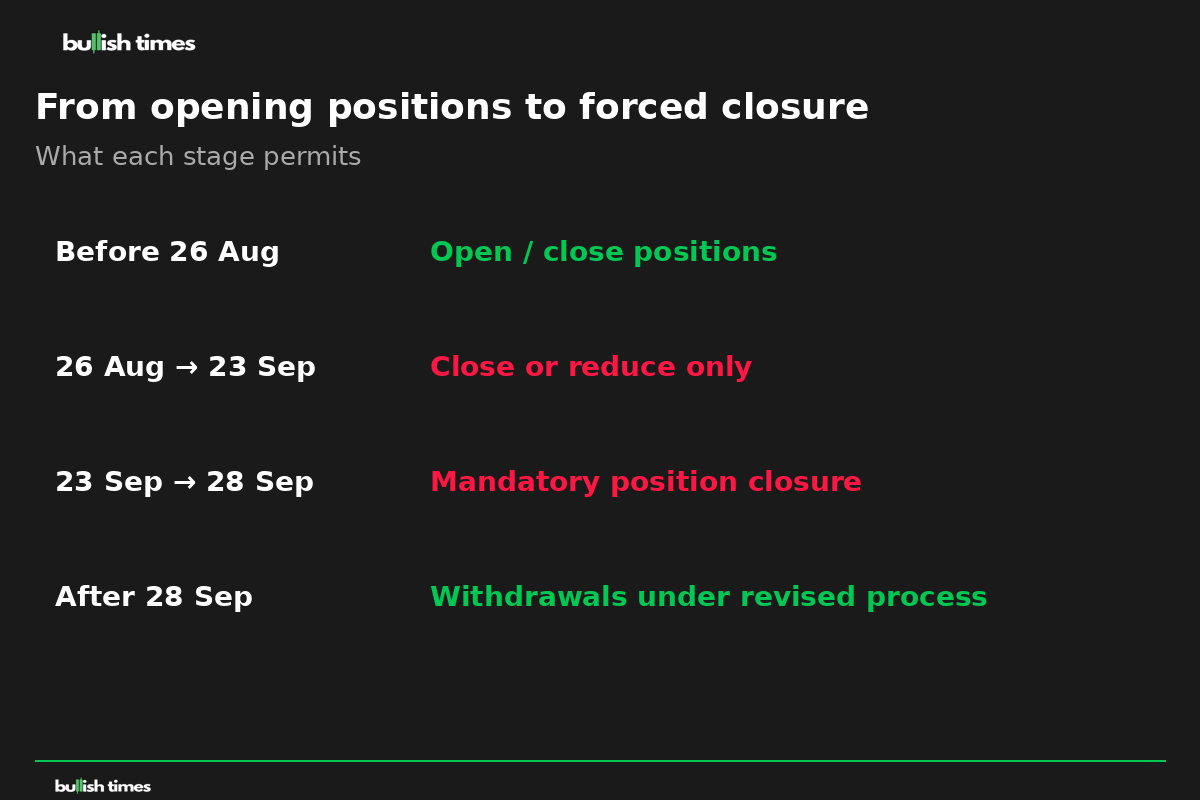
The first cut is subtle but consequential. Once reduce-only mode begins, customers can close or reduce existing positions, but cannot open new ones. That changes the character of the venue immediately: price discovery and risk-taking give way to orderly exit management. It also makes the exchange’s risk controls visible to everyone at once, rather than leaving them as background infrastructure. The venue is no longer asking users to choose a direction; it is asking them to choose an exit.
BitMEX’s planned wind-down is voluntary, according to the exchange’s announcement, rather than a single-day failure. Yet voluntary does not mean frictionless. Open positions still have to be managed, collateral still has to move, and every participant must understand which deadline applies to which product.
Why reduce-only is more than a settings change
A derivatives exchange is built around the ability to change exposure. Removing that ability turns the platform from a marketplace into an exit queue. Traders who normally roll, hedge or rebalance positions must instead decide whether to close early, carry risk into the next deadline, or move it elsewhere.
That is the uncomfortable lesson in this timetable. A position may be economically profitable and still become operationally awkward if the venue, product or withdrawal process changes underneath it. “Can I close?” is no longer the only question; users must ask when contracts stop accepting activity, when forced closures can occur, and when withdrawals change.
The available reporting puts the final trading halt at 04:00 UTC on 23 September. TradingView’s account of the official notice describes the shift to strict risk limits on 26 August, while CryptoSlate reports that the staged process may leave positions open after the first cutoff even as traders lose the ability to add exposure.
The calendar is the risk disclosure
BitMEX’s dates reveal a hierarchy of control. Before 26 August, users can open and close positions. From 26 August to 23 September, the exchange permits reduction only. On 23 September, trading ends and positions may be subject to mandatory closure. From 28 September, withdrawal arrangements change again.
This is not a prediction about prices or a recommendation to trade. It is an operational map. The critical information is not whether Bitcoin rises or falls, but whether an account holder has enough time to identify every open position, confirm margin requirements and test the destination for any funds being moved.
What BitMEX’s exit says about the exchange era
BitMEX’s importance was never just its brand. It was one of the venues that made perpetual swaps a central product in crypto markets. Its closure therefore reads as a market-structure event as much as a corporate decision: liquidity, traders and institutional habits do not disappear; they have to be redistributed.
That redistribution will test the industry’s claims about resilience. Crypto markets often present themselves as open, always-on and globally redundant. But access to leverage remains dependent on private companies, their risk systems, their legal structures and their ability to keep operating. When one venue closes, decentralisation at the asset layer does not guarantee continuity at the trading layer.
The episode also exposes a communications burden. A platform can publish a timetable, but customers must translate that timetable into actions across different contracts and account types. Ambiguity at the edges — especially around forced closure and withdrawals — is where confidence is won or lost.
The final 28 days
BitMEX’s shutdown is now a deadline management exercise. The 26 August cutoff removes new-position risk; 23 September removes trading; 28 September changes the withdrawal environment. Each step narrows the choices available to customers.
The bigger question is what survives the exchange. The perpetual swap will remain a dominant crypto instrument, but the assumption that any one venue is permanent should not. BitMEX helped build the modern market. Its final month is a reminder that market infrastructure can become history on a published schedule.
Eleven years built the platform. Twenty-eight days will decide how cleanly the market leaves it behind.