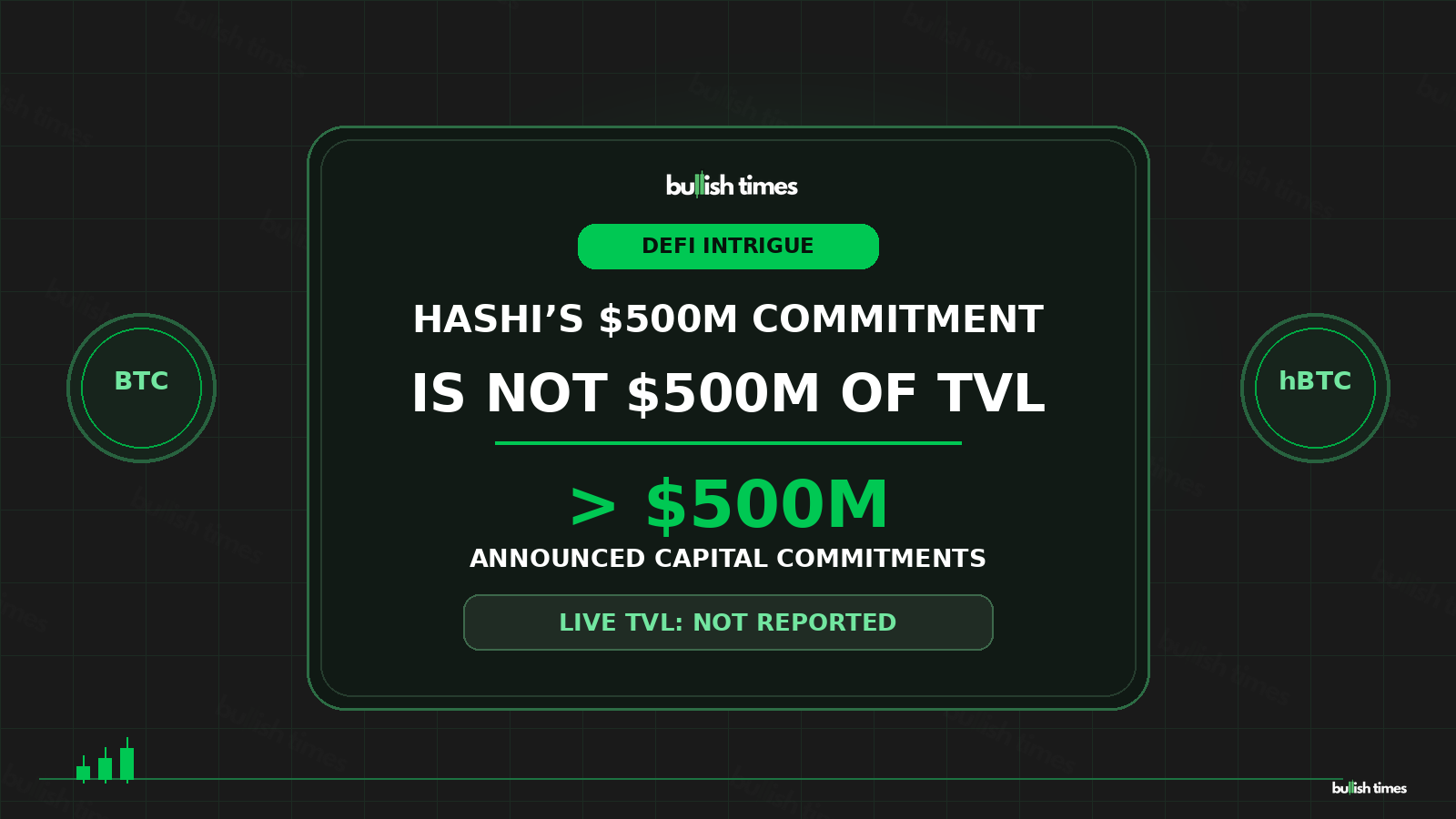
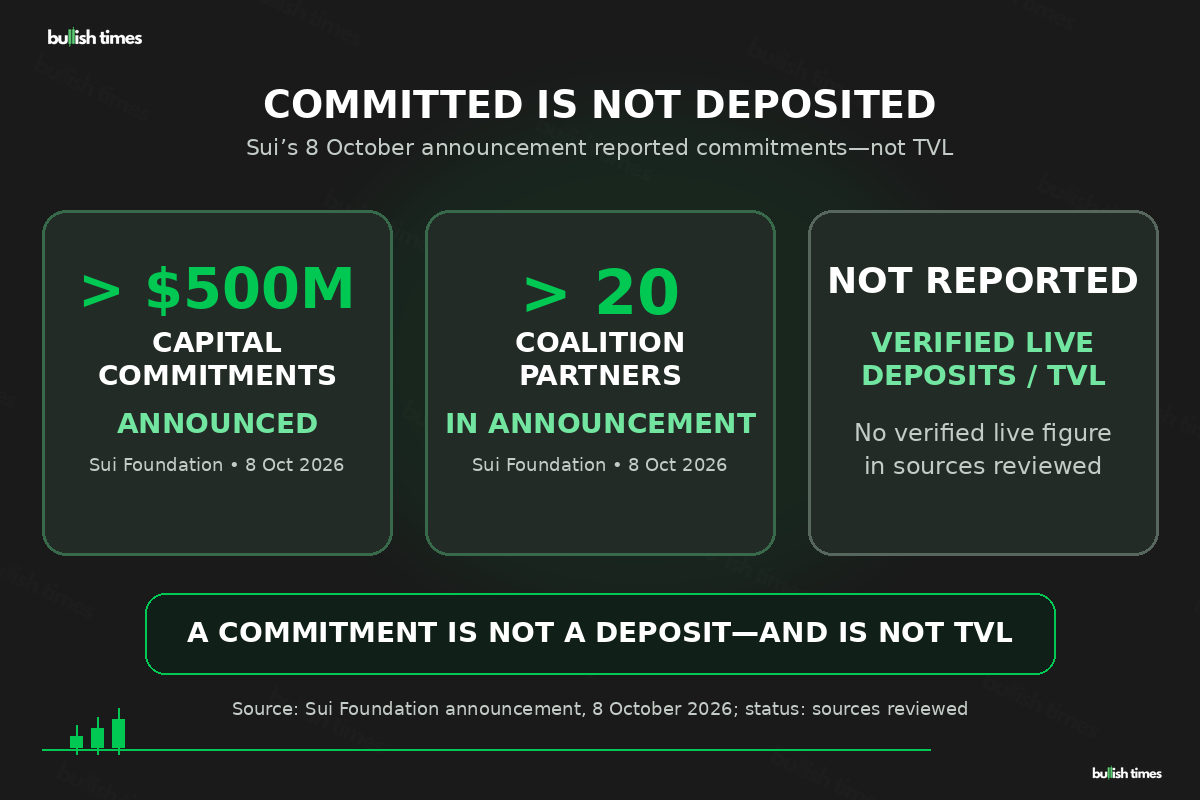
A $500 million launch figure sounds like a market already built. Hashi’s headline number is something else: capital commitments, not verified Bitcoin deposits, minted hBTC or total value locked.
The Sui Foundation says Hashi’s mainnet rollout will begin in phases later in October 2026, though it has not given an exact date. The project aims to connect native Bitcoin with Sui applications, and says a coalition of more than 20 partners has committed over $500 million. That is a sizeable promise; it is not proof that the money, or the Bitcoin, is already in the system.
Commitments are not collateral in the market
The distinction is not pedantry. TVL is an estimate of assets deposited in a protocol or ecosystem; a commitment is a stated intention to provide capital. Hashi’s more-than-$500-million commitment, announced by Sui and also distinguished from funds deposited in a Crypto Briefing report, does not establish that this amount has been funded, deposited, deployed or counted as TVL.
The public announcement does not break the figure down by partner, set out commitment terms, confirm funding status, or specify how much is intended to be Bitcoin versus stablecoins. That leaves basic questions open: how much capital will be available at launch, when will it arrive, and how much will be usable in actual markets? A coalition of more than 20 is a roster, not a balance sheet.
Names do add substance to the plan. Anchorage Digital says it will provide institutional access through Atlas, its tri-party collateral infrastructure, and the Porto self-custody wallet, and plans to supply stablecoin liquidity. Sui also names Aftermath, Concrete and Fluid among the vault providers expected to support Hashi applications. But named routes and expected integrations are not evidence of deposits or uptake.
How Bitcoin is supposed to reach Sui
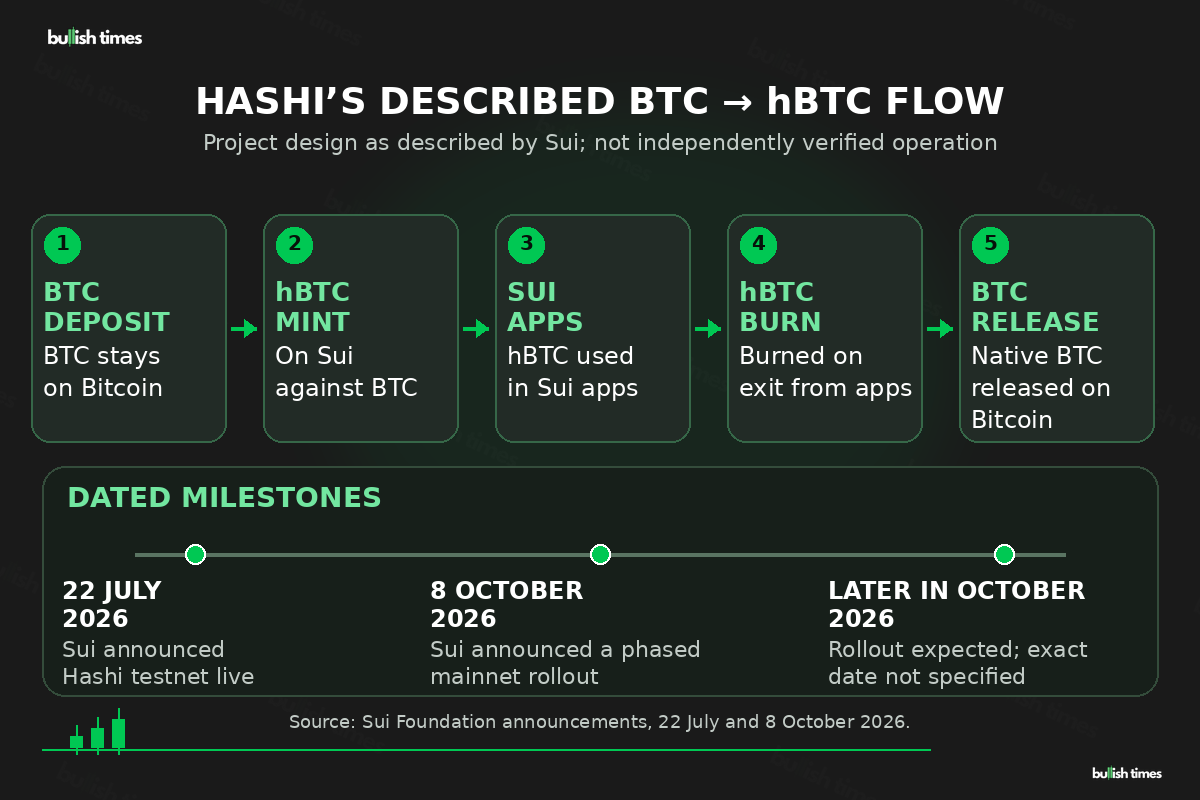
Hashi’s proposed design, as described by Sui, keeps native BTC on the Bitcoin network. A user deposits BTC; Hashi’s hBTC is then minted on Sui against that deposit, where it can be used in Sui applications. To exit, the user burns hBTC and native BTC is released. In other words, “Bitcoin collateral on Sui” means a Sui-side representation backed by a deposit, not native BTC moving onto a different chain.
That is Hashi’s proposition for Bitcoin finance on Sui: make Bitcoin usable in lending or other applications while retaining a path back to the asset on Bitcoin. Sui says institutional users will have Anchorage’s Atlas and Porto routes; it also says Aftermath, Concrete and Fluid are expected to provide vault support. Those plans make the product easier to picture, but they do not answer how much hBTC will be issued or what liquidity will be available when users want to borrow, trade or exit.
Mysten Labs co-founder Adeniyi Abiodun said in a company-supplied quote that “the financial infrastructure around it is catching up”. The ambition is clear. The hard test is whether the financial plumbing can connect deposits, issuance, applications and redemption reliably—and whether users actually choose to use it.
Security claims need operational detail
Hashi is not arriving without a development trail: Sui announced a live testnet on 22 July, before its 8 October mainnet announcement. Sui describes a 2-of-2 structure, MPC safeguards and a Guardian Layer, and says Certora formally verified the smart contracts while CommonPrefix reviewed the MPC protocol. These are claims and descriptions from the project; independent review reports were not located in the sources checked for this brief.
That distinction is not an accusation of a flaw. It is a reason not to translate security language into a guarantee. The public material reviewed does not establish the Guardian Layer’s precise operating limits, who can pause or change it, or what that means for withdrawals during stress. Nor does it independently settle custody arrangements, recovery procedures or how users would resolve a mismatch between the Sui-side token and the underlying BTC.
These are not footnotes for specialists. In a collateral system, users need to understand what backs the token, which parties act at each step and what happens when an ordinary process fails. An assertion that contracts were verified is relevant, but it does not by itself answer every question about operations, governance, custody or redemption.
The launch will be judged by what goes live
Sui reports more than 144 apps and over 400,000 users in its ecosystem. Those are project-reported network figures, not independently measured Hashi users or proof of demand for hBTC. A broad ecosystem may give collateral a place to go; it cannot substitute for evidence that users deposit assets, applications support them and liquidity persists.
The scorecard for Hashi’s mainnet should therefore be concrete: capital actually funded, its BTC and stablecoin composition, hBTC outstanding, markets with usable liquidity, and whether users can redeem as described. These are precisely the details the $500 million headline does not yet supply. A commitment may become a live market, but the conversion has to be shown rather than assumed.
Hashi could still make a useful product. The point is that the announcement is a financing signal and a design proposal, not a report of a functioning $500 million Bitcoin market. Watch the rollout for disclosed deposits, operational detail and real usage—not just a larger number on the launch banner.
Until commitments become transparent, usable collateral, Hashi’s most important metric is still the one it has not reported: what is actually live?