Cronos says it saved $111.2 million. It did so by deleting 10,961 blocks of settled history — including transactions that had nothing to do with the attack. That is not a footnote to the rescue. It is the story.
The Crypto.com-linked Layer 1 has published its post-mortem on the 30 August Tectonic incident: an attacker manipulated TONIC collateral against thin decentralised-exchange liquidity, then borrowed roughly $120.4 million across nine markets. Cronos halted the chain and, after validator consensus, restored an earlier state. About $9.19 million had already left the network.
The emergency arithmetic looks impressive
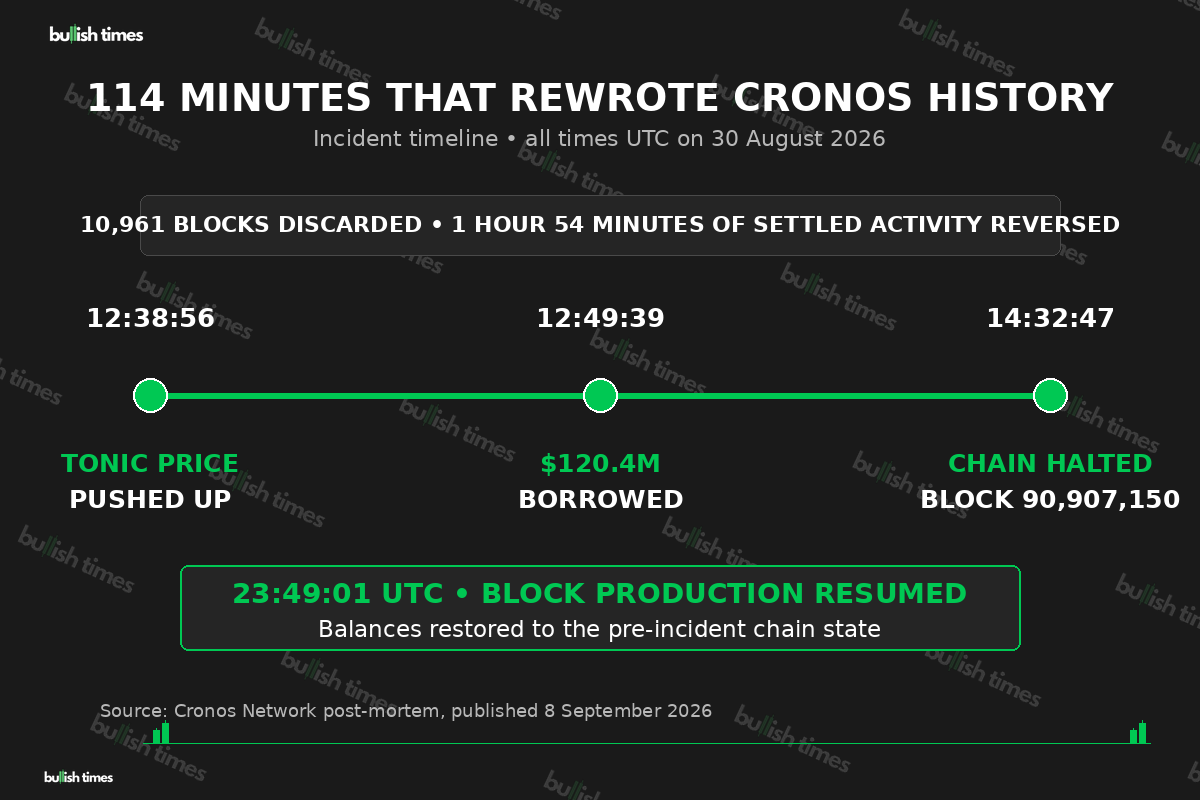
On Cronos’s own account, the attacker began pushing up TONIC’s price at 12:38:56 UTC. At 12:49:39, a single transaction borrowed $120.4 million across nine markets against the inflated collateral. The network says its team identified irregular activity at 13:25, and validators halted production at 14:32:47, at block 90,907,150.
The response did what it was designed to do. Validators restored the chain to block 90,896,188 — the last block before the suspicious activity — and production resumed from block 90,896,189 at 23:49:01. Cronos puts the value reversed at approximately $111.2 million, or around 92% of the affected borrowing activity. The remaining $9.19 million, about 7.6%, had escaped the chain before the halt and remains unrecovered.
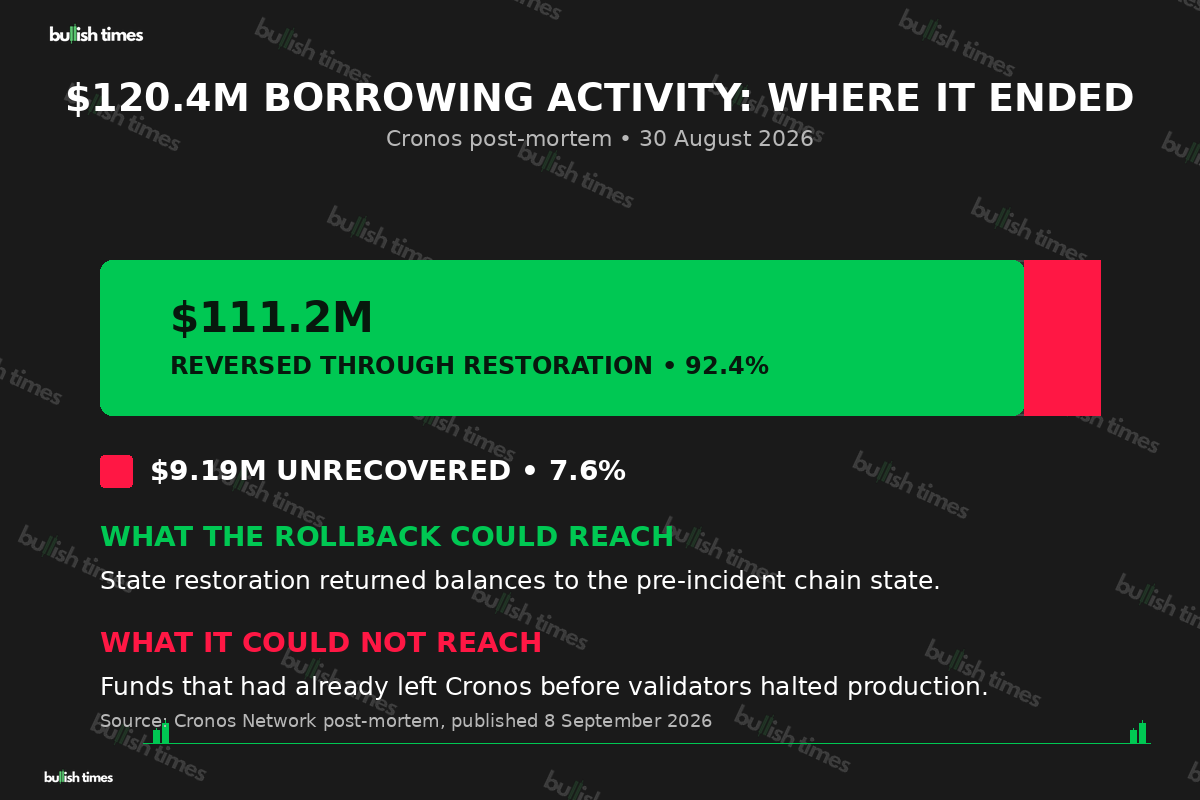
Those numbers are materially different from the roughly $75 million preliminary estimate reported when Cronos first stopped the chain. The later report is welcome precisely because it makes the trade-off measurable. But its language matters: this is borrowing activity and impacted value as reported by Cronos, not a court-tested loss figure or a calculation of an attacker’s net profit.
A rollback is a power, not a bug fix
The state restoration discarded 1 hour and 54 minutes of history. Every transaction in that window was reversed, whether or not it touched Tectonic; open positions on live applications repriced when trading resumed. Cronos has said affected activity can be checked through archive snapshots because the discarded-fork blocks no longer resolve on public explorers.
That is a huge operational intervention. A holder transferring funds, a trader closing a position or a protocol settling a transaction inside those 114 minutes may have behaved correctly under the chain’s then-live state and still have had that state removed later. Exchanges, bridges and other systems which acted on the old chain now have reconciliation work that a clean on-chain reversal cannot magically finish.
Cronos’s explanation is candid. “It was a hard decision, taken together with the validators, weighing the finality users expect from a chain against the funds at risk,” the network wrote. The alternative was to restart without restoring state and leave the borrowed assets under the attacker’s control. That is a defensible emergency choice; pretending it did not alter the meaning of finality would not be.
Finality has a governance clause
Blockchains are often sold on the intuition that completed transactions are final. In practice, finality is a bundle of technical rules, incentives and governance. Cronos has now shown where its bundle ends: coordinated validator consensus can override settled history in an emergency. CoinDesk notes that the network is capped at 100 validators, a structure that can make coordinated action feasible — and makes the source of that emergency power much easier to identify.
That does not make Cronos uniquely hypocritical. Its validators made the choice out loud, accepted the disruption and returned most of the affected value. A chain that cannot respond to a catastrophe may look principled right up until its users are left with the bill. The uncomfortable counterpoint is that a chain that can reverse finality has to be judged by its process, its threshold and its restraint — not merely by the value saved on one night.
The real test is after the applause
Cronos says balances were returned to their pre-incident state, most integrations have resumed, and it is working with partners to reconcile the outstanding systems. It has also identified the right next areas: collateral and pricing risk, unusual-activity monitoring, and incident coordination. The thin-liquidity TONIC manipulation was the trigger; the rollback exposed the governance question underneath it.
The network should now publish as much detail as it safely can about the reconciliation process: which kinds of transactions are affected, how off-chain venues should handle them, and what route exists for the $9.19 million beyond the chain’s reach. It has already admitted communication during the shutdown could have been better. That admission is more useful if it becomes a durable operating rule rather than post-mortem punctuation.
Cronos prevented a larger immediate loss. But the lasting lesson is sharper: in a crisis, transaction finality is only as final as the people empowered to rewrite it.
Sources:
Cronos Network post-mortem (8 September 2026)
CoinDesk: Cronos executes controversial blockchain rollback (8 September 2026)
Decrypt: Cronos erased two hours of transactions (8 September 2026)