Linqto sold ordinary investors a route into private-market royalty. Prosecutors now say the real product was opacity: a pricing machine allegedly dressed up as a market, with markups that sometimes exceeded 200%.
The bankrupt pre-IPO investment platform put names such as Ripple and Anthropic within reach of buyers who could not access those companies directly. On 2 September, US prosecutors charged founder William Sarris over an alleged $450 million fraud scheme, while his former second-in-command, Joseph Endoso, pleaded guilty and is cooperating with the government.
This is not just another founder scandal. It is a warning about what happens when start-up access is democratised before price discovery, custody and conflicts of interest are made transparent.
The $450 million promise
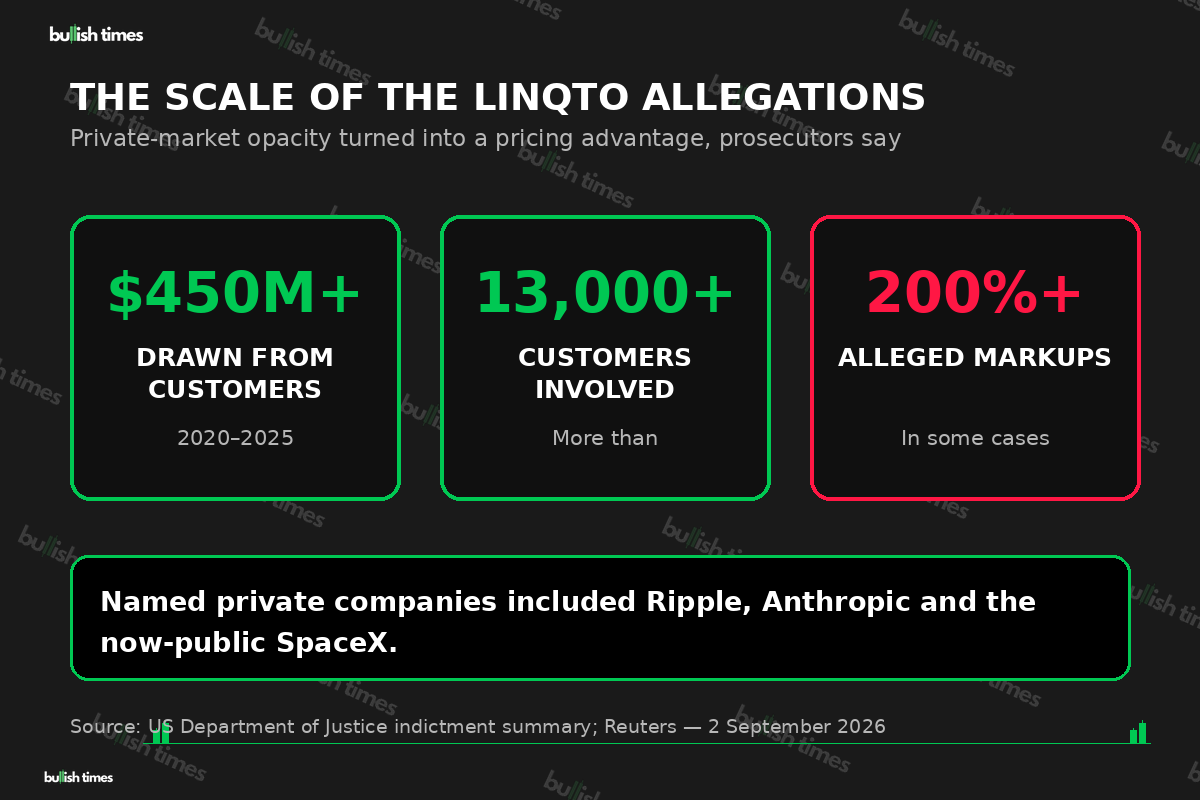
The US Department of Justice says Linqto drew more than $450 million from over 13,000 customers between 2020 and 2025. The platform marketed access to private companies expected eventually to float, including Ripple, Anthropic and SpaceX, according to Reuters.
Prosecutors allege Sarris exploited the absence of visible market prices. Linqto told customers that an algorithm reflected supply and demand, while the indictment says the company manufactured scarcity and manipulated pricing to maximise revenue.
The alleged markups were not marginal. The Justice Department says they reached high double-digit percentages and, in some cases, exceeded 200%, despite repeated warnings from Linqto’s own lawyers.
Sarris, 75, faces six counts, including securities fraud, wire fraud, broker-dealer fraud and conspiracy. His lawyer told Reuters that Sarris is innocent and intends to fight the charges. Every allegation against him remains unproven unless established in court.
Why Ripple and Anthropic mattered
Linqto’s appeal was emotional as much as financial. Ripple buyers were not merely purchasing an obscure private security; they were buying proximity to one of crypto’s best-known companies. Anthropic carried the same aura in artificial intelligence. Scarcity was therefore the sales engine, not an incidental feature.
That makes the alleged conduct especially corrosive. A private-company share does not flash a continuous public quote, and buyers cannot compare an order book across exchanges. If the platform controls the inventory, the displayed price and the story about availability, its customers are trusting an intermediary while being invited to feel they have bypassed one.
Prosecutors say Sarris privately described the pricing pitch as “fake it till you make it, baby” and compared it with “a little Wizard of Oz”, according to Reuters. That language is an allegation quoted from the indictment, but it captures the central risk: software can make a discretionary markup look like neutral market infrastructure.
The start-up lesson is uncomfortable. A slick interface does not create liquidity. Fractional access does not create fair value. And putting a famous company’s name on a dashboard does not remove the broker, custodian or conflict sitting behind the screen.
The moment the model cracked
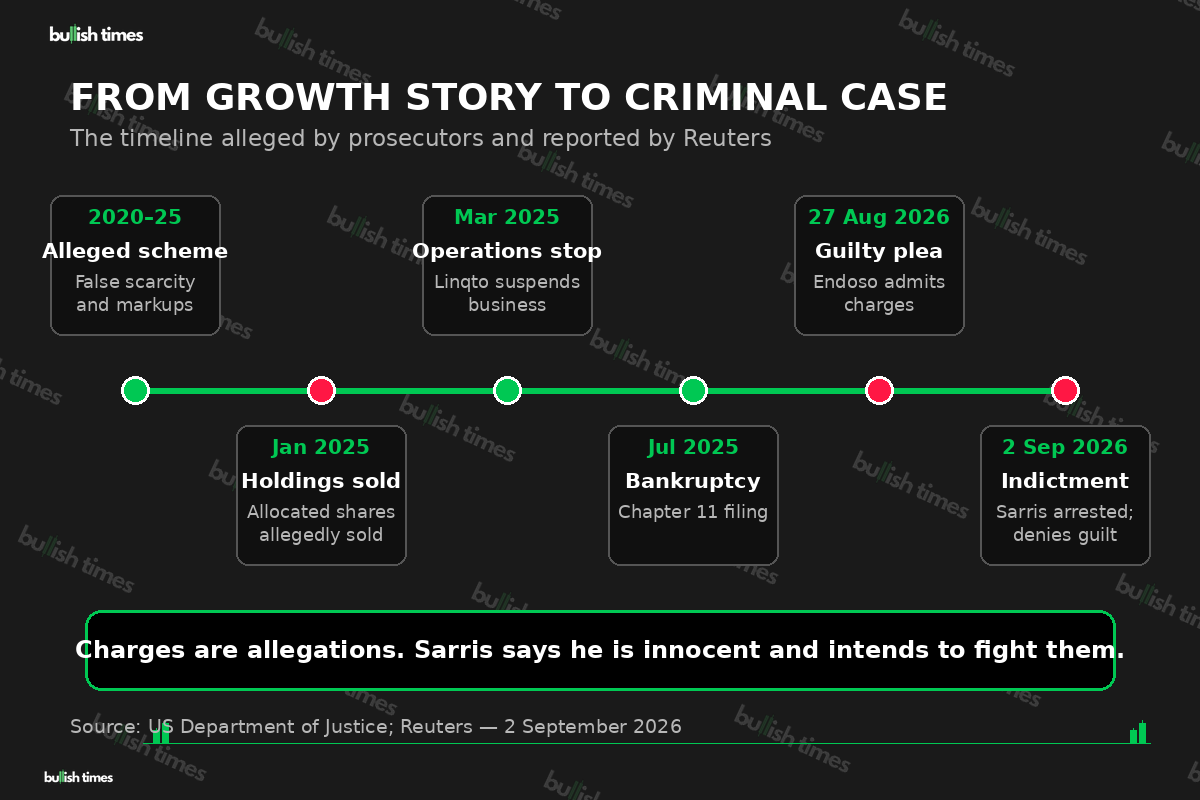
The indictment says Linqto’s finances came under pressure in January 2025. Prosecutors allege Sarris then sold shares allocated to customer holdings, without telling those customers, to help the company meet revenue targets.
Linqto suspended operations two months later and filed for Chapter 11 bankruptcy protection in July 2025. Reuters reported that a Texas bankruptcy judge approved a reorganisation plan in February 2026, giving customers a choice between interests in a liquidating fund or a closed-end fund holding private shares.
Endoso, 66, who succeeded Sarris as chief executive after serving as president, pleaded guilty on 27 August to securities fraud, broker-dealer fraud and conspiracy counts. His cooperation changes the pressure around the case: prosecutors now have a former senior executive who has admitted criminal conduct, although that does not prove the allegations against Sarris.
The democratisation trap
Private-market platforms promise to open a club once reserved for venture funds and wealthy insiders. That can be useful. Broader access can spread opportunity and give founders more routes to capital.
But democratisation without disclosure can simply distribute informational disadvantage to a larger audience. Public markets are noisy and imperfect, yet their prices, filings and trading rules give investors common reference points. Pre-IPO platforms can offer none of that while borrowing the visual confidence of an exchange.
The defence will matter. Sarris’s lawyer said Linqto customers face questions about recoveries because of a bankruptcy filed six months after Sarris stopped running the company, not because of the investments themselves. Courts, not headlines, must decide whether prosecutors can prove their case.
Even so, the structural warning already stands. When one platform supplies the access, sets the price, narrates the scarcity and benefits from higher markups, “marketplace” may be the least informative word on the page.
The takeaway
The Linqto fraud charges should force every crypto and AI investor chasing pre-IPO shares to ask a boring question before the exciting one. Not “which company can I get into?”, but “who decides what I pay, what do they own, and how can I verify it?”
The next generation of private-market start-ups will insist that tokenisation, automation or better interfaces solve the access problem. Perhaps they do. None of them solves the trust problem unless pricing, inventory and conflicts are independently visible.
Linqto sold the dream of getting behind the velvet rope. The criminal case alleges that the darkness behind it was the business model.