Poland’s crypto fight has stopped being a technical argument about regulation. It is now a test of whether a state can watch a client-funds scandal unfold, then still pretend oversight is the risky part.
The Zondacrypto affair has dragged a once-dull cryptoasset bill into the centre of Polish politics. Prime Minister Donald Tusk has asked Sejm Speaker Włodzimierz Czarzasty to put President Karol Nawrocki’s latest veto back before parliament, after prosecutors widened their investigation into alleged links between the collapsed exchange, conservative media, political foundations and figures around Law and Justice.
That is why the next vote matters. It is a public audit of every politician who still wants to argue that Poland has more to fear from crypto rules than from a market where thousands of users have reportedly been unable to access funds.
The veto that became impossible to hide behind
According to bne IntelliNews, Poland’s lower house is expected to vote this week on overriding Nawrocki’s third veto of legislation regulating cryptoassets. The bill is designed to implement the EU’s Markets in Crypto-Assets framework domestically, name Poland’s Financial Supervision Authority, KNF, as the lead crypto regulator and give it sanctions powers over firms operating in the sector.
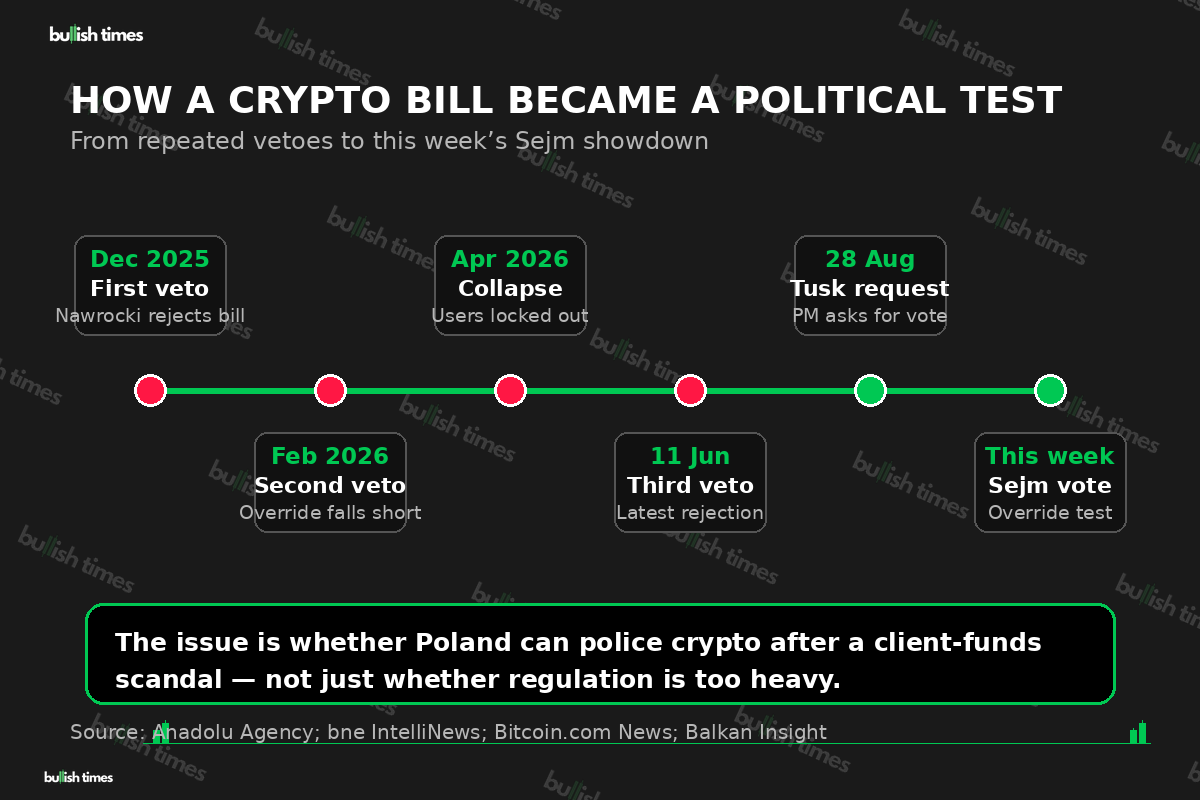
Anadolu Agency reported that Nawrocki vetoed government cryptoasset legislation in December 2025, February 2026 and again on 11 June, arguing that the proposals amounted to excessive regulation. The governing coalition failed to secure the required three-fifths majority on the first two override attempts.
Normally, that would be an argument about competitiveness, bureaucracy and whether a national regime should go further than Brussels requires. But Zondacrypto has changed the room. Tusk has alleged that the exchange’s “dirty and murky business” was strongly connected to the PiS environment, while prosecutors examine suspected financial links to politicians, foundations and media organisations.
What the numbers say
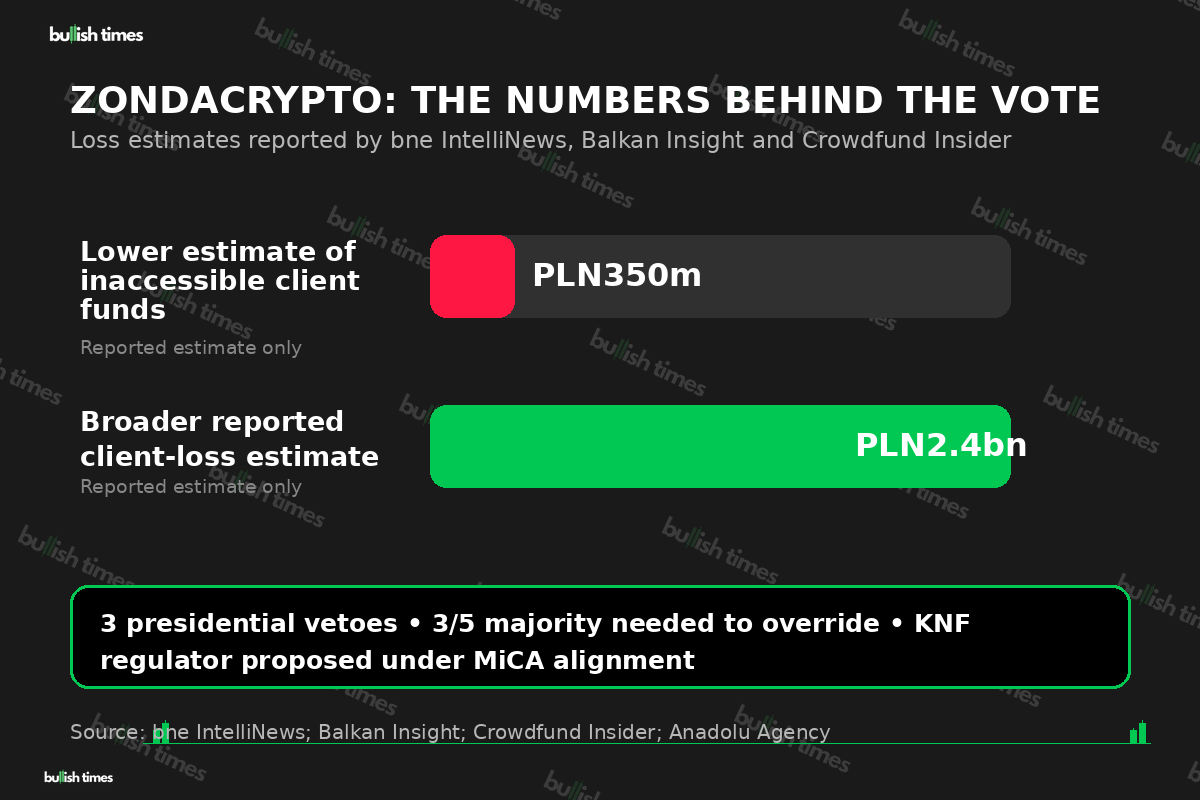
The reported loss figures are messy, and that matters. bne IntelliNews reported estimated losses of at least PLN350m, equivalent to €80.6m, while also noting that clients’ total loss has been estimated as high as PLN2.4bn. Balkan Insight cited prosecutors estimating investor losses at a minimum of PLN2.4bn, or €550m. Crowdfund Insider put customer losses at about PLN350m, roughly $94m.
Those are not final court findings. They are live estimates in a politically charged investigation. But even the lower figure is large enough to make the “wait and see” position look reckless.
The argument for delay used to sound like market protection: do not drive companies abroad, do not smother innovation, do not let overregulation turn Poland into a hostile jurisdiction. Bad regulation can punish legitimate builders while leaving fraudsters untouched.
But the burden has shifted. If users are locked out, prosecutors are investigating fraud and money laundering, and the national framework for MiCA remains jammed by repeated vetoes, then “innovation” starts to sound like a convenient label for institutional paralysis.
The scandal is now bigger than the exchange
The explosive part is no longer simply that a crypto exchange collapsed. It is that the collapse is being framed as a political financing story.
bne IntelliNews reported that prosecutors are investigating possible offences involving Zondacrypto financing of foundations linked to former justice minister Zbigniew Ziobro, pro-PiS broadcaster TV Republika and the 2025 CPAC Poland conference, which endorsed Nawrocki for president. Balkan Insight wrote that the company channelled substantial sums into conservative media, organisations and events before its downfall.
Former Zondacrypto chief Przemysław Kral has reportedly been charged in connection with the investigation and is cooperating with prosecutors, according to Anadolu Agency. bne IntelliNews reported that Kral had allegedly cut a deal with prosecutors to testify on links between PiS circles and the exchange in return for a potentially lower sentence.
This is where the story stops being ordinary crypto-sector damage control. If even part of that picture is proven, the veto fight becomes inseparable from a question of political self-interest: who benefited from a lightly policed sector, and who is now trying to keep the regulatory gap open?
A timetable that exposes the problem
The chronology is brutal for opponents of the bill. Three vetoes arrived before the latest parliamentary test. The scandal widened in parallel. Users waited. Prosecutors dug deeper. The MiCA implementation gap remained.
Bitcoin.com News reported Tusk saying that no one could now credibly claim there was “no problem” or that Poland still had plenty of time. That is the correct pressure point, even if Tusk’s framing is obviously partisan. Delay is no longer neutral. It is a choice with named victims, named institutions and a widening evidential trail.
PiS has rejected suggestions that it protected the company. Nawrocki’s side argues that regulation must be constitutional and that the government draft is flawed. Those objections should be tested, not waved away. A bad crypto law does not become good because a scandal makes everyone angry.
But the pro-veto side now needs more than slogans about overreach. It needs a credible alternative that protects users, fits MiCA, lets legitimate platforms register and explains why three vetoes have not left the country weaker.
The takeaway
The Poland crypto law veto fight is a warning for every jurisdiction still pretending that crypto supervision is a culture-war prop. Regulation can be clumsy, costly and politically abused. The absence of regulation can also become a business model.
Zondacrypto is not proof that every crypto company needs to be buried under red tape. It is proof that when client funds, political money and weak oversight collide, the clean firms are not protected by delay. They are contaminated by it.
If Poland’s lawmakers cannot separate constitutional concerns from cover for inertia, the market gets the worst of both worlds: fewer trusted domestic venues, louder political theatre and another reminder that crypto’s enemies rarely need to invent their best arguments.
The Sejm vote will not settle the Zondacrypto scandal. It will show who still thinks postponing accountability is a defensible policy.