Term Labs did not lose money because somebody found a clever trade. It lost roughly $8.5 million because governance — the control layer meant to protect a protocol — was apparently turned into the attack surface.
On Sunday, the fixed-rate DeFi lending protocol confirmed that a governance exploit was affecting its Term vaults. It is a stark reminder that a protocol can advertise transparent, on-chain rules and still leave the keys to the vault vulnerable to the people, code and permissions that make those rules work.
A vault drain hiding in plain sight
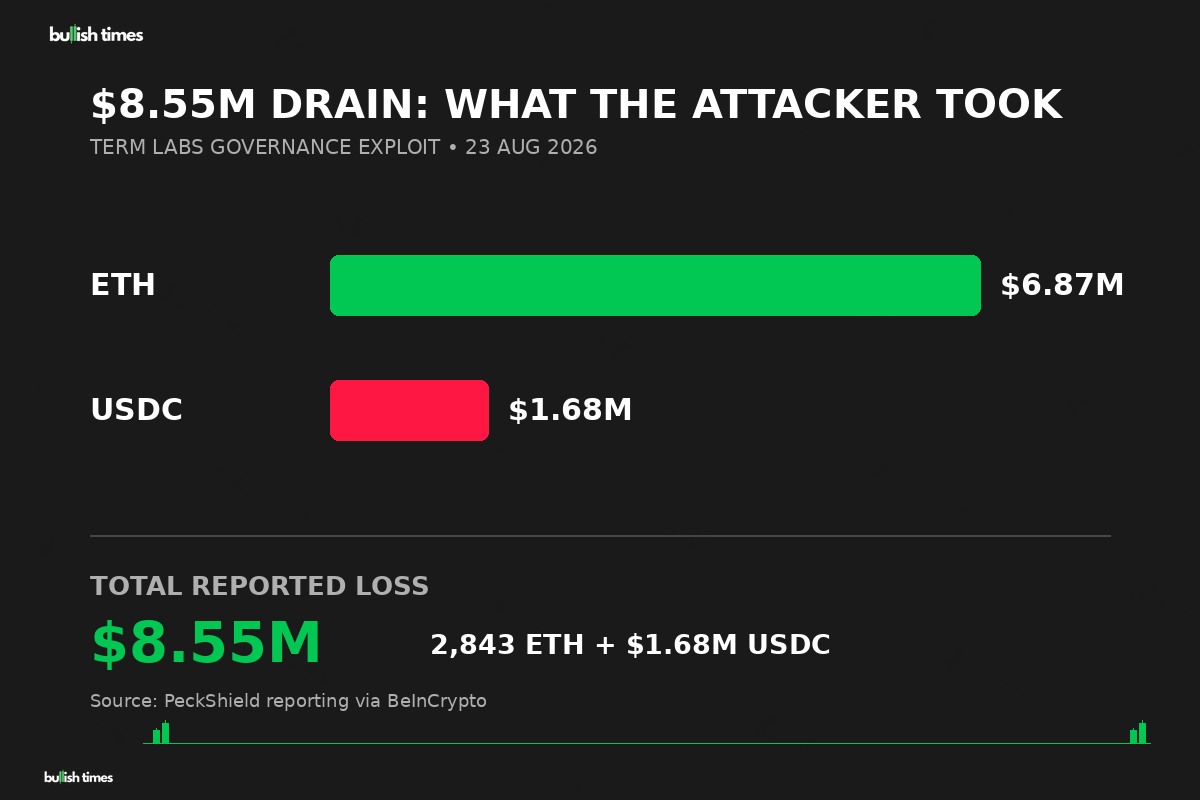
Blockchain security firm PeckShield reported that the attacker removed 2,843 ETH and $1.68 million in USDC, putting the reported loss at about $8.55 million. The ETH portion was valued at roughly $6.87 million at the time of reporting. The USDC was subsequently swapped into approximately 1.68 million DAI.
Term Labs said only that it was aware of “a governance exploit impacting Term vaults” and would share more detail after further investigation. That limited statement is sensible while an incident is live, but it is also the uncomfortable centre of the story: users still do not have a public explanation of the precise governance function that was abused, or a complete account of the controls that failed.
Term operates fixed-rate lending through on-chain auctions. That is a useful design choice for borrowers and lenders seeking certainty rather than floating-rate roulette. But the exploit is a warning against confusing predictable rates with predictable security. The protocol’s vault layer appears to have offered a route through which control could be turned into extraction.
Governance is not a rubber stamp
The word “governance” can make risk sound civilised: token holders voting, parameters changing, treasuries being directed by a community. In practice, governance is privileged infrastructure. If an attacker can gain enough influence over the relevant vault controls, the distinction between a proposal and an unauthorised transfer becomes frighteningly thin.
Reporting on the incident says the attacker’s wallet was initially funded with 2 ETH withdrawn from Tornado Cash. That detail does not establish identity or motive, but it shows the familiar operational pattern of trying to make fund flows harder to trace before an on-chain attack. The more consequential question is whether the path to control was sufficiently restricted and monitored before funds moved.
The episode also exposes a recurring DeFi contradiction. Projects rightly champion non-custodial design, but governance arrangements often reintroduce concentrated power in a different costume: voting thresholds, strategy managers, time locks and privileged functions. Those mechanisms may be transparent on-chain. Transparency is not the same thing as resilience.
An $8.5m hit in a month already under strain
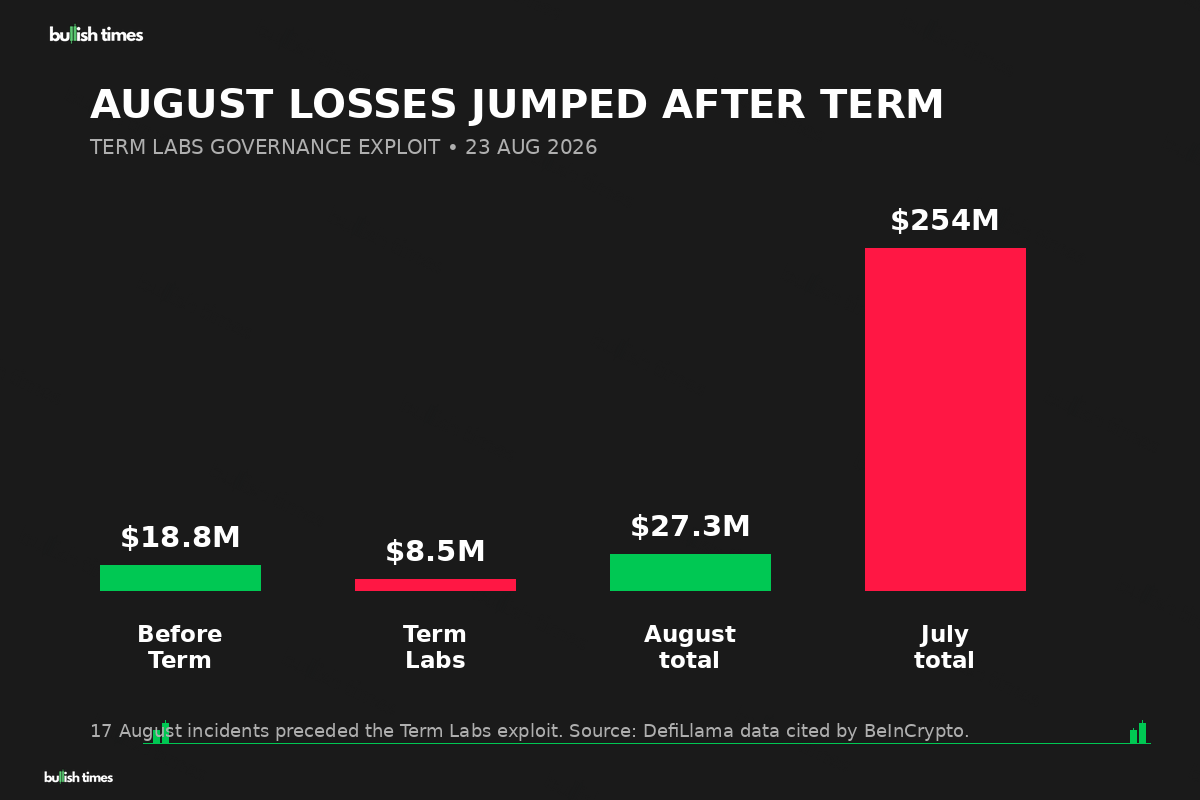
Before the Term Labs drain, DefiLlama had logged 17 August security incidents worth around $18.8 million, according to figures cited by BeInCrypto. Add the reported Term loss and the month moves beyond $27 million. That remains far below July’s roughly $254 million across 38 incidents, but “less bad than July” is not a security model.
The governance category is especially awkward because it is both rare and highly damaging. DefiLlama classified five governance attacks in 2026 worth a combined $25.1 million before this event, with a $20 million malicious proposal against BonkDAO in July the largest cited example. One compromised decision mechanism can have an outsized outcome precisely because it is granted authority by design.
Term is not approaching this incident without history, either. DefiLlama recorded a $1.65 million loss at Term Finance in April 2025, attributed to an oracle misconfiguration. The two events should not be conflated: an oracle issue and a governance exploit are different failures. Yet the recurrence matters. Security is judged by how systems behave under pressure, not by the elegance of their architecture in a calm market.
The unanswered question is bigger than the attacker
The immediate task is obvious: establish the exploit path, secure the affected vaults, trace funds and communicate clearly with users. The more important task is less glamorous. Term Labs and every protocol using governance-controlled vaults should ask whether their permissions, monitoring and emergency controls treat governance as a critical security boundary rather than a community feature.
That does not mean pretending that every decentralised system can be made risk-free, nor does it tell anyone what to do with an asset. It means refusing the lazy idea that decentralisation automatically makes a financial product safe. Governance can distribute power. It can also distribute responsibility so widely that nobody notices the door is open.
For Term Labs, the post-mortem will matter more than the first alert: the industry needs to see exactly how authority became a drain.