A trader can be right for two months and still be killed in twelve seconds. That is the brutal lesson from the Hyperliquid wallet known as pension-usdt.eth.
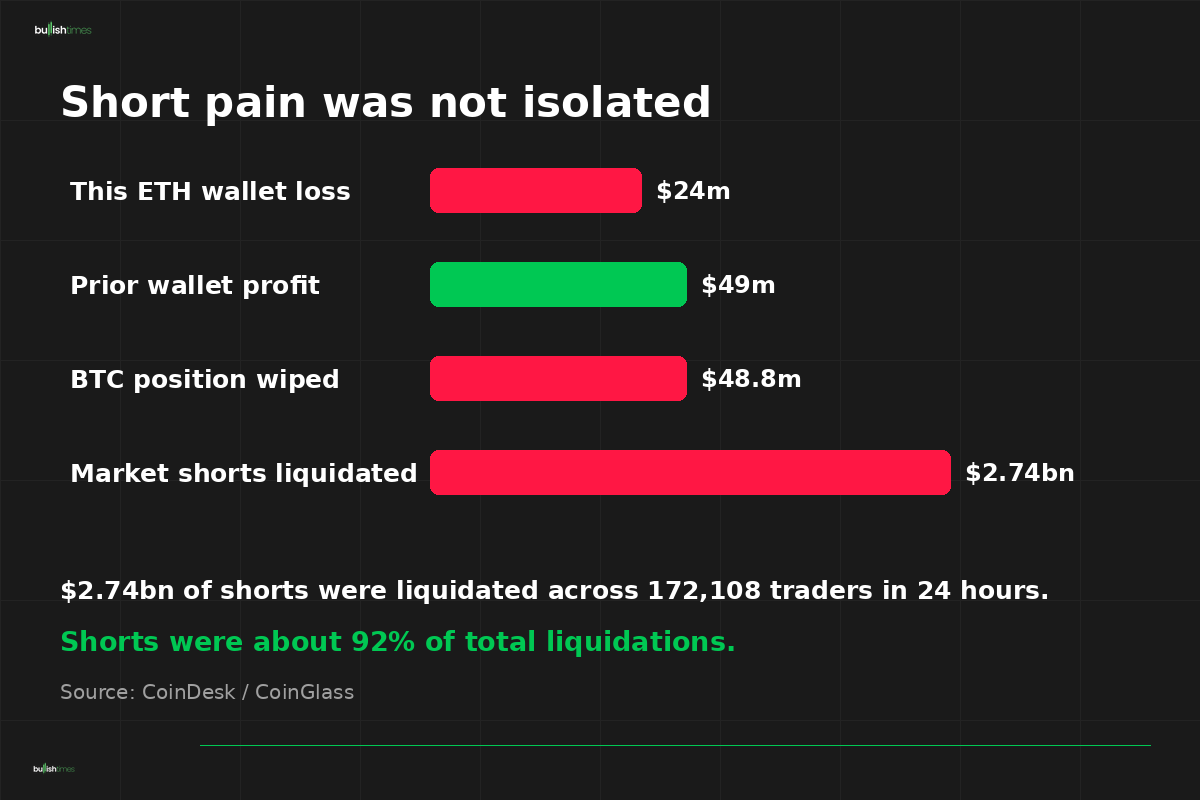
The address had built a reputation as one of the year’s sharper short sellers. Then ether ripped higher, the position was forced shut, and nearly $24 million disappeared in a liquidation cascade that turned the trader’s own exit into part of the squeeze.
The Short That Fed Its Own Funeral
According to CoinDesk, pension-usdt.eth was liquidated out of a 50,000 ETH short position on Hyperliquid on Thursday morning. The forced unwind ran from 04:51:03 to 04:51:15 — twelve seconds from damage to detonation.
The mechanics matter. Hyperliquid records cited by CoinDesk show five forced sales: 9,989 ETH at $2,193, then 20,698 ETH at $2,209, then 15,830 ETH at $2,214, then 1,871 ETH at $2,236. The last 1,417 ETH had no remaining buyers, so Hyperliquid’s insurance fund absorbed it.
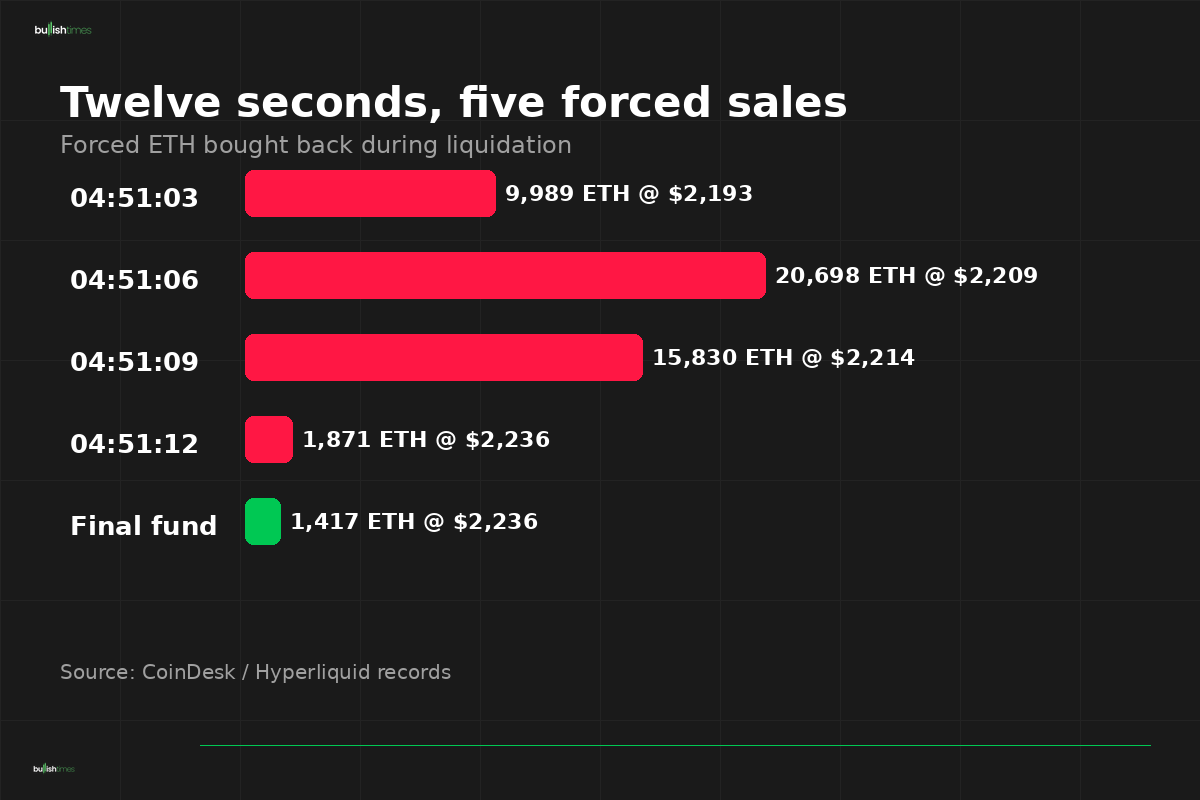
That is the ugly poetry of leverage. A short position closes by buying back the asset. When the market is already moving against the trader, that forced buying can push the price higher, which makes the next forced buy even worse. Ether rose $43 during the liquidation window, and the squeeze fed itself.
From $49m of Profit to an Empty Account
The wallet was not some random tourist punting into a green candle. CoinDesk reported that the address had made roughly $49 million from betting against crypto, including nearly $6 million on a 60,000 ETH short closed in June, $3.6 million on a 1,400 BTC short and $1.7 million on another bitcoin short in March.
That track record is why the wipeout is interesting. The market did not merely punish stupidity; it punished confidence that had become too large for the exit door.
The account’s visible state after the event was almost comic in its severity. Hyperliquid’s leaderboard showed the wallet holding about $35 and down 100% over 30 days, with $16.48 million of losses against $111.76 million of traded volume in that period.
The Bigger Squeeze Was Even Worse
The wallet was only the close-up shot. The wide shot was a full-market short squeeze. CoinDesk, citing CoinGlass, reported nearly $3 billion of total crypto liquidations across 172,108 traders in 24 hours. Shorts accounted for about $2.74 billion of that, roughly 92% of the damage.
That made the short side of this move larger than the short liquidation tally during the October 2025 crash, even though the October event remains the biggest total liquidation day in crypto history. In plain English: this was not just a trader getting smoked. It was a market structure event.
Bitcoin touched nearly $69,900 after moving from a Wednesday low near $64,100. Ether rose about 18% in 24 hours to above $2,250. Solana, XRP, Dogecoin and Hyperliquid’s HYPE also rallied hard. The spark was a broader risk-on move after the U.S. Treasury doubled bond buyback operations, but the accelerant was leverage.
Leverage Is Not Liquidity
The lesson is not that shorts are bad or longs are virtuous. That is nursery-school market commentary. The lesson is that leverage creates a second market underneath the visible one: a hidden map of liquidation prices, forced exits and insurance-fund backstops.
When price moves through that map, traders stop expressing opinions and start becoming order flow. The pension-usdt.eth wallet did not choose to buy ether at worse and worse prices. The system chose for it.
That is why the “smart money” label is usually useless in crypto. A trader can read the market correctly for weeks, build a beautiful profit curve, and still be one volatility burst away from handing it back. The sharper the position, the sharper the blade when it turns.
Hyperliquid did what a high-speed derivatives venue is designed to do: liquidate, route, absorb and move on. But the event is a warning about the theatre of on-chain transparency. Everyone can watch the whale. Everyone can screenshot the liquidation. None of that changes the oldest rule in the room: when a crowded leveraged trade breaks, the exit is smaller than the ego that built it.
Twelve seconds was enough. In crypto, that is not a glitch. That is the product working exactly as designed.