The man behind crypto’s most infamous short just moved $1.35 billion in Ethereum onto Binance in four days — and the market is bracing for impact.
Garrett Jin, former CEO of the now-defunct BitForex exchange, has once again sent shockwaves through the cryptocurrency world. Between 7 and 10 May, wallets linked to Jin deposited a staggering 577,896 ETH — worth approximately $1.35 billion — onto Binance, marking one of the largest publicly tracked inflows in the exchange’s history. The transfers have reignited fierce debate about insider trading, market manipulation, and whether one man is quietly engineering Ethereum’s next crash.
The Four-Day Blitz
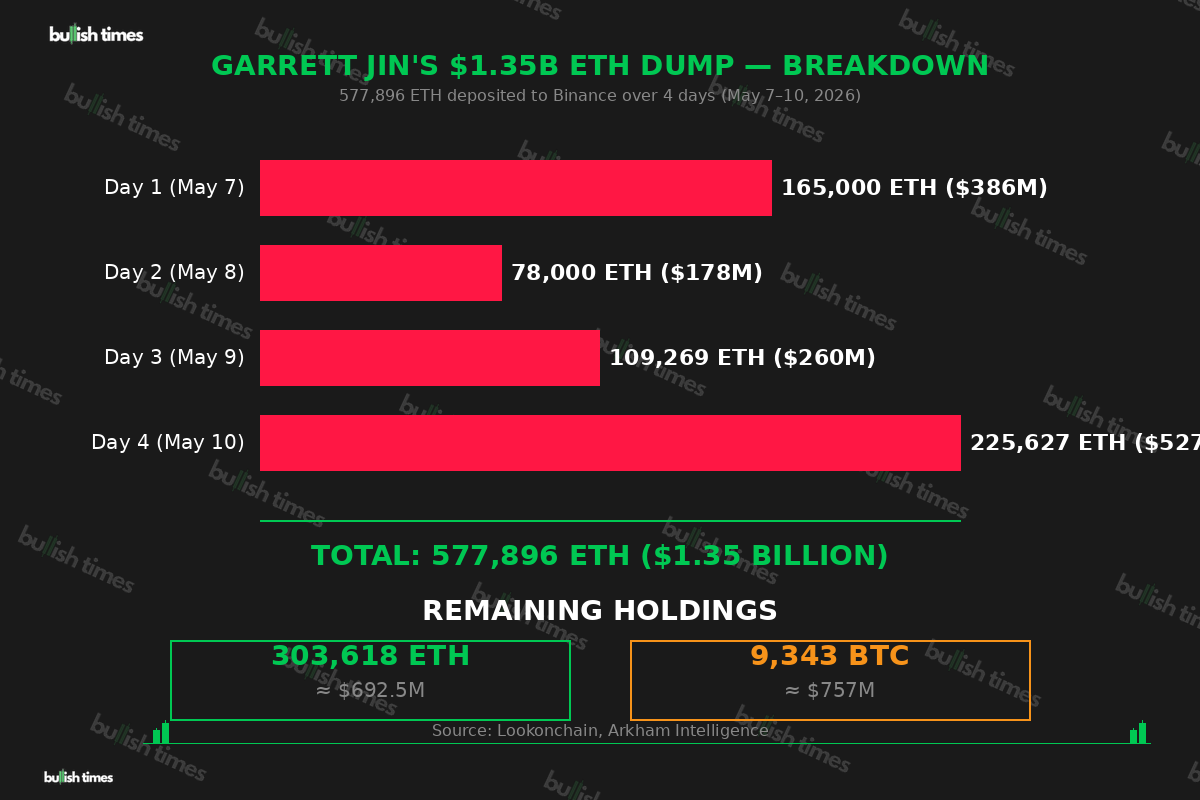
The deposits arrived in waves. On 7 May, Jin’s wallet sent 165,000 ETH ($386 million) to Binance. The following day, another 78,000 ETH ($178 million) followed. By 9 May, a further 109,269 ETH ($260 million) had landed. Then came the final blow: on 10 May, the remaining 225,627 ETH ($527 million) was transferred in a single transaction, emptying his primary ETH position into the exchange.
On-chain analytics firm Lookonchain flagged the activity within minutes, noting that most of this Ether had been swapped from Bitcoin roughly eight months ago, when ETH was trading at around $3,850 — significantly higher than today’s price of around $2,300.
The timing was hardly coincidental. Jin’s deposits coincided with $103.51 million in net outflows from US spot Ether ETFs on 7 May. BlackRock’s iShares Ethereum Trust sent 11,475 ETH ($26.27 million) to Coinbase Prime hours before Jin’s latest transfer, and Fidelity followed with 23,919 ETH ($54.44 million) within the hour. The combined institutional and whale flows exceeded 113,000 ETH — nearly $260 million — hitting exchanges in a single session.
ETH promptly dropped 6%, sliding from $2,423 to $2,277.
The Man Markets Love to Hate
To understand why Crypto Twitter is losing its collective mind, you need to know who Garrett Jin actually is — and the trail of wreckage behind him.
Jin served as CEO of BitForex from 2017 to 2020 and was previously operations director at Huobi (now HTX). In February 2024, BitForex froze all withdrawals without warning. Approximately $57 million vanished from the exchange’s hot wallets overnight. Hong Kong’s Securities and Futures Commission issued a fraud warning. Users were left holding the bag, and Jin’s public presence evaporated.
Then, in October 2025, on-chain investigators linked a wallet controlled by Jin to one of the most suspicious trades in crypto history. Thirty hours before President Trump posted on Truth Social that his administration would impose 100% tariffs on Chinese imports — a post that triggered $19.1 billion in liquidations — Jin’s wallet opened a $735 million short on Bitcoin via Hyperliquid. The position was closed almost immediately after the crash, netting roughly $150 million in profit.
Pseudonymous researcher Eye traced a $40,000 USDT transfer between Jin’s wallet and the whale account, sparking allegations of insider trading. Coffeezilla found that 200 BTC was added to the short position just one minute before Trump’s post went live. Jin denied everything, claiming the funds belonged to an unnamed client for whom he merely “runs nodes and provides in-house insights.”
Nobody was convinced.
A Pattern Too Convenient to Ignore
This is not the first time Jin has flooded exchanges with Ethereum. In February 2026, wallets linked to him deposited 261,024 ETH ($543 million) to Binance during a broader market downturn. At the time, analysts noted that ETH fell nearly 7% following similar large transfers from the same wallet.
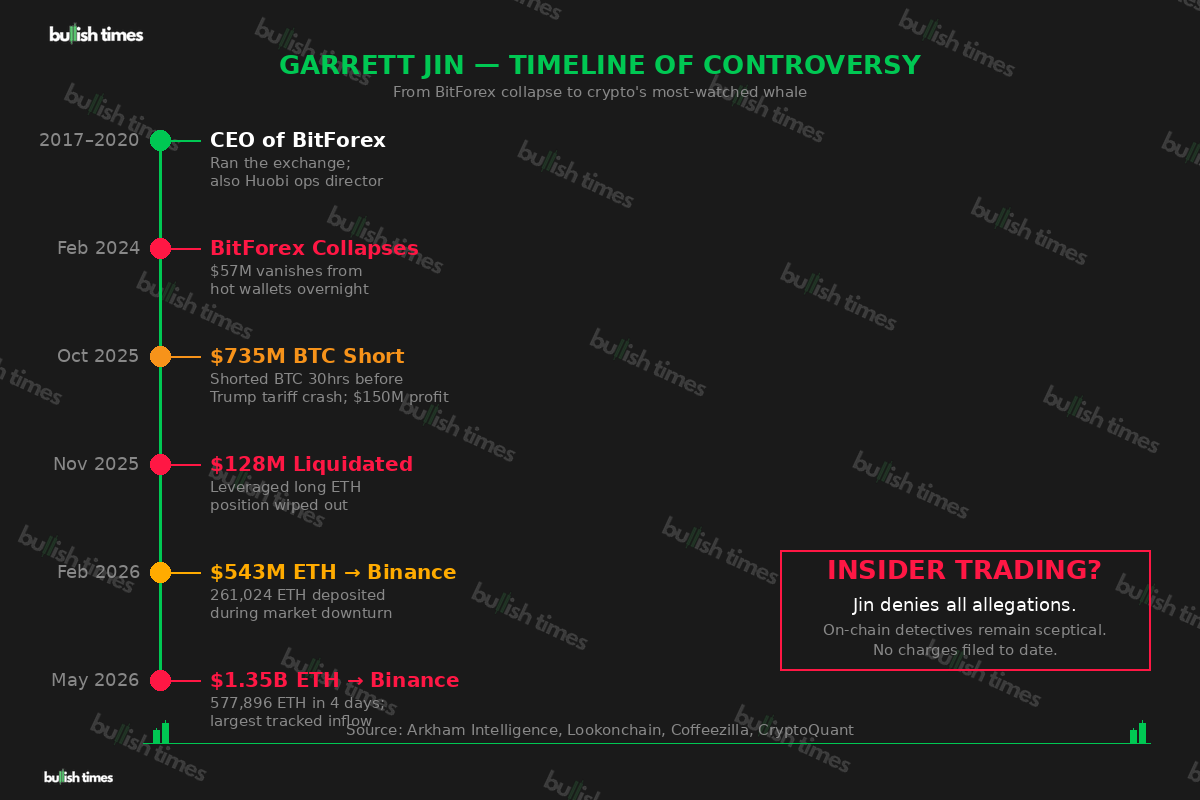
The pattern is becoming hard to dismiss as coincidence. Large deposit to Binance. Market drops. Jin denies selling. Repeat. After the October 2025 windfall, Jin went on to lose $128 million on a leveraged long ETH position that was liquidated — a fact that his defenders point to as evidence he is merely a volatile trader, not a calculating insider.
But sceptics note that Jin has rotated between BTC and ETH positions at least five times in 2026 alone, each move commanding headlines and moving markets. His wallet, tagged on-chain as #BitcoinOG1011short, is now one of the most scrutinised addresses in all of crypto. He still holds 303,618 ETH (approximately $692.5 million) and 9,343 BTC (roughly $757 million) — a combined portfolio exceeding $1.4 billion.
What Happens Next
The central question is deceptively simple: did Jin sell, or is this portfolio rebalancing? Exchange deposits do not confirm spot sales. Whales regularly transfer to centralised exchanges for liquidity management, collateral posting, or market-making — none of which requires hitting the sell button.
But the market is not in a forgiving mood. Bearish traders are already pointing to Binance’s order books, where sell-side depth has thickened since the deposits began. The ETH/BTC ratio remains under persistent pressure through 2026, and with the Clarity Act vote scheduled for 14 May, any additional volatility could trigger a cascade of liquidations across DeFi.
There is a counterpoint worth noting. A mysterious whale linked to ShapeShift — holding 126,634 ETH worth $293 million — has been accumulating aggressively throughout the dip, spending $6.67 million on 2,920 ETH at $2,284 on 8 May alone. Erik Voorhees has publicly denied any connection to the wallet, but its disciplined buying pattern suggests at least one deep-pocketed holder sees value where Jin apparently sees an exit.
For now, Ethereum sits at a crossroads defined by one man’s decisions. Whether Garrett Jin is cashing out, hedging, or simply repositioning, the fact remains: a figure credibly accused of front-running a presidential announcement, linked to a $57 million exchange collapse, and currently sitting on a $1.4 billion crypto portfolio is moving nine-figure sums through the market with no accountability whatsoever.
In traditional finance, this would trigger an immediate investigation. In crypto, it triggers a Lookonchain thread and some angry quote tweets.
This is a developing story. Bullish Times will update if on-chain data confirms spot sales from Jin’s Binance deposits.