BitMart is not collapsing in a panic. It is leaving in an orderly fashion — and that may be the more important warning for crypto.
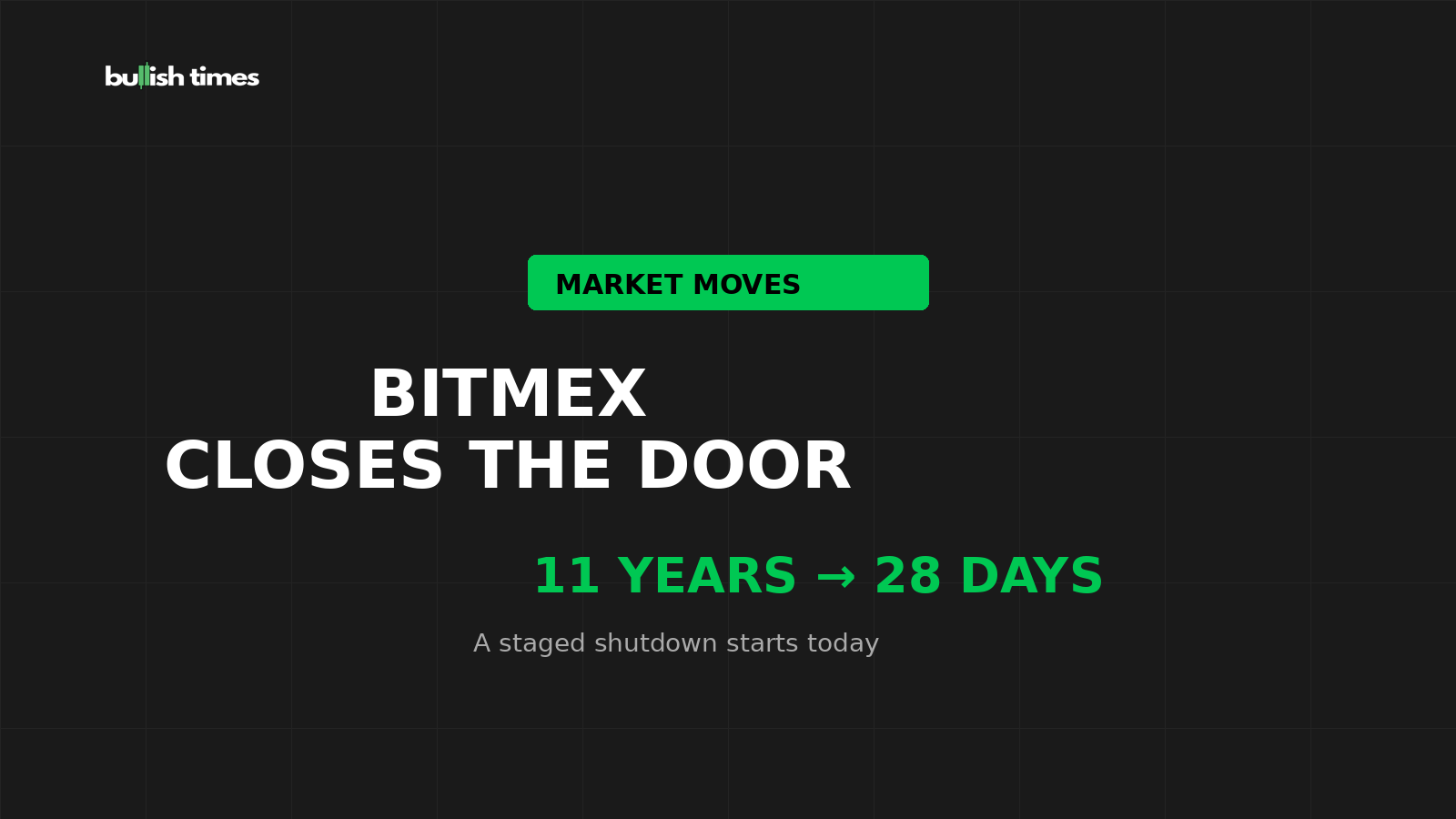
After nine years in operation, the exchange has announced an orderly wind-down of its trading platform. The decision makes BitMart the second major exchange to announce an exit in one week, after BitMEX said on 23 July that it would end operations by 23 September 2026.
According to BitMart’s official statement, trading will end on 26 August 2026 at 01:00 UTC. Platform operations will formally cease on 31 January 2027 at 15:59 UTC, with withdrawals available thereafter for a specified period. The company recommends that users submit withdrawal requests before 26 August at 05:00 UTC.
An orderly exit, not a funds-loss event
The distinction matters. BitMart has not presented this as an insolvency filing, a hack or an overnight suspension that strands customers without notice. Deposits and new registrations have been suspended, while futures accounts have moved to reduce-only mode. Users in roughly 180 countries have a defined timetable for trading to stop and for the platform to cease operations.
That does not make the process frictionless. Identity, device and IP verification, withdrawal-address screening, source-of-funds questions and sanctions checks may all be involved. BitMart warns that processing could take longer if request volumes rise, which is why the earlier recommended deadline is more consequential than the formal closure date.
The sensible reading is urgency without panic: customers should organise withdrawals early, retain access to their accounts and avoid treating the final operational date as a personal deadline.
The BMX reaction exposes the market’s judgement
The market responded far less gently than the company’s timetable. As CoinDesk reported, BitMart’s BMX token fell 58% in 24 hours to about $0.08, leaving it with a market capitalisation of roughly $27 million. The token was already down about 70% over 12 months.
That price action is not merely a dramatic footnote. An exchange token derives much of its practical value from the activity, access and confidence surrounding its platform. Once the platform’s future is fixed, the token becomes a direct expression of what the market thinks survives after the exchange itself disappears.
BitMart recorded approximately $1.6 billion in 24-hour trading volume before the announcement, up 51% from the preceding period, with Bitcoin accounting for about half. A surge in activity alongside a shutdown announcement should not automatically be read as renewed health. It can also reflect customers repositioning, closing exposure or moving assets before access changes.
Why the mid-tier model is under pressure
BitMart’s statement cites “operating conditions, market environment, and future strategic direction”. It does not provide a detailed explanation, so stronger claims about the company’s finances or internal decision-making would go beyond the evidence.
Even so, the structural pressure is visible. Exchanges must fund compliance across jurisdictions, maintain custody and security systems, provide reliable liquidity and compete for users who increasingly expect deep markets and sophisticated infrastructure. Those costs do not fall in proportion to a platform’s size.
At the same time, trading and user funds are concentrating on the largest venues. Binance’s dominant position is a useful illustration of the imbalance: smaller exchanges may still report impressive headline volume, but headline volume is not the same as durable pricing power, loyal users or sustainable margins.
This is the quiet death of the mid-tier exchange model. Not because every smaller venue is fraudulent or incompetent, but because a platform can be operationally credible and still struggle to justify its existence in a market where scale compounds.
Two exits in one week change the conversation
BitMart’s announcement followed BitMEX’s notice that its 11-year run was coming to an end. The businesses and their histories are not identical, and two announcements do not prove a universal exchange crisis.
They do, however, make consolidation harder to dismiss as a one-off. The industry is moving towards fewer platforms with the liquidity, regulatory capacity and infrastructure to serve a global customer base. That may remove weak or inefficient capacity, but it also concentrates operational and personal-data risk in fewer hands.
For users, optionality is being exchanged for scale. A larger venue may offer tighter markets and greater resources, yet every closure narrows the range of jurisdictions, interfaces and business models available to traders. The market may become more efficient while becoming less diverse.
The real test is what comes after the timetable
BitMart’s orderly process is preferable to a disorderly failure. Its prior record also matters: after a December 2021 hot-wallet breach that resulted in a reported $196 million loss, the company said it covered customer losses. That history shows why the present announcement should not be lazily framed as a repeat security incident.
The more revealing question is whether a platform can remain viable when it has survived a major operational shock but cannot secure a convincing long-term position in a consolidating market. BitMart’s exit suggests that orderly governance and customer procedures are no longer enough on their own. Scale, liquidity and regulatory reach increasingly determine who gets to stay.
Crypto has not run out of exchanges. It is running out of room for exchanges that sit in the middle. BitMart’s closure is therefore a milestone, not a death knell: the market is growing up into a smaller, more centralised platform economy — with efficiency gained, and choice lost.