The most revealing thing about Washington’s crypto rulebook is that it could not even make it to the meeting room.
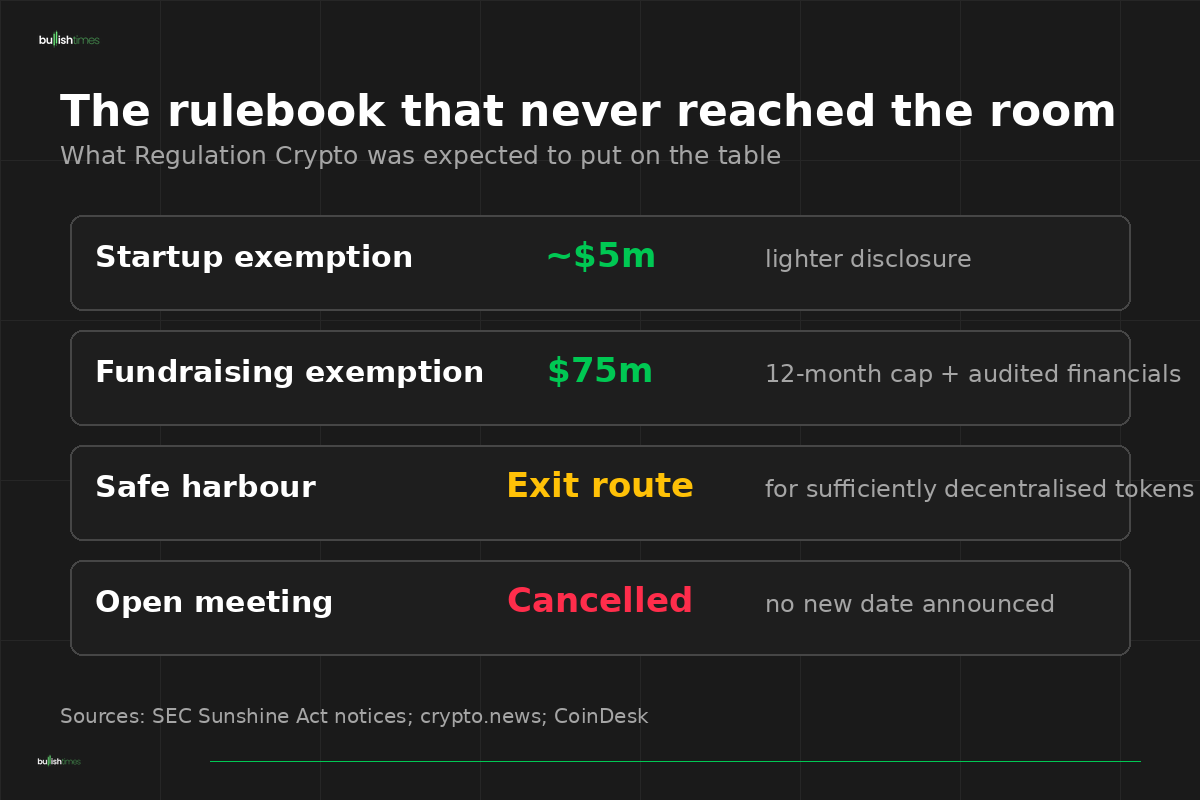
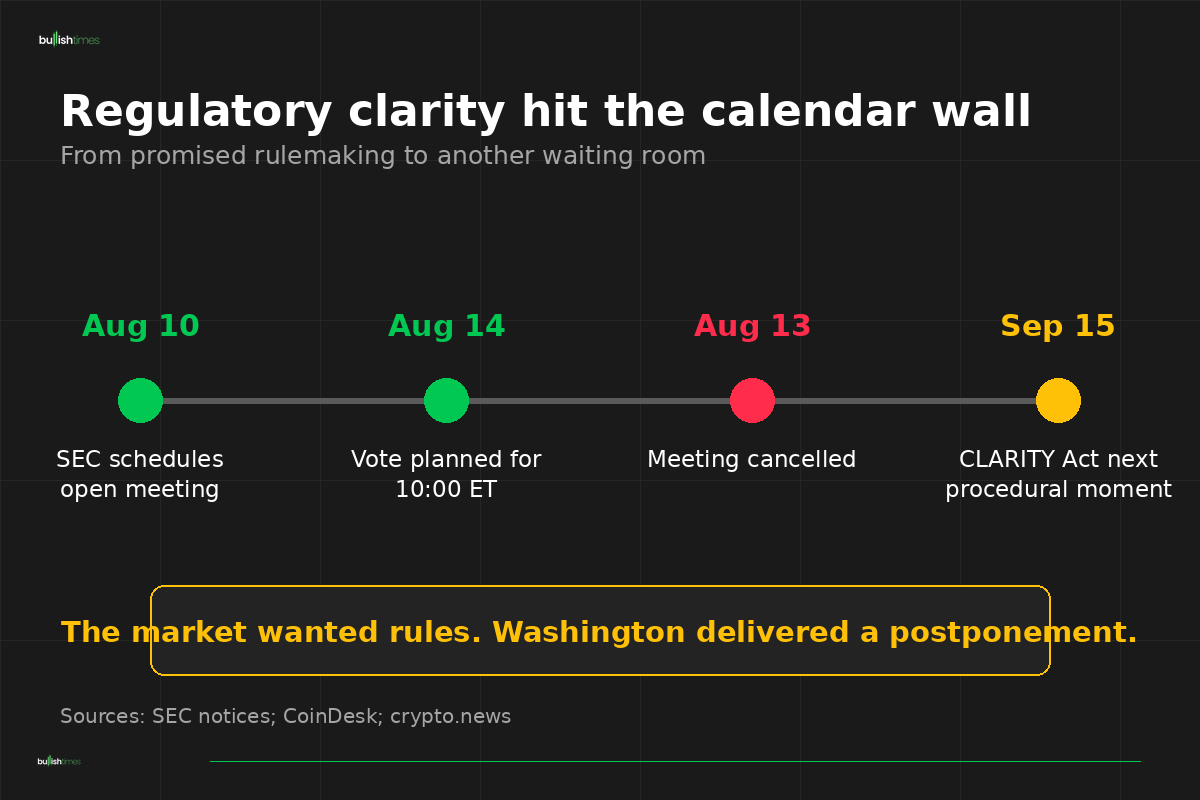
The U.S. Securities and Exchange Commission had scheduled an open meeting for 14 August to consider a tailored offering regime for certain crypto investment contracts. By the evening before the vote, the meeting had been cancelled. No new date was announced in the official cancellation notice.
That is not a technical footnote. It is the whole problem in miniature. A market that has spent years asking for a usable rulebook was handed a calendar entry, then a postponement.
The rule that was meant to change the argument
The SEC’s 10 August Sunshine Act notice said commissioners would consider whether to propose new rules for “a tailored offering regime for certain investment contracts involving crypto assets”. In plain English, the agency was expected to move from enforcement-first ambiguity towards a formal process for token fundraising and eventual decentralisation.
Reporting ahead of the meeting described three core pathways: a startup exemption of roughly $5m, a broader fundraising route capped at $75m in a 12-month period, and a safe harbour intended to let sufficiently decentralised tokens move out of securities classification once the original managerial effort had genuinely fallen away.
That matters because the current system has trapped serious projects between two bad options: behave like a full public securities issuer before a network is mature, or operate in legal fog and hope the agency does not arrive later with a courtroom explanation.
Cancellation is a policy signal too
The official SEC cancellation notice is brutally thin. It says the open meeting scheduled for Friday 14 August at 10:00 a.m. was cancelled. CoinDesk reported that an agency spokesperson cited an “unforeseen scheduling issue” and said the meeting would move to a later date.
Maybe that is all it was. Institutions do have diaries, conflicts and procedural problems. But crypto regulation is not a normal diary item. It is a live contest between agencies, Congress, courts, investors, founders and a market that has already learned to price legal uncertainty as part of the product.
When a long-trailed proposal is pulled hours before the vote, the message is not neutral. It tells builders that even the supposed clarity process remains dependent on timing, personnel and political air cover.
Congress left a vacuum
The SEC delay lands while the Digital Asset Market Clarity Act, widely known as the CLARITY Act, remains stuck in the Senate timetable. CoinDesk noted that the industry had been looking to the SEC to pick up the baton in the absence of congressional progress.
That is the absurdity: crypto wants rules, but the rulemakers keep disagreeing over who gets to write them. Congress wants a market-structure framework. The SEC wants an offering regime. The Commodity Futures Trading Commission remains central to the commodity side of the debate. Meanwhile, projects, exchanges and investors are expected to behave as if the boundary lines are obvious.
They are not obvious. A token can start as a fundraising instrument, evolve into network infrastructure, trade like a commodity and still carry the historical baggage of its initial sale. That lifecycle problem is exactly what Regulation Crypto was supposed to confront.
The safe harbour is the real fight
The most important part of the expected proposal was not the fundraising cap. It was the proposed exit route. If a token can never mature out of securities treatment, then decentralisation becomes theatre: a slogan used in decks, not a legally meaningful transition.
If a token can exit too easily, the opposite problem appears. Founders raise money under the aura of future decentralisation, then use the safe harbour as a wash cycle for what was effectively a speculative public offering. That is why the details matter. A serious safe harbour must separate real network independence from foundation-controlled decentralisation cosplay.
That distinction is where good regulation could help. It would not save bad projects. It would expose them faster. The market does not need permission for every experiment, but it does need a way to distinguish a protocol that has genuinely shed managerial dependence from one still being steered by insiders with better lawyers.
The takeaway
Crypto’s problem is not that every rule is hostile. It is that the rulebook keeps arriving as rumour, litigation, speeches and delayed meetings. That rewards the worst operators because they are built to exploit ambiguity. It punishes the serious ones because they are the only people trying to comply with rules that keep moving.
The SEC may still reschedule the meeting. The proposal may still be published. The comment period may still produce the first durable U.S. framework for token offerings and decentralisation. But the cancellation has already proved the larger point.
A market cannot mature on vibes, enforcement threats and postponed calendar invites. If Washington wants credible crypto markets, it has to stop treating clarity like an optional extra.