Goliath Ventures did not collapse because crypto was too complicated. Regulators say it collapsed because the “liquidity pools” investors were sold were never there.
The latest SEC and CFTC actions against Goliath Ventures turn a familiar crypto scandal into something more revealing than another fraud headline. The alleged machine was dressed in market-structure language: liquidity pools, Bitcoin and Ether trading, monthly distributions, guaranteed principal and dashboard performance metrics. Strip that language away and the regulators describe an old trick in modern clothes.
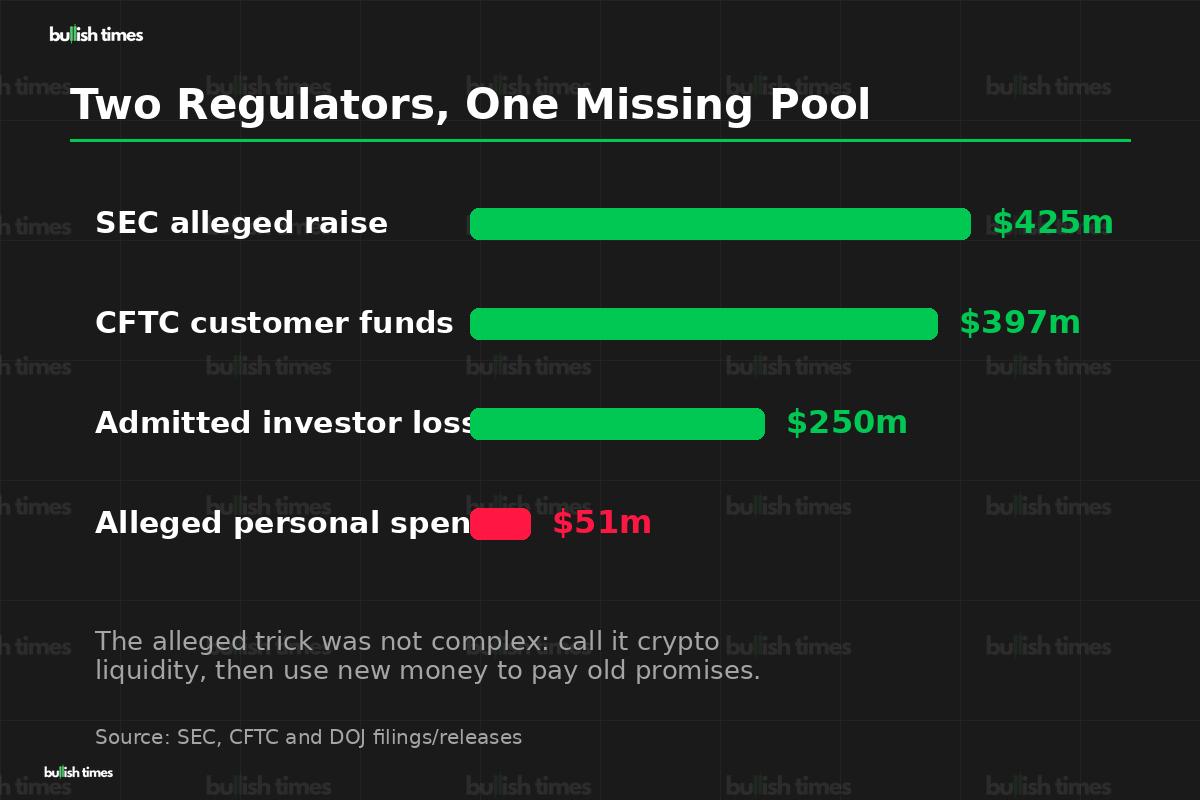
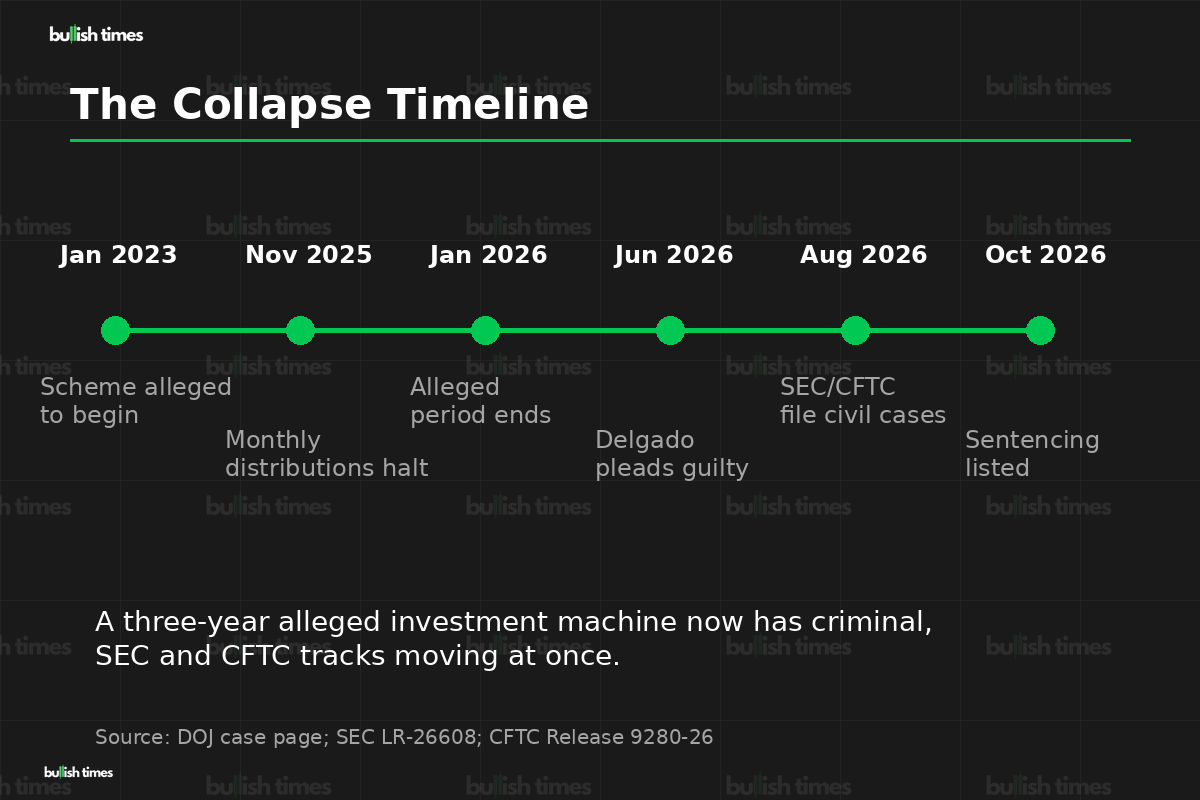
The U.S. Securities and Exchange Commission says Goliath raised at least $425 million from more than 1,300 investors. The Commodity Futures Trading Commission says about 1,600 customers contributed at least $397 million for purported crypto asset trading. The Department of Justice case page says Christopher Alexander Delgado, Goliath’s founder and chief executive, has pleaded guilty in the parallel criminal case and is listed for sentencing on 21 October 2026.
The promise was crypto liquidity. The allegation is pure circular finance
According to the SEC’s 11 August litigation release, Goliath told investors they would “partner” with the company to invest in crypto asset liquidity pools. Those pools were supposed to generate fees from buyers and sellers trading crypto assets, producing monthly profit distributions of 3% to 10% while guaranteeing the return of principal.
That promise is the tell. Real liquidity provision is volatile, competitive and operationally messy. It does not naturally produce smooth monthly returns with capital protection attached. When a crypto investment pitch offers market risk with a savings-account rhythm, the first question should be simple: where is the return actually coming from?
The SEC’s answer is blunt. Its complaint alleges that no investor funds or crypto assets were placed into any crypto asset liquidity pool. It also alleges that Delgado misappropriated at least $51 million for personal use, including homes, luxury vehicles, a yacht and travel, while money from new and existing investors was used to pay earlier investors.
The dashboard problem
The most corrosive allegation is not merely that money was diverted. It is that performance itself was allegedly manufactured.
The SEC says Goliath fabricated account balances and investment performance metrics to make it appear that investors were earning profits and that their assets were invested in crypto asset liquidity pools. The CFTC says customers received false account statements reflecting non-existent profits, while defendants allegedly guaranteed principal and/or profits.
That matters because crypto fraud often hides behind transparency theatre. A slick dashboard, a token name, a liquidity-pool label and a monthly statement can make a private black box look like market infrastructure. But if investors cannot verify the assets, the venue, the counterparties and the cash flows, the interface is not proof. It is decoration.
The alleged Goliath structure also shows why regulatory labels alone do not solve the problem. The SEC is pursuing alleged securities-law violations. The CFTC is pursuing alleged commodity-fraud violations involving Bitcoin and Ether trading. The Justice Department’s criminal case uses wire fraud, money laundering and related proceedings. The same factual pattern can sit across several legal boxes because the real issue is simpler: were customers told the truth about where their money went?
When “crypto” becomes a costume
The industry should stop treating cases like this as reputational weather. If the regulator’s allegations are proven, Goliath was not a failed DeFi experiment. It was a conventional alleged Ponzi scheme wearing crypto market-structure clothing.
That distinction matters. Real decentralised finance has visible risks: smart-contract bugs, governance capture, oracle failure, liquidation cascades and bridge design flaws. Those risks are serious, but at least they can often be inspected. The Goliath allegations are different. They point to the off-chain sales machine that borrows DeFi language while removing DeFi’s only useful defence: verifiability.
The DOJ case page says federal authorities allege Goliath obtained at least $328 million from victim investors and that proceeds were used for purported returns, principal repayments, extravagant business gatherings, Christmas parties, luxury travel and residential properties. It also says the United States has pursued civil forfeiture over real properties and vehicles allegedly bought with proceeds.
The takeaway is not anti-crypto. It is anti-nonsense
The useful lesson is not that every crypto yield product is fraudulent. The useful lesson is that yield without verifiable mechanics deserves suspicion before it deserves capital.
Investors were allegedly sold a story about liquidity pools, trading fees and guaranteed principal. Regulators now say the pools did not receive the assets, the profits were fictitious, and the personal spending was very real. That is not innovation. It is common-sense failure with a crypto wrapper.
The market does not need softer language for this. It needs sharper filters. If a product cannot show where the assets are, how returns are generated, who controls the wallets, what risks can break the model and why promised distributions are economically plausible, it is not sophisticated. It is asking for trust while pretending to offer proof.
Goliath Ventures is now a legal case. For the wider market, it should be a vocabulary test: never let “liquidity pool” become camouflage for money that cannot be traced.