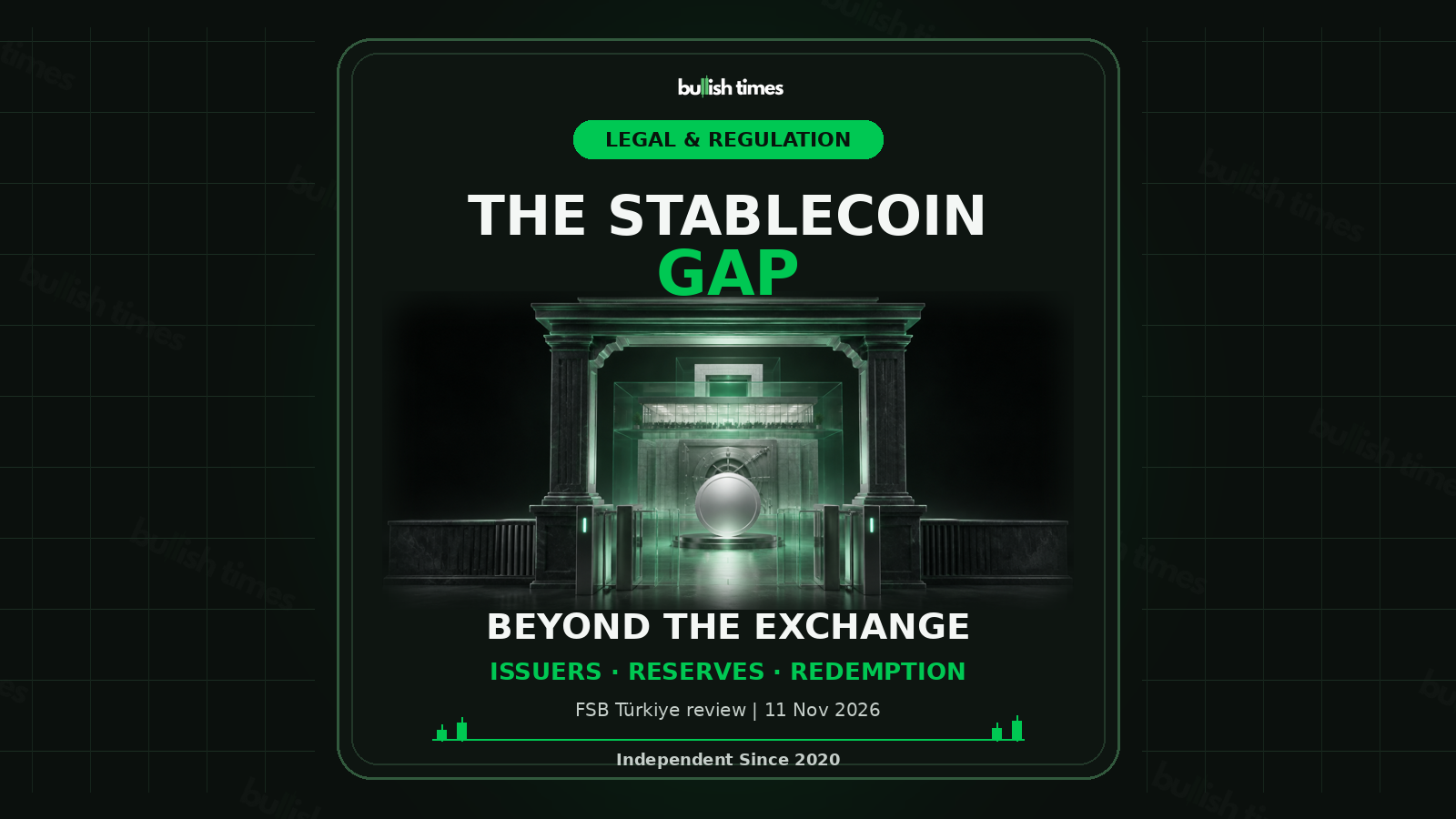
Licensing the shop does not settle the promise printed on the money it sells. Türkiye’s crypto reforms deserve credit, but a regulated exchange cannot substitute for clear rules on a stablecoin issuer’s reserves, redemption obligations and overseas supervision.
That is the consequential distinction in the Financial Stability Board’s (FSB) 11 November peer review. The international financial watchdog recognises meaningful progress while identifying a missing stablecoin-issuer framework. The useful question is not whether Türkiye has “regulated crypto”, but which risks its rules actually reach.
Progress at the exchange is real, but incomplete
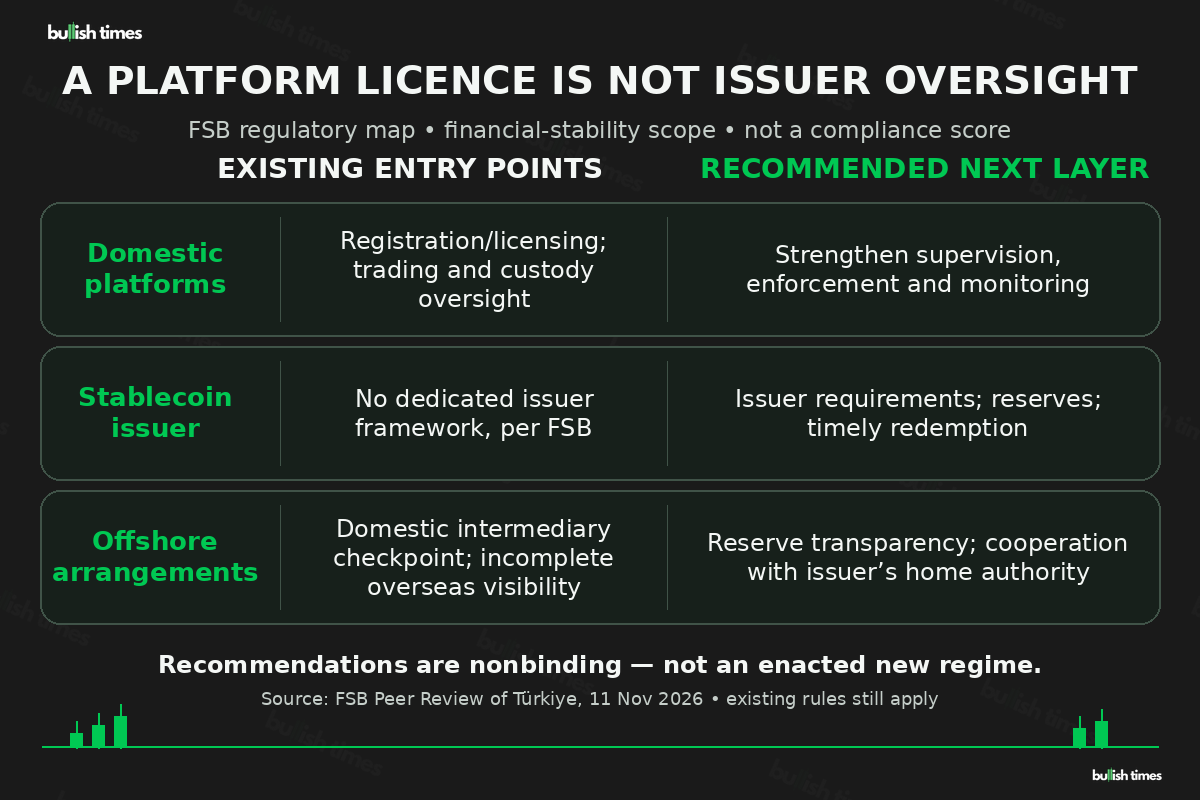
The FSB’s accompanying release credits registration and licensing requirements for crypto-asset service providers, the businesses handling activities such as trading and custody. Strict custody separation and the prohibition on domestic crypto payments also limit some channels through which trouble could spread into banking and payments.
Those are substantive changes, not regulatory theatre. Knowing who operates a platform, separating custody and gathering activity data gives supervisors a stronger starting point than watching an opaque market from outside.
But an exchange and an issuer make different promises. A platform can safeguard a customer’s token without determining whether the organisation behind that token has adequate reserves or can honour redemption. Stablecoins aim to maintain a reference value, often one US dollar; the mechanism supporting that aim matters as much as the venue offering access.
The review states: “There remains no framework in place for the regulation of stablecoin issuers.” That does not mean stablecoins escape every existing rule. The FSB describes oversight of listing, trading and custody, alongside other targeted measures. Its criticism is that these entry points do not amount to comprehensive issuer oversight.
Measure the market without inflating the claim
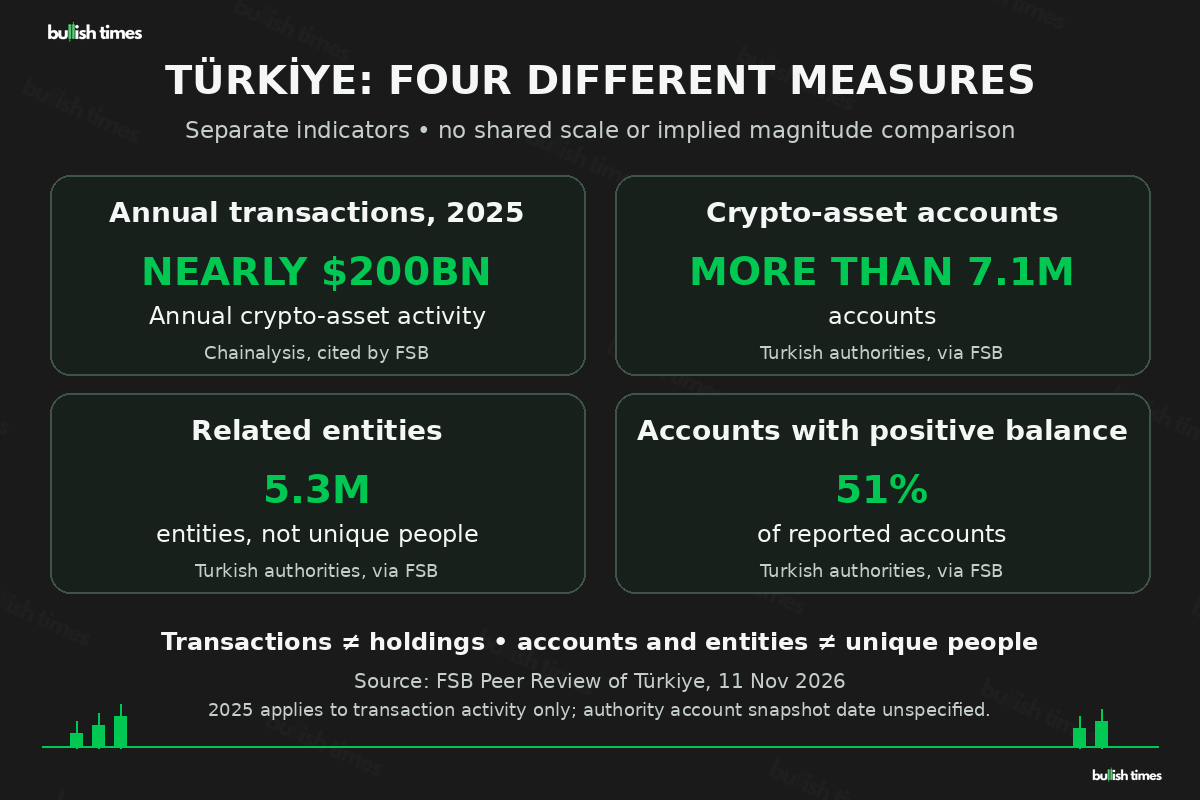
The review cites Chainalysis for nearly $200 billion in annual Turkish crypto-asset transactions in 2025. That is activity over a year, not a pile of assets sitting in accounts. Recycling the number as “$200 billion in Turkish crypto holdings” would manufacture a much larger balance-sheet claim.
Separately, Turkish authorities report more than 7.1 million crypto-asset accounts associated with 5.3 million entities, with 51% of accounts showing a positive wallet balance. Accounts are not unique people, and the report’s “entities” should not be casually relabelled individual investors.
These measures establish a substantial footprint without providing a complete map of exposure. The report warns that official holdings data exclude self-custody and providers outside the regulated reporting perimeter. More domestic reporting can improve the picture while still leaving important activity beyond the frame.
The scale makes precision more important, not less. A financial-stability argument should explain where losses or funding pressures could travel, rather than treating every transaction as another dollar permanently at risk.
The dollar promise needs an accountable issuer
Reuters reports that crypto-assets and stablecoins have become increasingly important for people seeking protection from lira depreciation and high inflation. The FSB likewise describes stablecoins as a store of value and a hedge against those pressures.
That motivation is understandable. It also makes the quality of the substitute crucial. Moving from exposure to a weakening currency into a dollar-linked token changes the risks; it does not abolish the need to identify the claim, the backing and the party responsible.
The FSB calls for issuer requirements covering redemption rights, stabilisation mechanisms and prudential requirements: safeguards concerning an issuer’s financial resilience. It also identifies reserve management and timely redemption as central issues. These are the operational foundations of the peg, not optional extras to be checked after an exchange licence is granted.
For foreign-issued stablecoins, the review recommends targeted expectations for reserve composition and transparency, plus stronger cooperation with the issuer’s home authority. A domestic intermediary is an important checkpoint, but it cannot conjure reliable overseas information into existence.
The next test is coverage, not another label
The review’s recommendations are not binding law. Nor is this a comprehensive verdict on consumer protection, market integrity or financial crime: its stated focus is financial stability. Treating it as either a clean bill of health or a finding of universal regulatory failure would miss that scope.
The FSB also acknowledges that authorities currently regard domestic stablecoin exposures as modest. Potential digital dollarisation, meaning greater substitution into dollar-linked digital instruments, is a risk channel to monitor, not proof that a systemic crisis is already happening.
The appropriate next step is therefore neither complacency nor a blanket claim that regulation has failed. It is to connect domestic supervision with enforceable issuer obligations, intelligible reserve information and practical cross-border cooperation. Financial-stability monitoring must follow the activity, not stop where the easiest data end.
Türkiye has made the exchange counter more accountable. The harder task is making the dollar promise behind it accountable too.