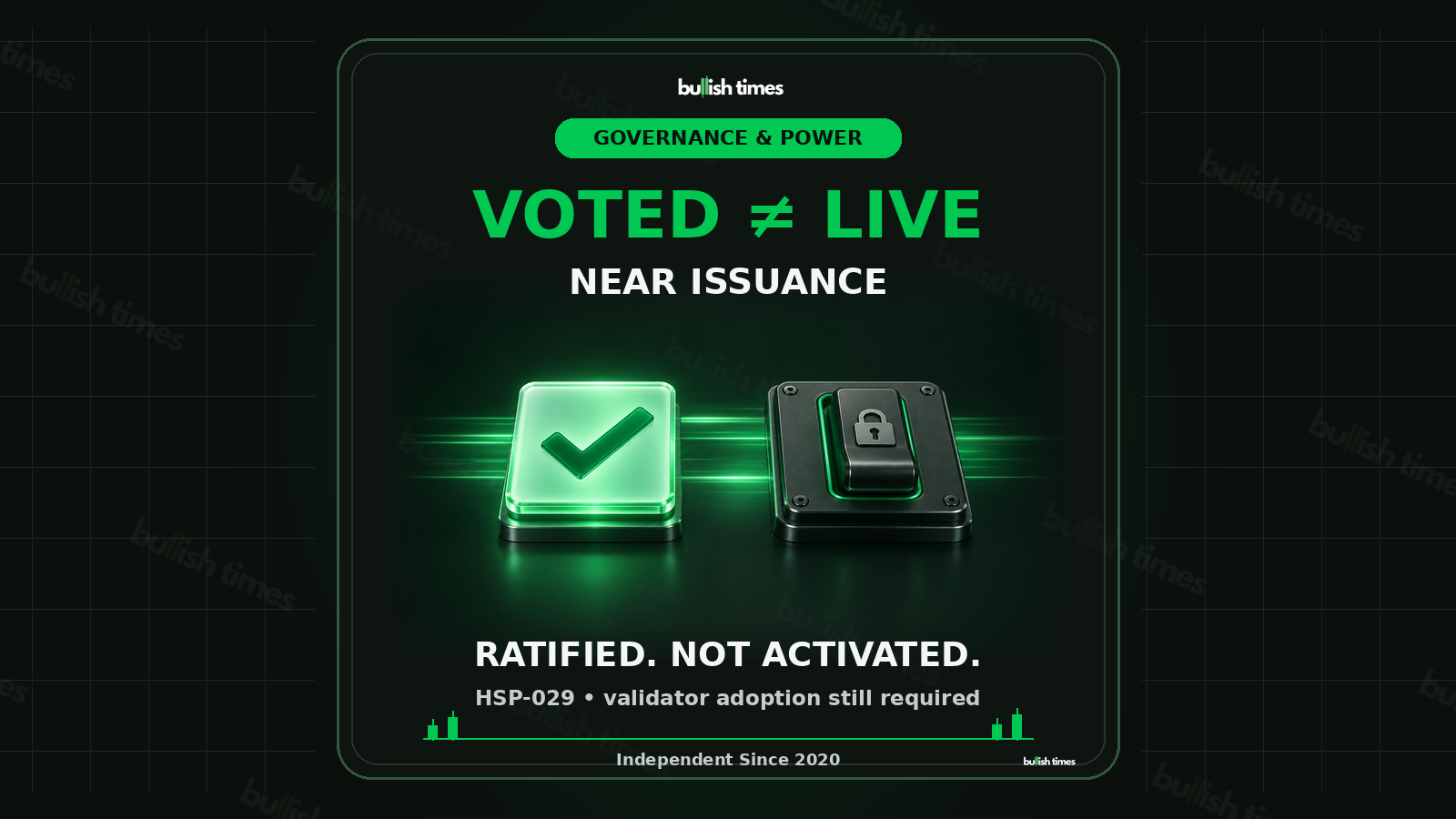
NEAR has approved a smaller issuance budget. It has not switched one on. The distinction is the point of its governance system, not an inconvenient footnote to a scarcity story.
House of Stake, NEAR’s token-holder governance body, has ratified HSP-029, a proposal to lower the maximum annual rate at which new NEAR tokens can be created. Validators, the operators responsible for running and securing the network, must still adopt the protocol upgrade before that policy becomes binding.
That separation deserves attention. Crypto governance is often judged by the size of a vote or the appeal of a supply headline. The harder test is whether a community can change the rewards supporting its infrastructure without treating implementation, operator economics and public accountability as somebody else’s problem.
A mandate is not an activation notice
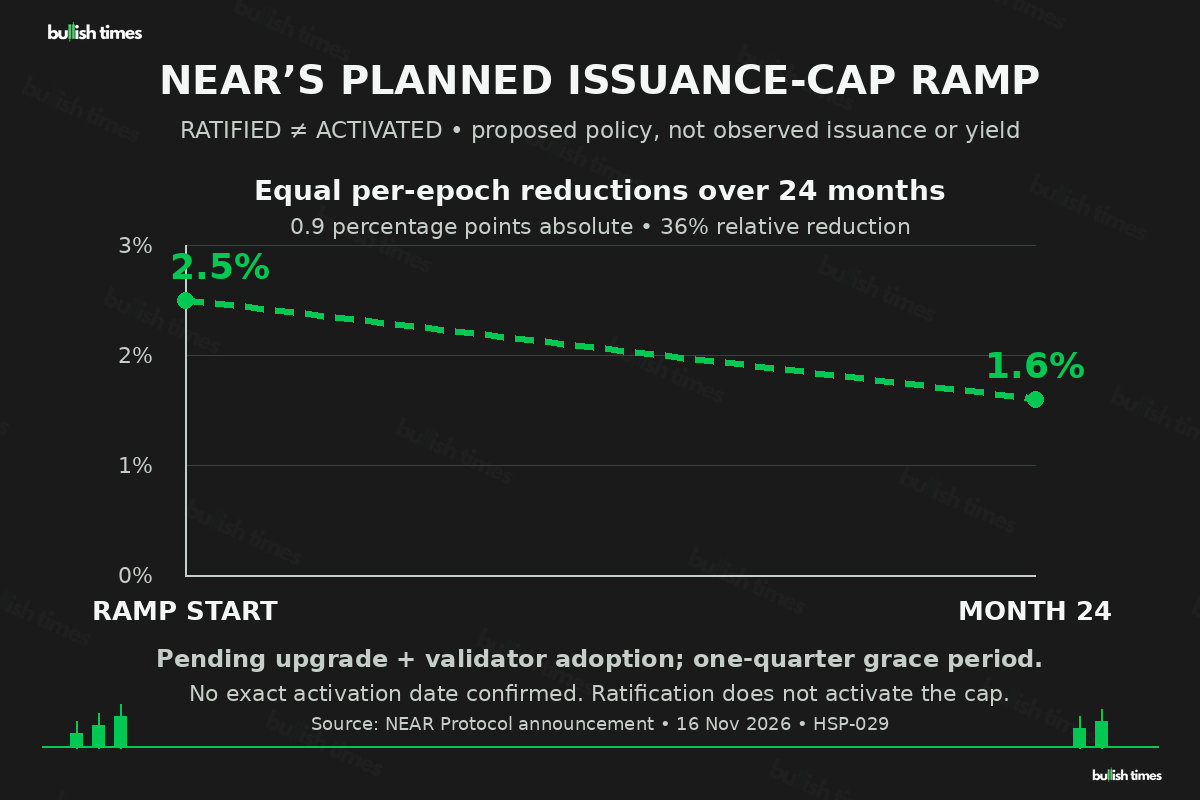
In its 16 November announcement, NEAR said HSP-029 was ratified after the Security Council’s 14-day veto window closed without a veto. The governance vote had closed on 2 November. Those are completed governance stages, not evidence that validators have already changed the network’s issuance parameter.
The announcement describes a full-quarter grace period and says NEAR One will release the upgrade, validators will independently decide whether to adopt it, and a confirmed activation schedule will be published. The reduction is scheduled to begin one quarter after ratification, but the reviewed announcement supplies no confirmed calendar activation date.
There is also a documentation inconsistency worth stating plainly. The proposal page displays a Ratified label while its frontmatter still says “Status: Draft”. The dated NEAR announcement explicitly reports ratification; neither that statement nor the conflicting metadata establishes activation. The inconsistency needs resolving without inventing an explanation for it.
Validator consent is not an administrative rubber stamp. A governance body can set direction without unilaterally binding the people operating the protocol. Keeping those authorities distinct is healthier than presenting a successful ballot as an accomplished software deployment.
A lower cap is not a token bonfire
The proposed maximum annual issuance rate falls from 2.5% to 1.6% through equal reductions each epoch, a recurring network operating interval, over 24 months. That is a 0.9 percentage-point cut, or a 36% relative reduction in the cap. It is not a 36-percentage-point reduction, nor does the target apply immediately.
The distinction between issuance and inflation matters just as much. Issuance creates new tokens; burning removes tokens. Avoiding future issuance does not destroy existing NEAR, and a maximum issuance rate is not a measurement of realised net supply growth after fee burning. Calling all three “inflation” makes the announcement easier to sell and harder to understand.
The 90% allocation to staking participants and 10% to the protocol treasury remains unchanged. Staking means committing tokens to support network validation. An unchanged split does not mean unchanged rewards: the same proportions of a smaller issuance budget produce fewer newly issued tokens.
The model is a counterfactual, not a receipt
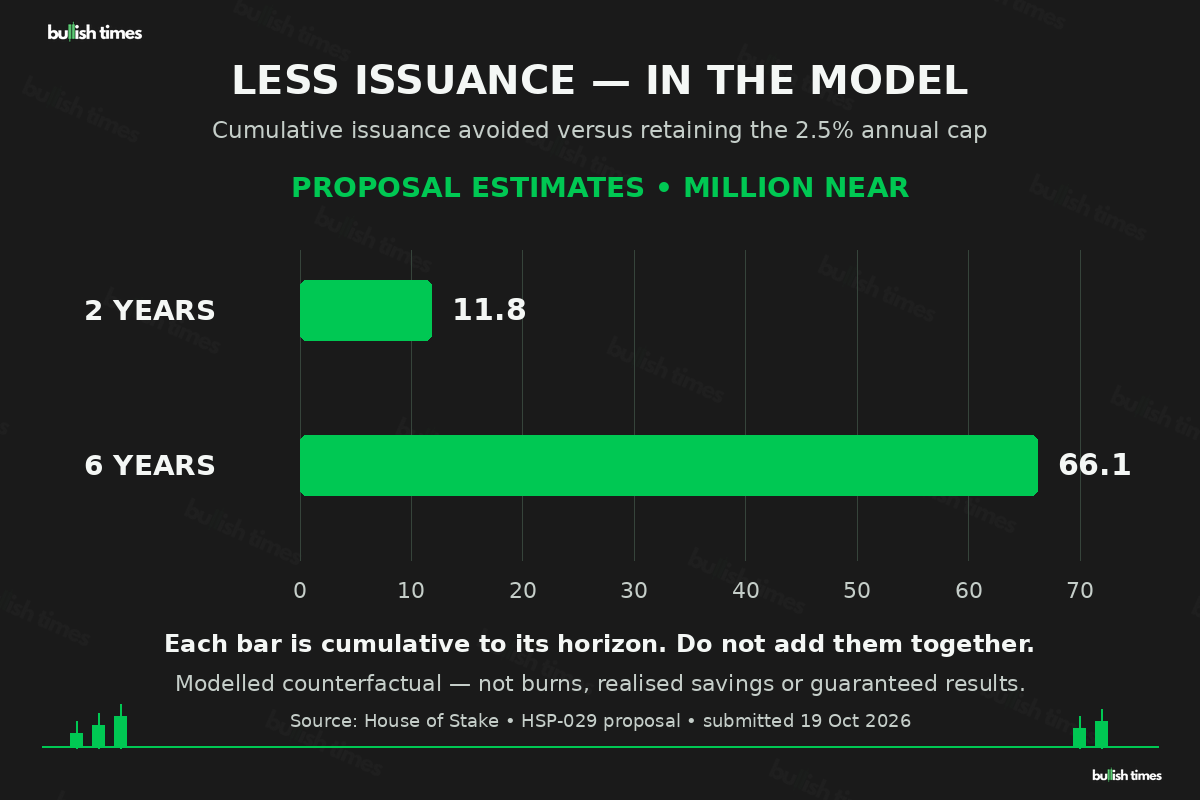
HSP-029 models 11.8 million NEAR less issuance over two years and 66.1 million over six years compared with keeping the cap at 2.5%. These are estimates against an alternative policy, not tokens already saved, recovered or burned.
The horizons are cumulative and overlapping. Adding them would double-count the first two years. Nor should anyone draw a smooth empirical growth story between two model outputs: there are no observed savings points here, only a calculation whose assumptions need to remain attached.
The policy’s defensible promise is narrower than a price thesis: a published rule for creating fewer tokens than under the baseline. It cannot guarantee demand, a market valuation or compensation for every participant receiving lower rewards. Monetary restraint is a design choice, not an automatic economic dividend.
The security budget still needs defending
Lower issuance reduces dilution, but it also changes incentives for validators and the holders delegating stake to them. The proposal itself acknowledges possible validator attrition and uncertainty about how much supply will remain staked.
Its modelling is evidence for debate, not proof that operator viability is settled. An aggregate argument about an established network cannot answer every operator’s cost problem, and a smaller reward pool should not be treated as costless simply because its destination percentages stay the same.
A gradual schedule gives operators time to adapt; it does not pay their bills. The relevant accountability tests are realised issuance against the schedule, validator-set health and whether participation becomes more concentrated. NEAR’s announcement promises quarterly transparency reports covering issuance and validator health. Those reports should test the thesis, not merely celebrate progress towards 1.6%.
HSP-029’s achievement is a ratified direction with a separate implementation check. Its credibility will depend on respecting that boundary, publishing the activation evidence and confronting the security-budget trade-off after the applause.