Binance’s $3.64bn net outflow is neither a clean bill of health nor a verdict of collapse. The sharper question is whether customers and outside observers can measure the exchange’s reopening on terms they can actually compare.
As Binance restores withdrawals after the incident it estimated cost approximately $6.3bn, customer behaviour has become the next test. A spectacular loss attracts attention; the quality of the numbers published afterwards determines how much confidence that attention deserves.
The first disclosed window offers evidence, not closure. Treating it as either proof of panic or proof that trust has returned asks a short, company-reported dataset to do far too much.
Start with the window, not the headline
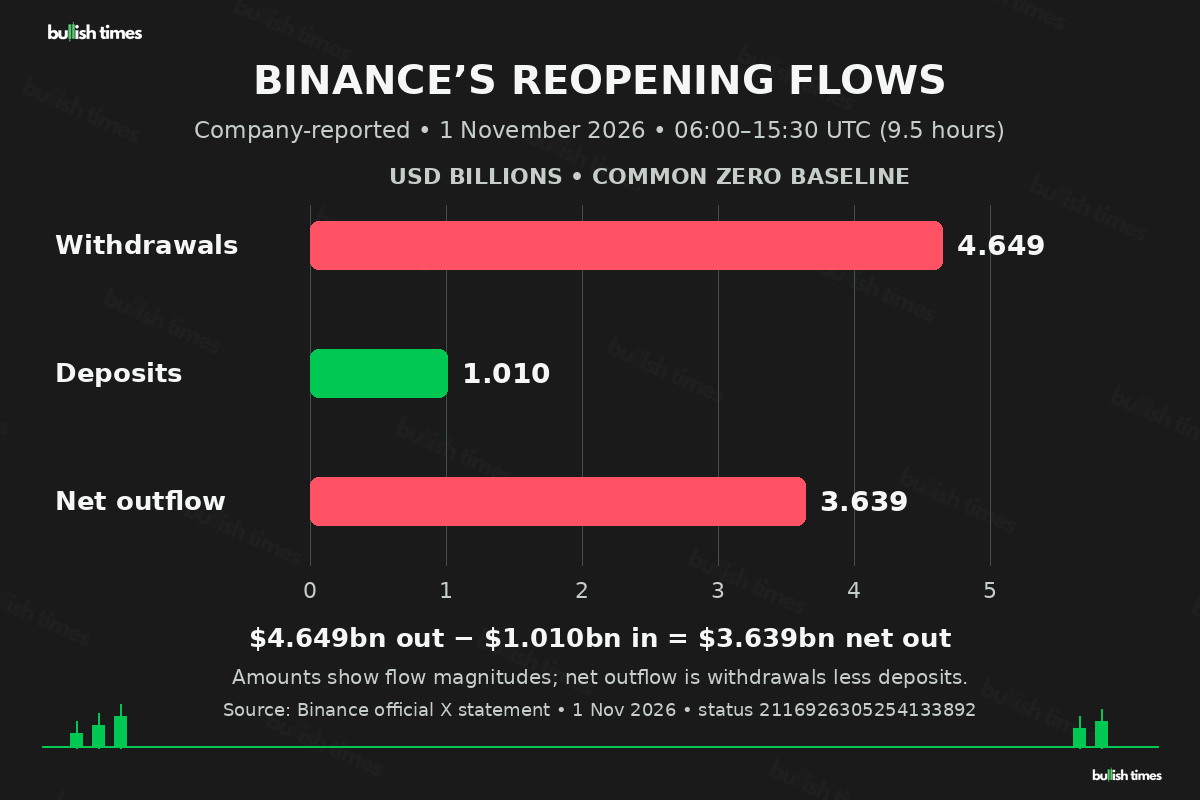
In its 1 November flow statement, Binance said it processed $4.649bn in withdrawals and $1.01bn in deposits between 06:00 and 15:30 UTC. That is nine and a half hours, not a full day.
Subtracting deposits gives $3.639bn, which Binance rounded to approximately $3.64bn in net outflows. Gross withdrawals describe money leaving; net outflow also recognises money arriving. Confusing the two exaggerates the customer exit without improving the analysis.
Binance said the net figure represented 2.1% of $171bn in assets under management. Crucially, that denominator came from Proof of Reserves data dated 28 October: before both the incident and the withdrawal window. It is not a same-day, post-incident reserve balance.
The ratio supplies scale, but not an independent solvency assessment. Neither the dollar total nor its percentage reveals how many customers withdrew, which customer groups moved funds, or why they did so.
A phased reopening is not an unrestricted confidence poll
Binance said withdrawals began returning at 06:00 UTC and that all networks and assets in the initial phase were available by 12:36 UTC. Its reopening announcement explicitly described a phased process, with other services subject to further checks.
That matters commercially. Observed flows reflect both customer preferences and the services available to express them. Withdrawals after a suspension may include delayed transactions; customers whose asset-network combinations remain unavailable cannot contribute equally to the exit total.
Binance said withdrawal volumes had “declined and are stabilising” after an initial spike. That is the company’s description, not an independently verified time series. The reported deposits are meaningful counterevidence to an account of exclusively one-way flight, but they cannot explain every depositor’s intentions.
Reuters reported on 2 November that analysts characterised the outflow as fairly modest. HashKey researcher Tim Sun nevertheless warned that the damage to confidence could extend beyond the stolen assets. Both observations can be true: a manageable opening flow need not mean the commercial consequences are finished.
Replacement assets are not recovered stolen coins
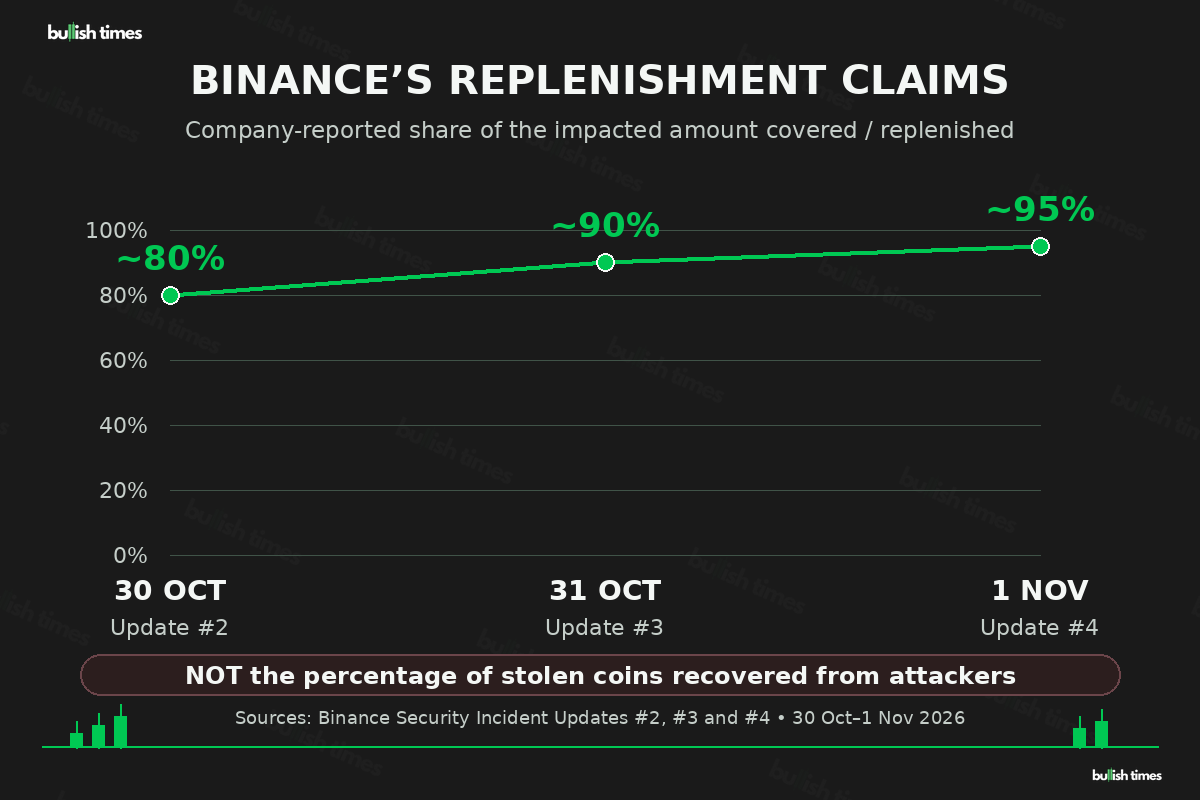
Binance’s other prominent percentages concern replenishment. Its updates reported coverage of approximately 80% of the impacted amount on 30 October, 90% on 31 October and 95% on 1 November.
The 30 October statement described setting aside company resources and buying replacement tokens. The 31 October update identified corporate treasury, SAFU and futures-insurance-fund resources. These are Binance’s coverage claims, not independently audited results.
Calling that “95% recovered” would tell the wrong story. Replacing assets using the exchange’s resources is different from retrieving stolen coins from an attacker. Binance attributed the remaining 5% to less-liquid tokens that took longer to source.
This distinction is operational, not pedantic. An exchange can commit substantial financial resources while still needing the correct tokens and functioning withdrawal routes to meet particular customer requests. Aggregate backing and reliable access answer related but different questions.
Trust needs a measurement standard
The next useful disclosure is not a bigger reassurance slogan. It is a repeatable customer-flow series with explicit start and end times, consistent wallet treatment and clear withdrawal-availability information.
That would let observers distinguish a reopening backlog from continuing withdrawals without guessing at customer motives. Repeating the same measurement is more informative than selecting whichever snapshot makes the strongest headline.
An on-chain dashboard tracking labelled exchange wallets need not measure the same thing as a company ledger of customer deposits and withdrawals. Internal transfers, wallet classifications and observation windows can change the result. Different methodologies are not apples-to-apples evidence that one number proves the other false.
Reserve reporting also needs its dates attached. Binance said it took a new snapshot at 00:00 UTC on 31 October; that snapshot and the completed zero-knowledge proof are distinct outputs. Neither should be confused with the older denominator used for the 2.1% comparison.
Binance deserves scrutiny that is harder to dismiss than a dramatic chart with incompatible numbers. Successful withdrawals and replenishment disclosures matter. Sustained confidence requires evidence that remains intelligible when the opening window closes and more services return.
Trust is not restored by choosing the most comforting number. It is earned by making the numbers testable.