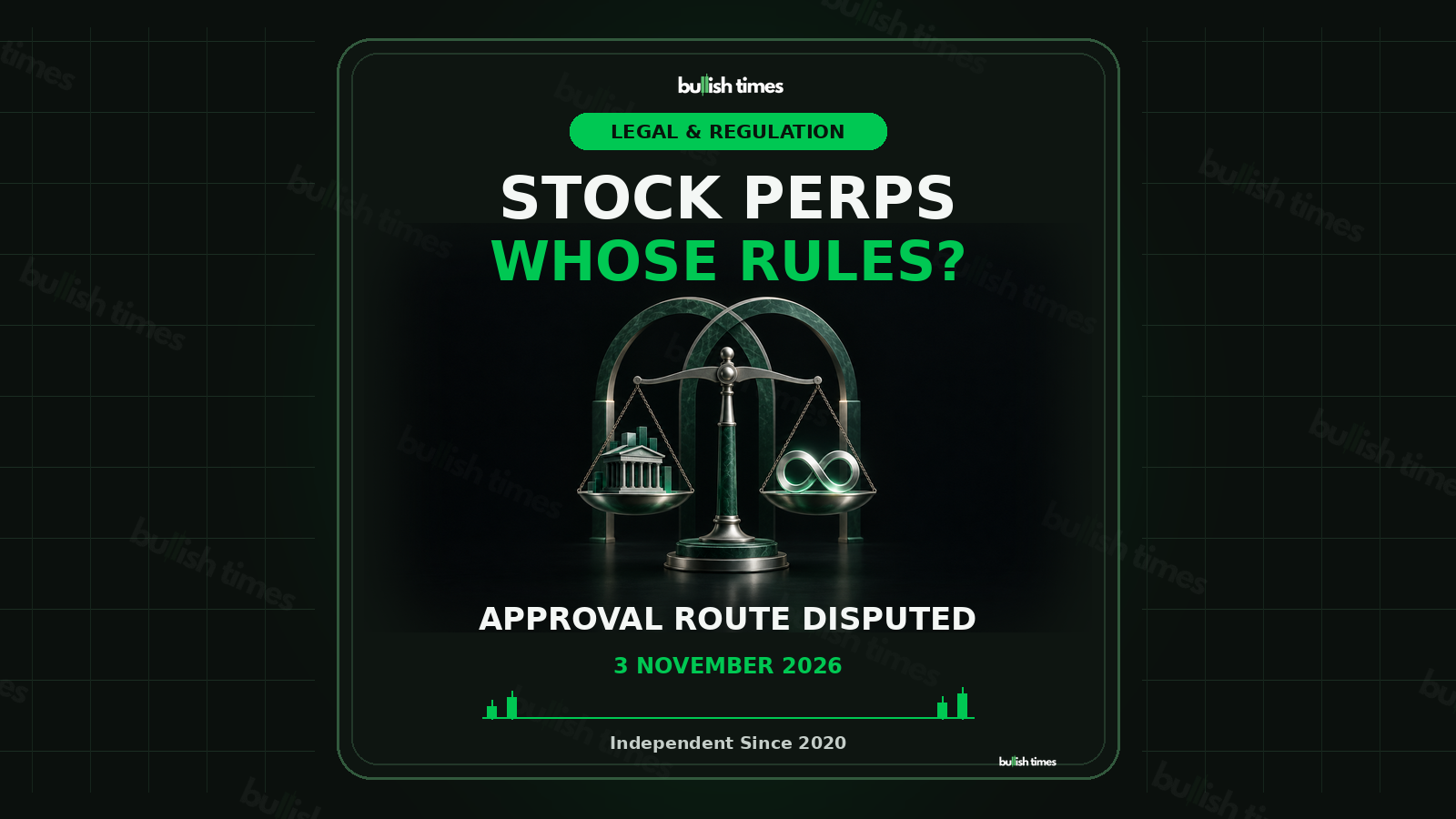
Putting stock perpetuals on a regulated exchange does not settle which rules should govern them. America’s latest derivatives dispute tests whether innovation can earn a clear legal perimeter rather than merely find a convenient regulatory doorway.
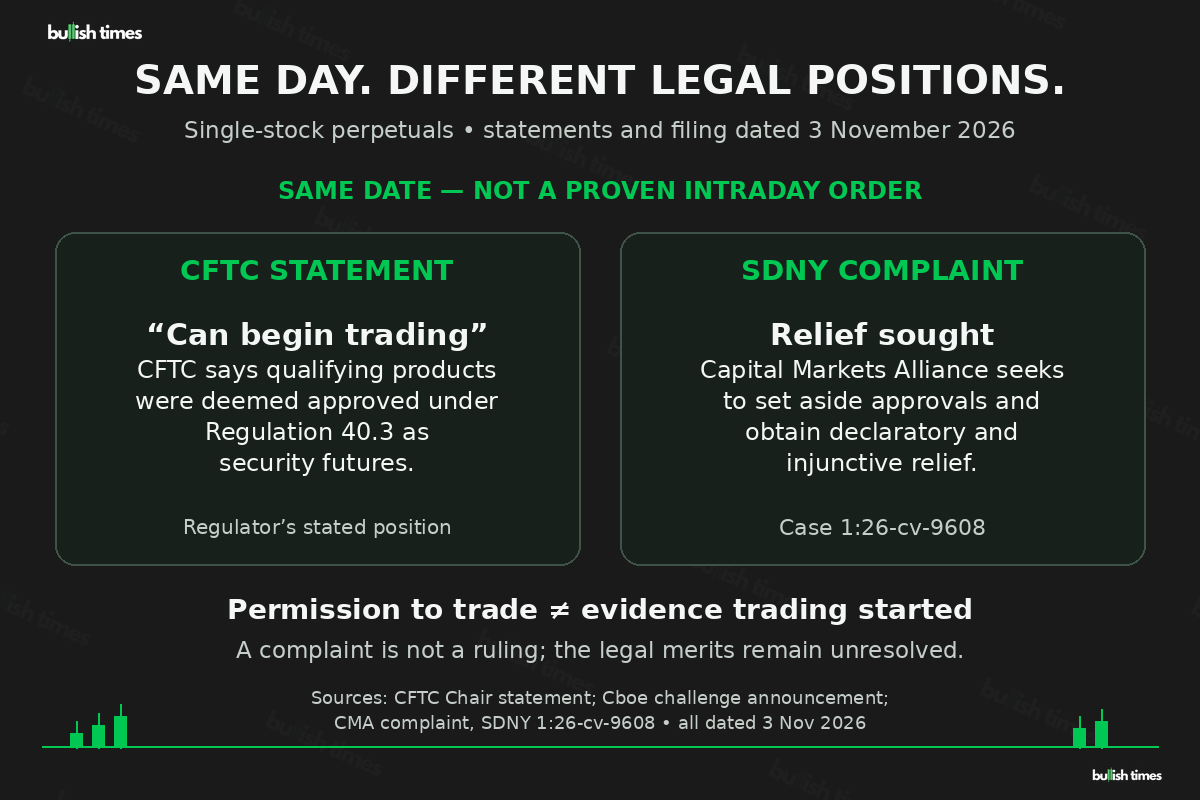
On 3 November, the Commodity Futures Trading Commission (CFTC) announced that perpetual futures on individual equities could begin trading on qualifying exchanges. The same day, the Capital Markets Alliance challenged the agency in court, turning a market-opening announcement into a fight over statutory boundaries.
The useful question is not whether crypto-style products belong in mainstream finance. It is whether the route to market delivers the protections the law actually requires. Neither an innovation slogan nor a lawsuit answers that by itself.
Read the footnote before celebrating the opening
In his equity perpetual futures statement, CFTC chairman Michael S. Selig said the contracts were “deemed approved” under Commission Regulation 40.3 as security futures products. He presented the move as bringing useful instruments into regulated American markets rather than leaving demand to offshore venues.
That is a serious argument. A domestic framework with enforceable obligations could be preferable to pushing activity beyond effective oversight. But the argument depends on identifying the correct framework, not simply attaching the word “regulated” to an exchange.
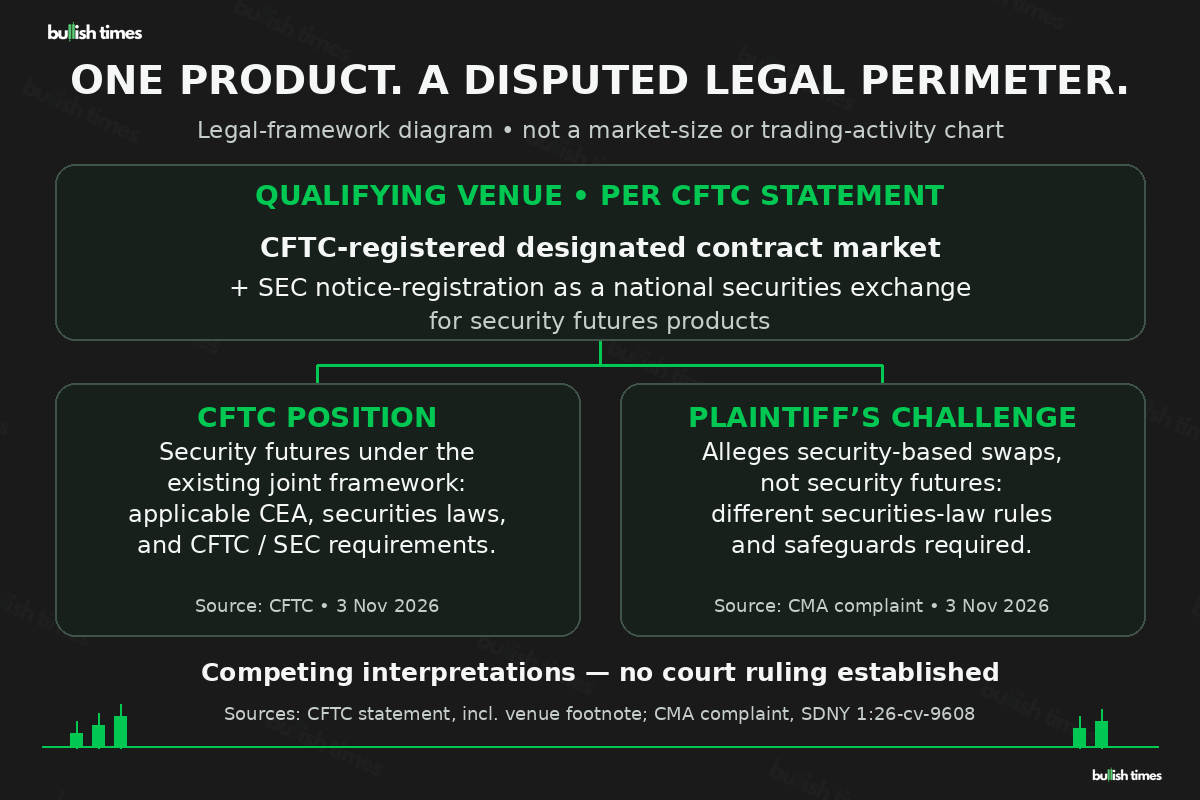
The statement’s footnote matters: eligible venues are designated contract markets dually registered with the Securities and Exchange Commission (SEC) as notice-registered national securities exchanges for security futures. This is not permission for every CFTC-registered platform to list anything linked to a stock.
Selig also says the contracts remain subject to applicable commodity and federal securities laws and both agencies’ regulatory frameworks. Describing this as a declared escape from all SEC oversight would misrepresent the CFTC’s position.
The dispute is about classification, not branding
A stock perpetual provides exposure to a share’s price without giving the holder the share itself. Unlike an ordinary expiring futures position, a perpetual is designed to continue without a scheduled expiry. The Alliance’s complaint describes periodic funding payments intended to keep prices aligned with the underlying market.
The legal fight is whether these instruments qualify as security futures, as the CFTC says, or are security-based swaps, as the Alliance argues. Those categories are not interchangeable labels: the complaint contends that different trading restrictions and investor safeguards follow from them.
The Alliance alleges that the approvals bypass Congress’s protections and invite a “parallel, synthetic market” outside the SEC’s exclusive jurisdiction. That is the plaintiff’s case, not an established description of an unlawful market.
Its requested remedies include setting aside the approvals, a declaration supporting its classification argument, and temporary, preliminary and permanent injunctive relief. A request to stop activity is not an order stopping it. The sources reviewed establish neither a judicial ruling nor that trading has actually launched.
Investor protection is also a commercial argument
Cboe’s statement supporting the challenge identifies Alliance members including Cboe, Citadel Securities and Healthy Markets Association. These are participants with views about how markets should operate, not a court delivering a neutral verdict.
Cboe chief executive Craig Donohue frames the dispute as investor protection and the rule of law. His counter to the obvious commercial-incentive question is unusually direct: “If this were simply a commercial issue, Cboe could bring these products to market” on CFTC-regulated platforms it operates.
That deserves inclusion, but not automatic acceptance. An incumbent can defend genuine safeguards while also having commercial interests in the rules governing competitors. Equally, a regulator can favour competition without settling the legal basis for a particular product.
The commercially intelligent position is to demand a framework durable enough for firms to build around. If classification determines which protections apply, uncertainty is not a minor compliance footnote. It is uncertainty about the product’s operating conditions.
A lawful perimeter is infrastructure, not obstruction
Selig invokes the joint security-futures framework established by the Commodity Futures Modernization Act of 2000. The Alliance disputes whether these contracts fit that framework. The disagreement cannot be resolved by declaring one side pro-innovation and the other afraid of competition.
What matters next is the legal reasoning, the handling of the requested relief and the obligations that follow for qualifying venues. Announcement, permission to trade, actual trading and judicial endorsement are separate milestones. None should be silently substituted for another.
Innovation needs a clear lawful regulatory perimeter, not jurisdiction shopping dressed as progress. That principle does not prejudge the lawsuit: it demands that whoever prevails can explain why the product belongs inside the rules they want to use.
A new trading instrument is not a breakthrough in market structure until its legal foundations can bear the weight.