Eighty accounts. Thirty topics. $143 million in profits. And a CEO who thinks insider trading is actually a feature, not a bug.
A bombshell New York Times investigation published yesterday has laid bare the scale of insider trading on Polymarket, the world’s largest prediction market. Backed by a Harvard research paper that traced $143 million in suspicious profits, the exposé reveals a platform where military operatives, government insiders, and unknown actors have been systematically converting classified information into crypto winnings — with near-perfect timing and zero accountability.
The Numbers That Should Terrify You
The Harvard study didn’t find a handful of lucky punters. It identified more than 80 Polymarket accounts that placed bets with what researchers described as “suspicious characteristics” — well-timed wagers on events that hadn’t been publicly announced, using accounts created hours or days before the bet, with no subsequent activity.
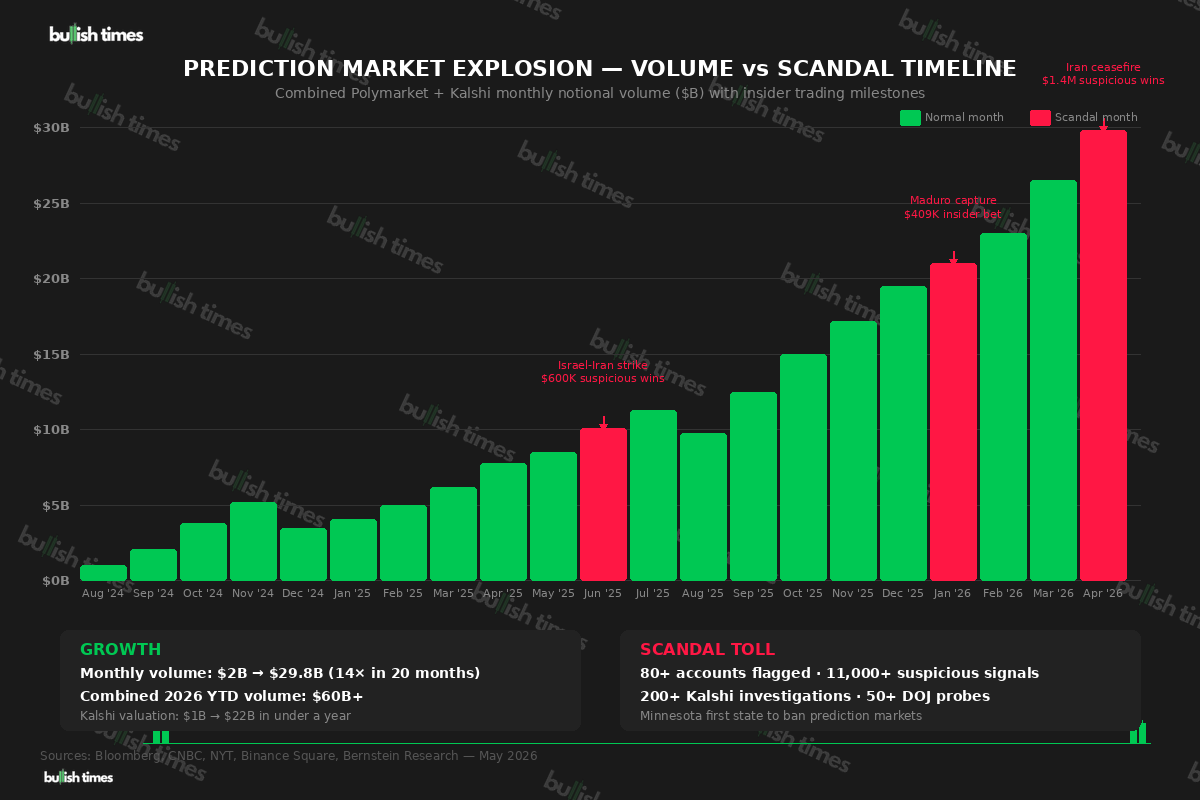
More than 11,000 accounts exhibited some combination of these warning signals. The Justice Department has 50 accounts under active investigation. Kalshi, Polymarket’s main rival, has opened more than 200 insider-trading investigations of its own, with a dozen active cases.
The pattern is chillingly consistent: brand-new accounts, single bets, maximum stakes, perfect timing. This isn’t crowd wisdom. It’s a dead drop.
The Iran Ceasefire: $1.4 Million in Minutes
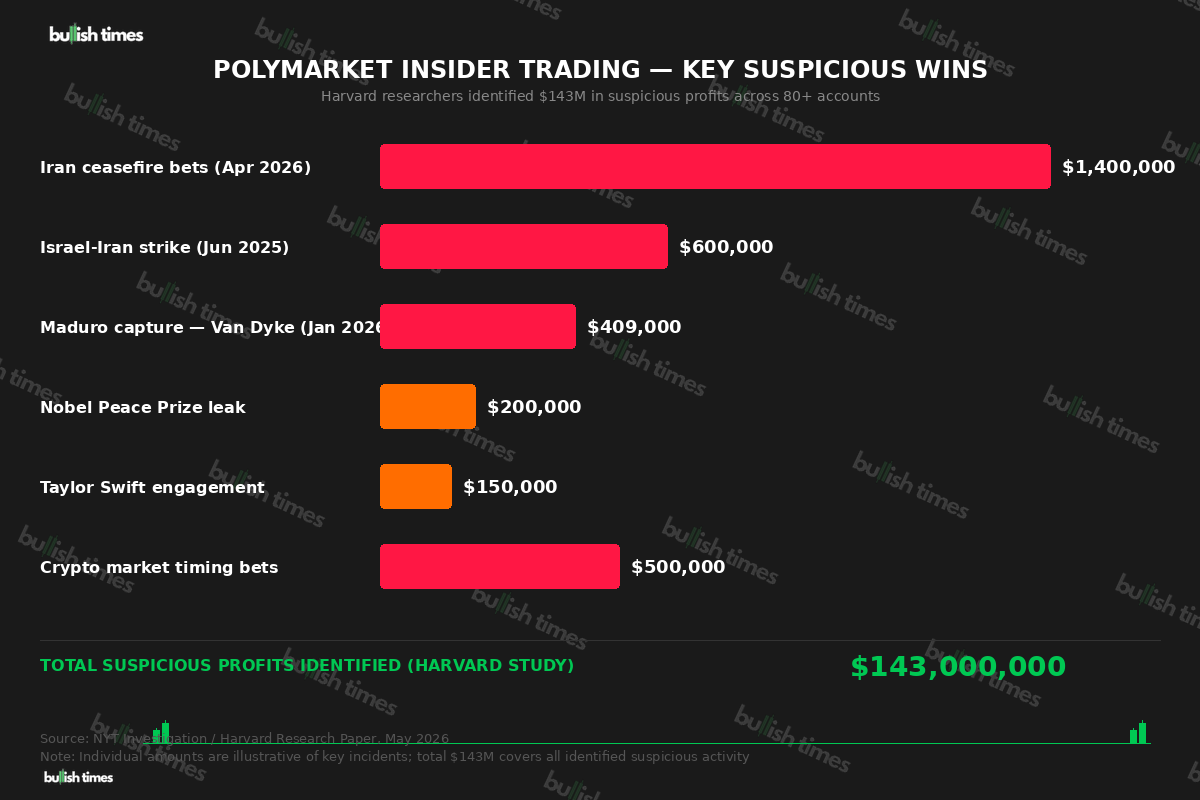
The most brazen example came on 7 April 2026. In the hours before President Trump announced a US–Iran ceasefire on Truth Social, at least 50 brand-new accounts placed substantial bets that the announcement was coming. These were the only bets those accounts ever made.
Seven users collectively won more than $1.4 million. Two walked away with over $400,000 each. Congressional investigators want to know how 50 people who had never used Polymarket before all knew to bet on a ceasefire seconds before the President tweeted.
No one has answered yet.
The Iran pattern had a precedent. In June 2025, a small group of gamblers wagered $140,000 that Israel would strike Iran by the end of that week — even as the odds suggested an attack was unlikely. Seven of the accounts had been opened just days earlier. Israel attacked Iran in the early morning hours of 13 June. The accounts netted more than $600,000.
From Maduro to Taylor Swift: Nothing Is Sacred
The scandal spans far beyond geopolitics. In January 2026, US Army Special Forces soldier Gannon Van Dyke — who participated in the planning and execution of the operation to capture Venezuelan strongman Nicolás Maduro — placed tens of thousands of dollars on Polymarket betting it would happen. He made more than $409,000. The DOJ says he routed profits to a foreign crypto account and asked Polymarket to delete his account.
The Harvard paper also identified insider trading on the Nobel Peace Prize — someone bet heavily on the winner before the announcement. The Nobel Committee doesn’t leak. Except, apparently, to Polymarket.
And then there’s the Taylor Swift engagement market. Someone knew. Bet big. Won. If you can insider-trade a pop star’s engagement, you can insider-trade anything.
Senator Blumenthal called it “an illicit market to sell and exploit national security secrets unlike any in history.” Two bipartisan bills are now pending in Congress to regulate prediction markets that trade on non-public government information.
A $30 Billion Industry With a $143 Million Problem
The insider trading scandal arrives at the worst possible moment for prediction markets. Combined monthly trading volume on Polymarket and Kalshi has exploded from roughly $2 billion in mid-2024 to $29.8 billion in April 2026 — a 14× increase in 20 months. Kalshi’s valuation has rocketed from $1 billion to $22 billion. The industry processed $60 billion in trades in the first four months of 2026 alone.
But cracks are showing. Polymarket’s April volume fell 9% — its first monthly decline since August 2025 — while Kalshi surged 13% to $14.8 billion. A Wall Street Journal analysis found that 67% of all Polymarket profits go to just 0.1% of accounts. On Kalshi, unprofitable users outnumber profitable ones by nearly three to one.
Minnesota is poised to become the first US state to outlaw prediction markets entirely, with a bipartisan bill headed to Governor Walz’s desk. Wisconsin has already sued both platforms. The CFTC, which theoretically regulates these exchanges, has been conspicuously quiet.
The CEO Defence: Insider Trading Is ‘a Good Thing’
Perhaps the most extraordinary element of this story is Polymarket CEO Shayne Coplan’s response. In a CBS News interview, the 27-year-old billionaire defended insider activity, arguing that insiders “having an edge on the market is a good thing” because it “speeds up the discovery of truth.”
The logic is superficially elegant — if someone with classified knowledge of a ceasefire bets on it, the market price adjusts, signalling the likelihood to everyone else. Information discovery in action.
But Senator Blumenthal isn’t buying it. Neither is the Justice Department. And neither should anyone who considers the implications: a world where military planners, White House staffers, and intelligence operatives have a financial incentive to leak classified information into an offshore prediction market registered in Panama.
Polymarket’s terms of service stipulate that disputes will be resolved in closed-door arbitration in Panama, where the company relocated after a 2022 CFTC settlement banned it from operating in the United States. The platform says insider trading has “no place” on its exchange and claims to “continuously monitor” for suspicious activity — but 80 flagged accounts and $143 million in suspicious profits suggest the monitoring isn’t working.
The Iran peace deal market is still open. The investigation is still open. And somewhere, someone with a security clearance and a VPN is weighing up whether 28.5% odds are worth the risk.
This is a developing story. The DOJ has charged one person so far, with 50 more accounts under investigation. Two congressional bills targeting prediction market insider trading are pending.