The same regulator that drove Bittrex into bankruptcy is now being asked to hand back $24 million — and it may not have a coherent argument to refuse.
In one of the most audacious legal manoeuvres in crypto history, attorneys representing the shuttered Bittrex exchange filed a motion this week asking a federal judge to vacate the exchange’s 2023 SEC settlement and compel the agency to return every penny of the $24 million penalty. The filing lands at an extraordinary moment: the SEC, under its new Trump-era leadership, has publicly conceded that the legal theory it used to pursue Bittrex was wrong all along.
The Settlement That Killed a Company
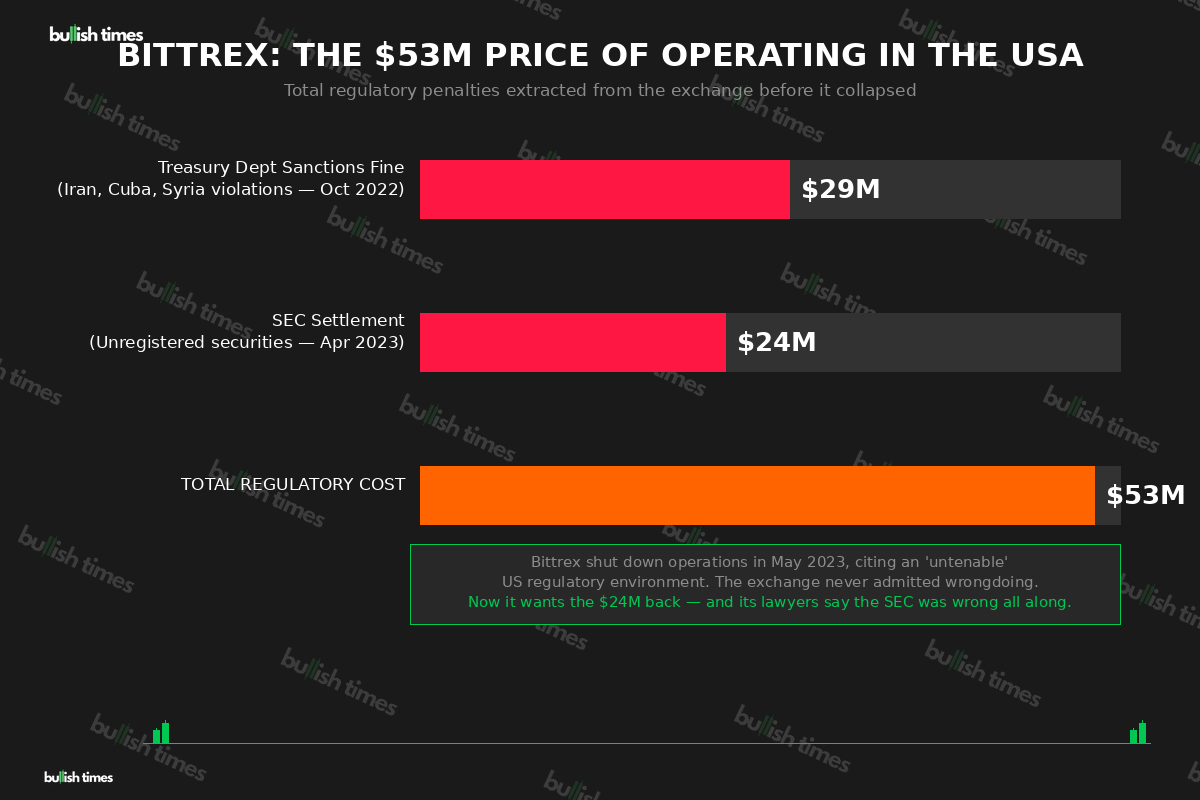
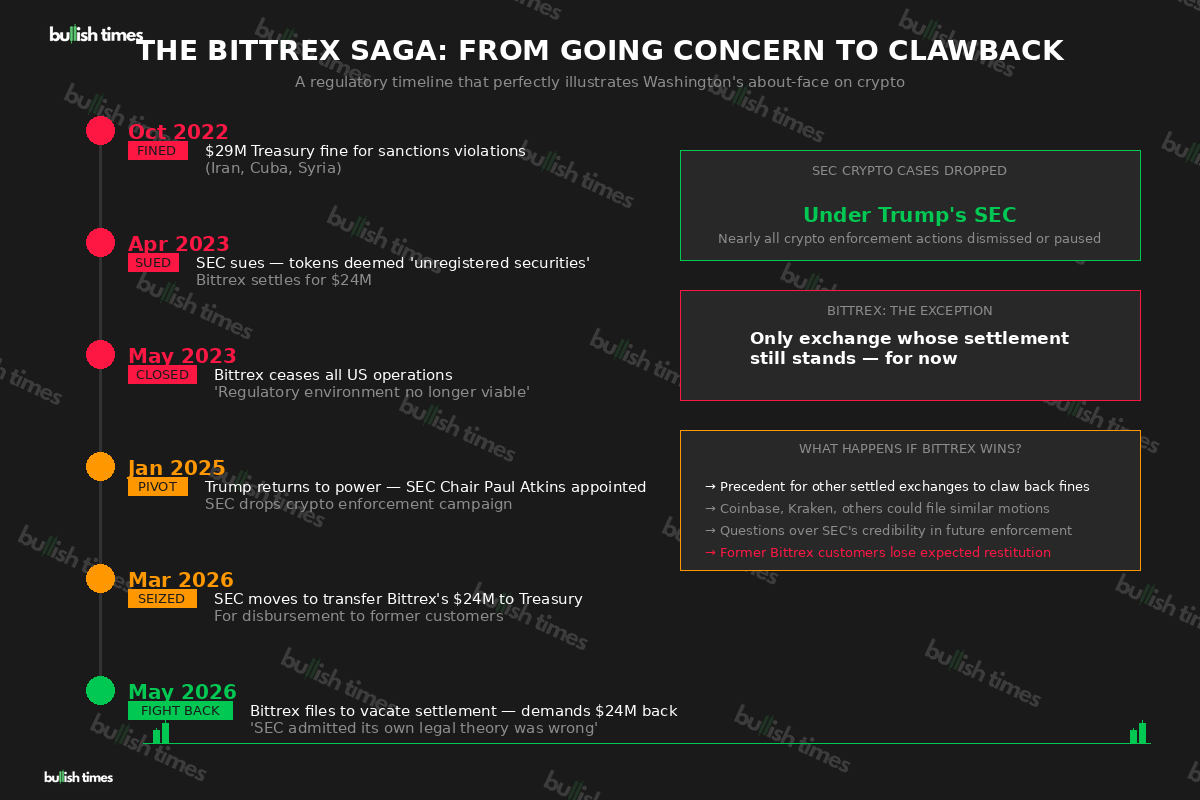
In April 2023, Bittrex — once one of the largest US crypto exchanges — agreed to pay $24 million to settle SEC allegations that it had facilitated the trading of unregistered securities. The exchange, already reeling from a $29 million Treasury Department fine for sanctions violations the previous year, simply could not absorb another blow. Within weeks of signing the settlement, Bittrex announced it was shutting down US operations entirely, blaming what it called an “untenable” regulatory environment.
The total cost of operating as a crypto exchange in America: $53 million in regulatory fines, followed by the death of the business itself.
The Regulator That Changed Its Mind
Since President Donald Trump’s return to the White House in January 2025, the SEC has undergone a dramatic reversal on crypto. Under new Chair Paul Atkins — a longtime crypto advocate — the agency has dropped or paused nearly every major enforcement action it launched during the Biden era, against targets including Coinbase, Kraken, and Uniswap.
Crucially, the SEC has now publicly stated that it does not consider the vast majority of crypto tokens to be securities. That is precisely the legal theory the agency used to sue Bittrex in the first place.
Bittrex’s attorneys are not mincing words about what that means. “Two-and-a-half years after extracting a settlement from a bankrupt cryptocurrency exchange premised on the legal theory that the tokens that traded on the exchange were securities, the SEC has (a) conceded that its legal theory was wrong and those tokens were not securities, (b) acknowledged that its enforcement strategy was misguided from the start, and (c) dropped every similar case and investigation except this one,” the filing reads.
That final clause — “except this one” — is the crux of the argument. Bittrex contends it is being treated unfairly relative to every other exchange the SEC pursued, and that maintaining the settlement in light of the agency’s public reversal is both inequitable and legally untenable.
Timing Is Everything — And It Gets Messier
The motion arrives at a particularly delicate moment. In March 2026, the SEC filed a separate request seeking permission to transfer Bittrex’s $24 million to the US Treasury Department, where it would be distributed as restitution to former Bittrex customers who allegedly suffered financial harm.
Bittrex’s legal team is now urging the judge to halt that transfer process immediately and return the funds to the estate before any disbursement takes place. If the money is sent to customers first, clawing it back becomes significantly more complicated.
The SEC declined to comment on the case.
The situation creates a peculiar tension: the very customers who might argue they were harmed by Bittrex’s alleged misconduct are also the people set to receive restitution — money that Bittrex now says was extracted under a legal theory the government has since abandoned.
The Precedent No One in Washington Wants to Set
If a federal judge agrees with Bittrex, the implications extend far beyond one defunct exchange.
Bittrex would not be alone in having settled with the Biden-era SEC under legal theories the current administration has now repudiated. Other exchanges, token issuers, and protocol teams reached similar agreements — and a favourable ruling for Bittrex could open the floodgates for comparable motions across the industry.
The prospect clearly worries the SEC. A clawback order would represent an embarrassing public acknowledgement that the agency’s aggressive crypto enforcement campaign was not merely misguided in policy terms but legally flawed — flawed enough to justify unwinding concluded settlements and returning tens of millions of dollars.
For the broader industry, however, the case has become something of a litmus test for what the regulatory rollback actually means in practice. It is easy for the SEC to drop pending cases — it simply stops pursuing them. Reversing completed settlements is far harder, and far more consequential.
What Happens Next
The judge must now weigh whether changed legal circumstances constitute sufficient grounds to vacate a settlement that was negotiated and signed by both parties. Bittrex’s argument rests on a legal concept known as relief from a final judgment, which courts grant only in exceptional circumstances.
The timing pressure is real. If the $24 million is disbursed to former customers before the judge rules, the motion becomes moot. Bittrex’s attorneys will almost certainly push for an expedited hearing.
For crypto Twitter, the spectacle of a regulator being asked to literally give the money back — because it admitted it was wrong — is peak 2026 energy. Whether the courts agree is another matter entirely. But the argument is harder to dismiss than the SEC might like.
This case remains before a federal judge. A ruling could arrive in the coming weeks and would set significant precedent for the entire post-Biden crypto enforcement landscape.