Illinois has become the first US state to tax every single cryptocurrency transaction — win, lose, or break even — and if you operate without registering, you face prison time. Welcome to America’s most hostile crypto jurisdiction.
Governor JB Pritzker signed his state’s $55.9 billion budget into law on 16 June, and buried on page 847 of a 1,624-page bill sits the Digital Asset Tax Act (DATA). It imposes a 0.2% “privilege tax” on every digital asset transaction involving an Illinois resident. Not on profits. Not on gains. On the act of trading itself.
What the Tax Actually Does — and Why It’s Unprecedented
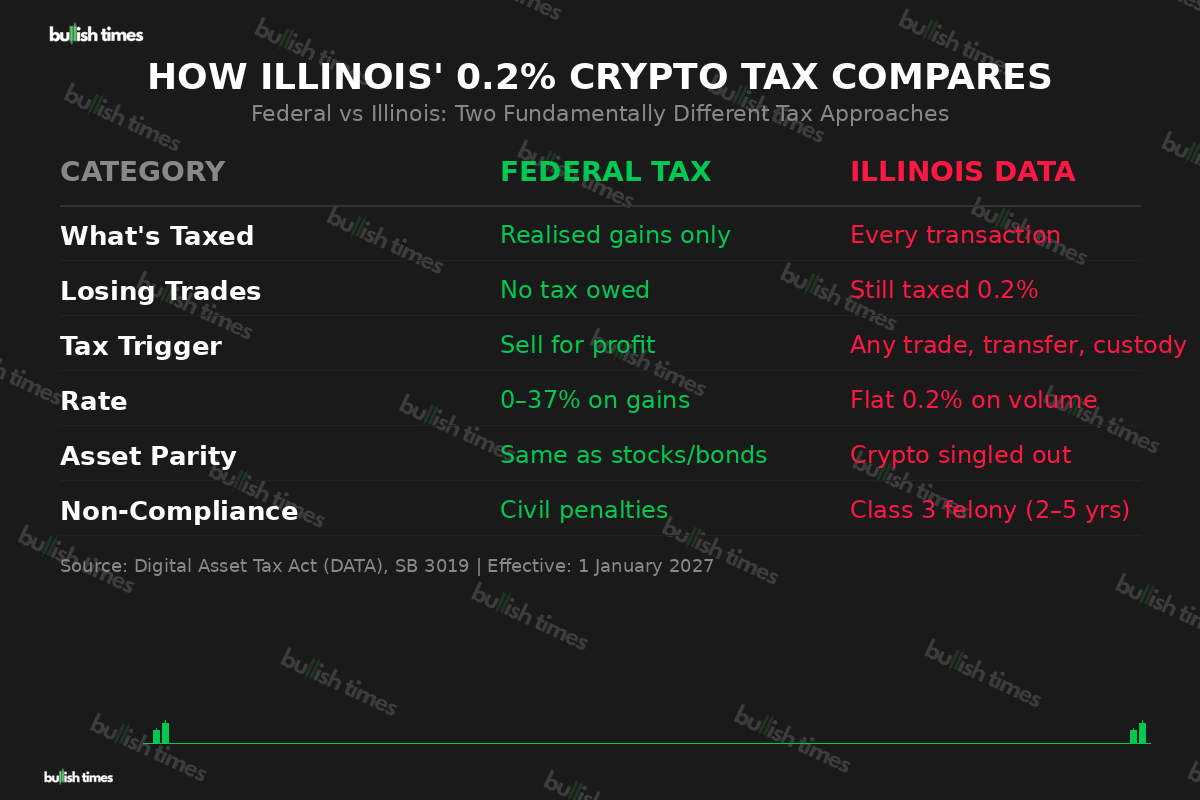
The distinction matters enormously. Federal crypto tax rules — the ones every other state piggybacks on — only trigger when you realise a gain. Sell Bitcoin for more than you paid, you owe capital gains tax. Sell at a loss, you owe nothing. Illinois has torn up that logic entirely.
Under DATA, a trader turning over $100,000 a month owes $200 in state tax every single month, regardless of whether those trades made a penny. An active day trader churning $1 million monthly faces $2,000 in unavoidable overhead — before accounting for exchange fees, spreads, or federal tax obligations.
The tax applies to exchanges, custodians, wallet providers, and any platform facilitating the “exchange, transfer, or storage of digital assets.” Out-of-state brokers aren’t exempt either: any firm generating over $100,000 in annual receipts from Illinois customers must register with the state and collect the levy.
And here’s the kicker: operating without registration is classified as a Class 3 felony, carrying two to five years in prison and fines up to $25,000.
The Industry’s Fury Is Unanimous — and Specific
The Crypto Council for Innovation (CCI) and the Digital Chamber both urged Pritzker to veto the provision before signing. Their joint letter described DATA as “an unprecedented framework that unfairly targets crypto users” based on the technology they use rather than any income they earn.
The Illinois Blockchain Association went further, calling the legislation “substantively unsound, procedurally deficient, and economically destructive.” Their core complaint: the provision was slipped into a mammoth budget bill with no dedicated hearings, no formal industry consultation, and no standalone legislative scrutiny.
Renato Mariotti, a former federal prosecutor turned prominent crypto legal commentator, highlighted the constitutional vulnerability: “Singling out one asset class for a unique transaction tax that doesn’t apply to stocks, bonds, or commodities creates obvious equal protection and Commerce Clause challenges.”
Miles Jennings, head of crypto legal at a16z, was blunter, warning that Illinois had just given every crypto company in the state “a concrete, calculable reason to relocate to literally any other state.”
The Bigger Picture: A State Tax War Is Brewing
Illinois didn’t act in a vacuum. The state enacted DACPA (Digital Assets and Consumer Protection Act) in August 2025, establishing a regulatory framework with consumer protections. DATA, arriving just months later, transforms that regulatory posture from “oversight” to “extraction.”
The $60 million in projected annual revenue represents barely 0.1% of the state’s $55.9 billion budget. Critics argue it’s not even about the money — it’s about setting a precedent.
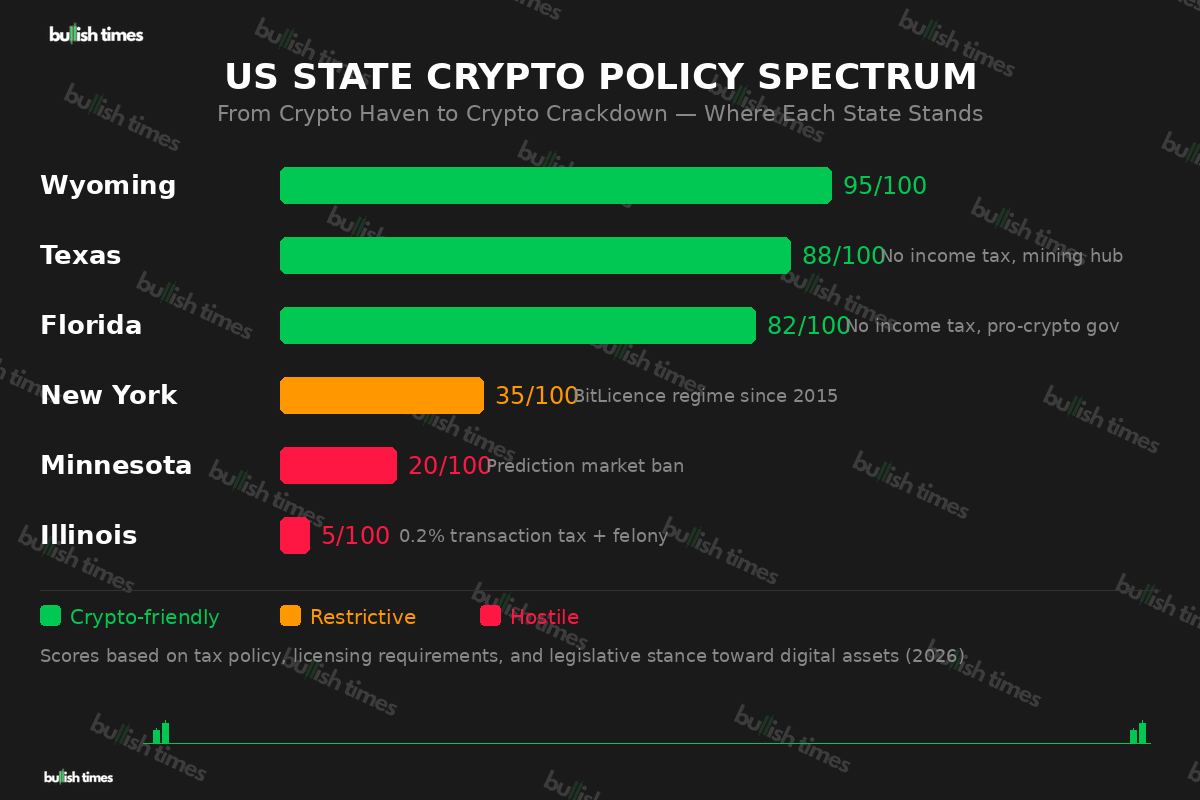
And that precedent terrifies the industry. If Illinois successfully collects without visible fallout, budget-strapped states across the country will take notice. The counter-examples, however, are stark: Wyoming has built an entire crypto economy on zero income tax and DAO-friendly legislation. Texas and Florida compete aggressively for mining operations and exchange headquarters. Even New York’s infamous BitLicence regime doesn’t impose a per-transaction levy.
The Constitutional Challenge Is Coming — and Illinois Knows It
Legal experts are already mapping the attack vectors. The Commerce Clause argument is straightforward: by imposing a unique tax on digital assets that doesn’t apply to equivalent transactions in stocks or commodities, Illinois may be discriminating against interstate commerce. The equal protection argument runs parallel: why should a Bitcoin trade bear a 0.2% levy when an identical-value stock trade does not?
The legislative process itself may prove vulnerable. Burying a novel tax framework inside a budget omnibus — bypassing committee hearings, expert testimony, and public comment — doesn’t exactly scream democratic legitimacy.
Industry groups are reportedly coordinating a multi-pronged legal challenge, with constitutional claims likely to be filed before the 1 January 2027 effective date. The Digital Chamber has already described the law as “procedurally deficient” — language that reads less like a press release and more like a preview of a court filing.
Meanwhile, crypto companies with Illinois operations are running the maths. For a mid-size exchange processing $500 million monthly in Illinois-resident volume, DATA represents $1 million per month in additional costs — costs that either compress margins or get passed to users via higher fees, making Illinois platforms less competitive than competitors operating from friendlier jurisdictions.
The message from Springfield is unmistakable: Illinois sees crypto not as an industry to nurture, but as a revenue stream to tap. Whether the courts — or the market — let them get away with it is the $60 million question.
This is a developing story. Constitutional challenges are expected before the 1 January 2027 effective date. Bullish Times will continue to track industry responses and legal developments.