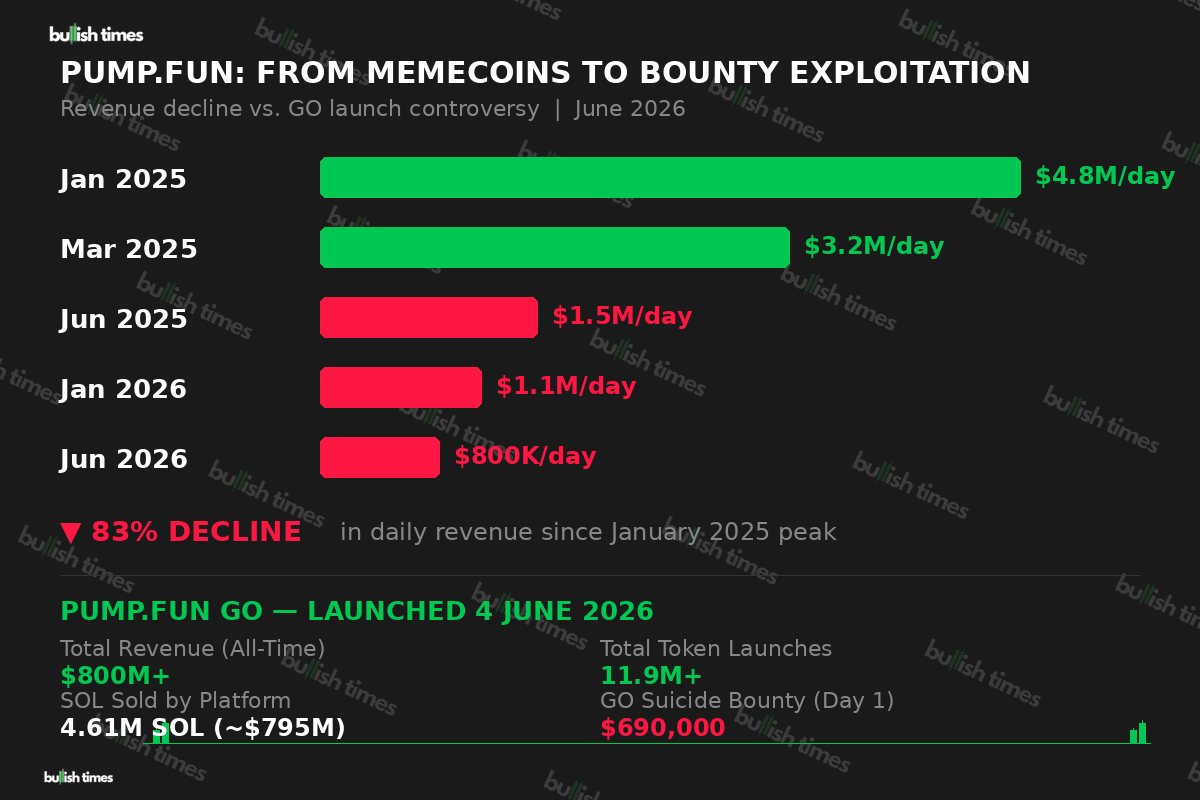
A Solana startup with $800 million in lifetime revenue just launched a feature that lets anyone pay anyone to do anything — and on day one, someone posted a $690,000 bounty for a filmed suicide. Welcome to the future of decentralised labour.
Pump.fun, the memecoin launchpad that turned Solana into the world’s busiest token casino, has pivoted into something far darker. Its new “GO” feature, launched on 4 June, is a crypto-native bounty marketplace with a tagline that reads like a dystopian pitch deck: “Pay ANYONE to do ANYTHING.”
Two weeks in, the results are exactly what you’d expect — and exactly what Pump.fun’s founders should have anticipated.
From Memecoins to Human Exploitation
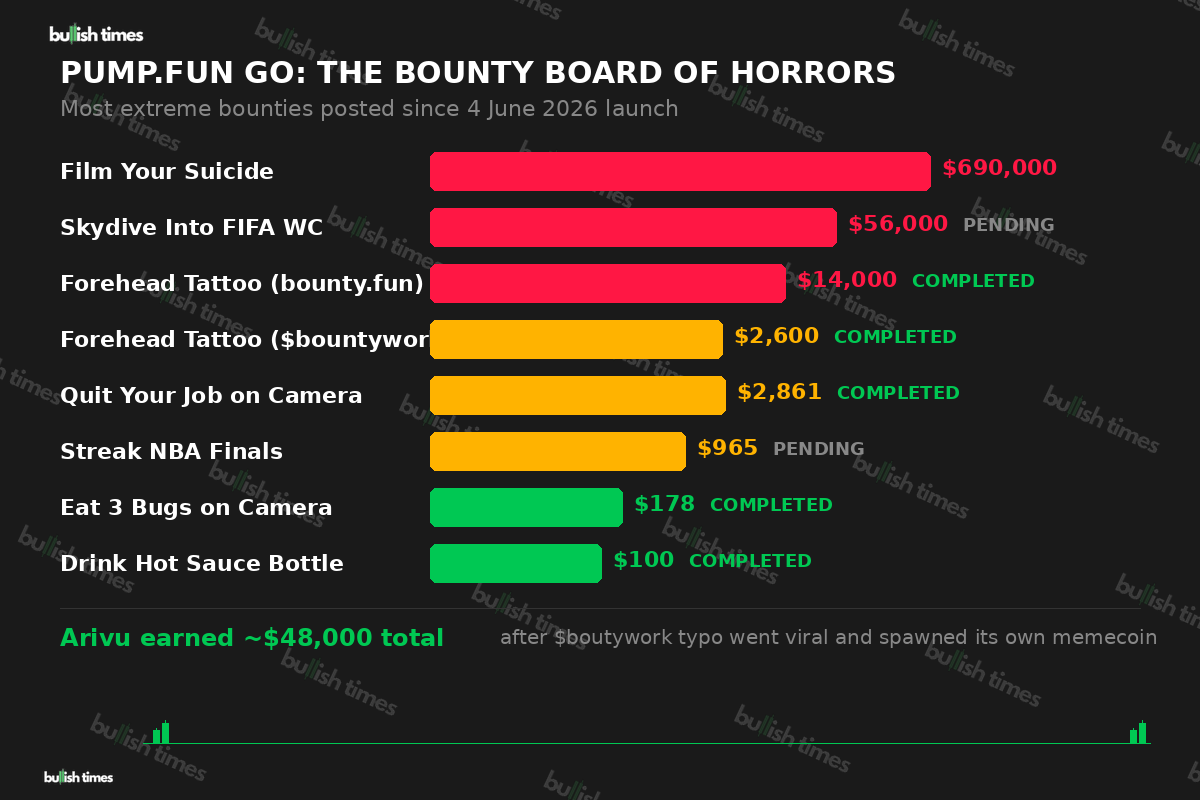
The mechanics are simple. Post a task, attach a crypto reward held in escrow, wait for someone desperate enough to complete it. On day one, a user offered 10,000 SOL — roughly $690,000 at the time — to anyone who would film their own suicide. The listing has since been removed, but the fact that it existed at all tells you everything about the platform’s “reactive moderation” approach.
Things escalated quickly from there. A 21-year-old from Florida named Ayush posted a 40 SOL bounty (~$2,600) for someone to permanently tattoo “$bountywork” across their forehead — a promotional stunt for a memecoin he’d created. An Indian man known as Arivu walked into a beachside tattoo parlour in Chennai and obliged.
There was a catch. Ayush had misspelled “bountywork” as “boutywork” in the task description. Arivu followed the instructions to the letter. Ayush refused to pay, arguing the misspelled tattoo wouldn’t promote his coin. Arivu returned the next day to have the letter “n” added. He was eventually paid.
“I was certain someone from a third world country would do it,” Ayush told CNN, with the quiet confidence of someone who has never once considered whether he should.
The Bounty Board of Horrors
Arivu’s story is the one that went viral, but the broader bounty landscape is far more disturbing. Beyond the removed suicide bounty, users have posted $56,000 to skydive into a FIFA World Cup match, $14,000 for another forehead tattoo reading “bounty.fun,” $2,861 to quit your job on camera, and $965 to streak an NBA Finals game.
A man in Toronto — using the pseudonym “Jordan” — got a crypto casino advertisement tattooed on his leg for $3,000. “I’m struggling financially and my girlfriend is a tattoo artist, so it was a little easier for me,” he told CNN, before adding that he plans to have it covered up.
The philosophical dimension is hard to ignore. Nicholas Vrousalis, a philosophy professor at Erasmus University Rotterdam who literally wrote the book on exploitation, put it bluntly: “The greater the precarity and vulnerability of a given population, the higher the predatory instincts there are towards them.”
Arivu ultimately earned approximately $48,000 in total — the original bounty plus revenue from a viral “$boutywork” memecoin spawned by the typo incident. By Indian income standards, that’s transformational. But the mechanism that delivered it — convincing a man in a country where labourers earn less than $10 per day to permanently disfigure his face — is the definition of extractive.
A Startup Running Out of Tricks
Context matters here. Pump.fun isn’t launching GO from a position of strength. The platform’s daily revenue has cratered from $4.8 million at its January 2025 peak to roughly $800,000 now — an 83% decline. The memecoin frenzy that made its founders rich (the platform has sold approximately 4.61 million SOL worth ~$795 million in total) has faded.
This isn’t Pump.fun’s first controversy rodeo, either. Its previous livestreaming feature “became notorious for incentivising increasingly extreme behaviour, including threats of self-harm, violence, animal abuse, and other shock content,” as K33 Research head Vetle Lunde noted. That feature was suspended and relaunched with moderation policies. The fact that GO launched with functionally no proactive moderation suggests the founders have learnt nothing — or simply don’t care.
Co-founder Alon Cohen did not respond to multiple media requests for comment. His lawyer, Stephen D. Palley, told CNN “I’m not able to talk” and hung up. The platform’s terms of service grant it “final say” over bounty approvals whilst simultaneously disclaiming any liability for labour or tax law violations. It’s the corporate equivalent of lighting a fire and insisting you’re not responsible because you posted a “No Fires” sign.
Black Mirror Was Supposed to Be Fiction
The comparisons to Black Mirror are everywhere, and they’re earned. Season 7’s “Common People” depicted a man forced to perform humiliating tasks on a streaming platform to fund his wife’s medical bills. Pump.fun GO has made that fiction operational — and monetised it on-chain.
New York Governor Kathy Hochul responded by posting on X: “Offering a bounty on the first bill introduced to ban this dystopian nightmare.” Her office confirmed the administration is exploring state-level legislation to restrict the platform. Nikita Bier, head of product at X, was more cutting: “It’s sad that all the rich people left crypto and it’s now the entire industry is just teenagers in America forcing poor people to do shameful things.”
There are, admittedly, some positive bounties on the platform — community food drives, random acts of kindness, a $15,865 bounty to organise an anti-work rally in New York. But these generate a fraction of the engagement of the exploitative ones, which is precisely the incentive structure that makes GO dangerous. The attention economy rewards cruelty. Pump.fun just made it programmable.
The broader memecoin market has shed $110 billion from its 2024 peak. Pump.fun’s revenue is in freefall. And its response is to build a global marketplace for exploitation dressed up as “decentralised human coordination.” Three British founders in their early twenties have created the infrastructure for a system where a teenager in Florida can convince a man in Chennai to tattoo an advertisement on his face for the price of a used car.
This is a developing story. At the time of publication, Pump.fun had not responded to requests for comment. New York state legislation targeting the platform is expected to be introduced in the coming weeks.