A long-time Bitcoin developer has just proposed the most audacious — and arguably sacrilegious — move in the network’s 17-year history: fork Bitcoin, steal Satoshi Nakamoto’s coins, and hand them to wealthy investors. The community is calling it digital grave robbery.
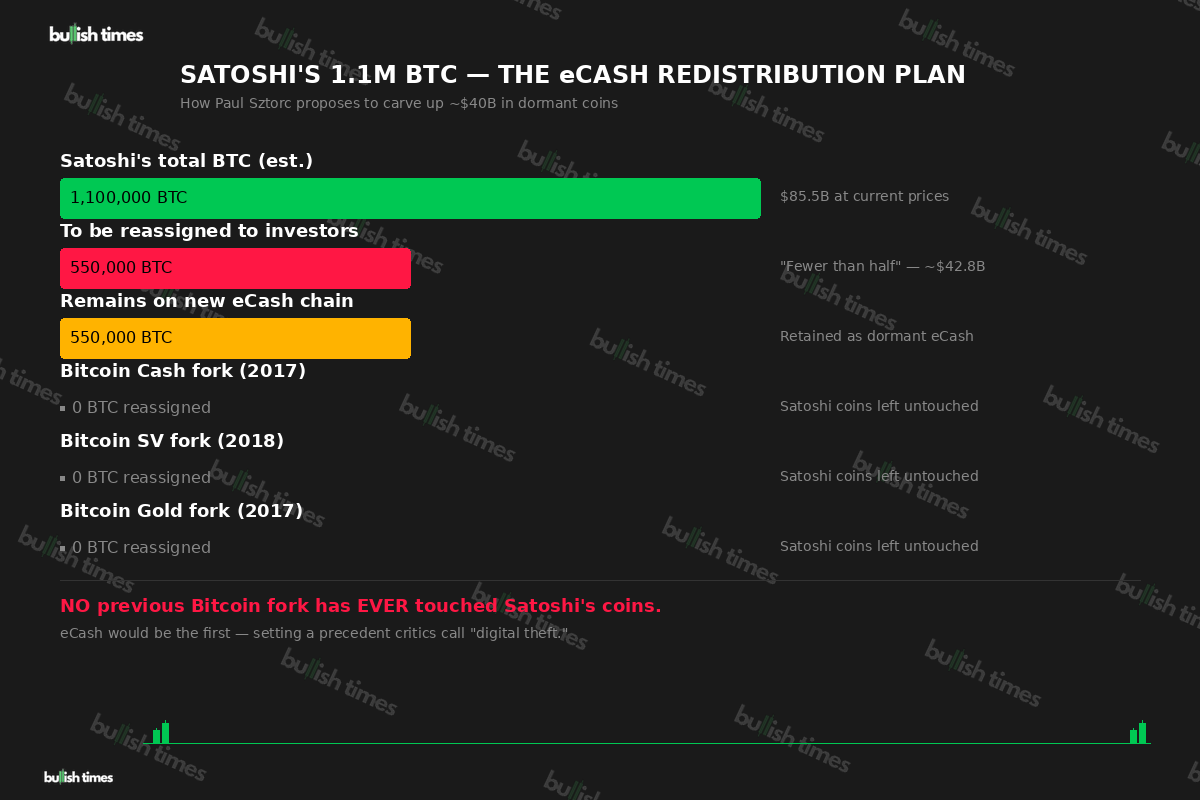
Paul Sztorc, creator of the Drivechain scaling proposal and a fixture in Bitcoin development circles since 2015, announced on 24 April that he intends to hard fork Bitcoin into a new chain called eCash at block height 964,000 — expected in August 2026. Every BTC holder would receive an equivalent amount of eCash tokens on the new chain. But buried in the fine print is a clause that has set Crypto Twitter ablaze: Sztorc plans to manually reassign up to half of Satoshi Nakamoto’s estimated 1.1 million dormant BTC — worth roughly $40 billion at current prices — to “accredited investors” before the fork goes live.
The Drivechain Grudge Match
Sztorc has been pushing his Drivechain architecture — formally submitted as BIP300 and BIP301 — for nearly a decade. The concept is straightforward: create merge-mined sidechains tethered to Bitcoin’s main chain, allowing developers to build new features (privacy, smart contracts, prediction markets) without altering Bitcoin’s base layer. Think of it as service roads branching off the motorway — same security, more flexibility.
Seven Drivechains are already in development, including a privacy-focused chain modelled on Zcash, a decentralised exchange called CoinShift, a prediction market dubbed Truthcoin, and a quantum-resistant chain called Photon. The technology itself is not particularly controversial. What is controversial is that Bitcoin Core maintainers have refused to merge the code for years, citing potential security risks and philosophical objections.
“Back in 2017, the Bitcoin tech stack was strong, and expectations for Lightning were strong,” Sztorc wrote on X. “Today is the reverse.” Frustrated by nearly a decade of rejection, he has decided to go it alone.
The Sacrilege: Raiding Satoshi’s Wallet
Here is where the proposal goes from “ambitious developer project” to “burn-it-all-down controversy.” Sztorc wants to use coins that would correspond to Satoshi’s addresses on the new eCash chain to fund development and attract early investors. “This will no doubt be a controversial decision,” he wrote, “but I think it is necessary, and in fact, ideal.”
The mechanism works like this: when Bitcoin forks, the entire transaction history carries over. Every balance — including Satoshi’s untouched 1.1 million BTC — appears as an equivalent eCash balance. Sztorc proposes manually reassigning “fewer than half” of those Satoshi-equivalent coins to high-quality, accredited investors before the fork launches.
The crypto community’s response has been swift and brutal. Bitcoin podcaster Peter McCormack called the proposal “theft and disrespectful,” adding that the eCash name is already used in the Lightning-adjacent payments space with Cashu and Fedi. Josh Ellithorpe, CTO of Pixelated Ink, warned of the dangerous precedent: “eCash, setting the precedent that they can and will steal coins. Now it’s Satoshi, but it could be anyone later.”
The criticism cuts to the heart of Bitcoin’s founding mythology. In 2009, Satoshi mined alongside everyone else — same hardware, same difficulty, same opportunity. There was no presale, no venture capital, no insider allocation. Sztorc’s proposal flips that origin story on its head, introducing the very class of privileged access that Bitcoin was designed to eliminate.
Breaking the Sacred Rule
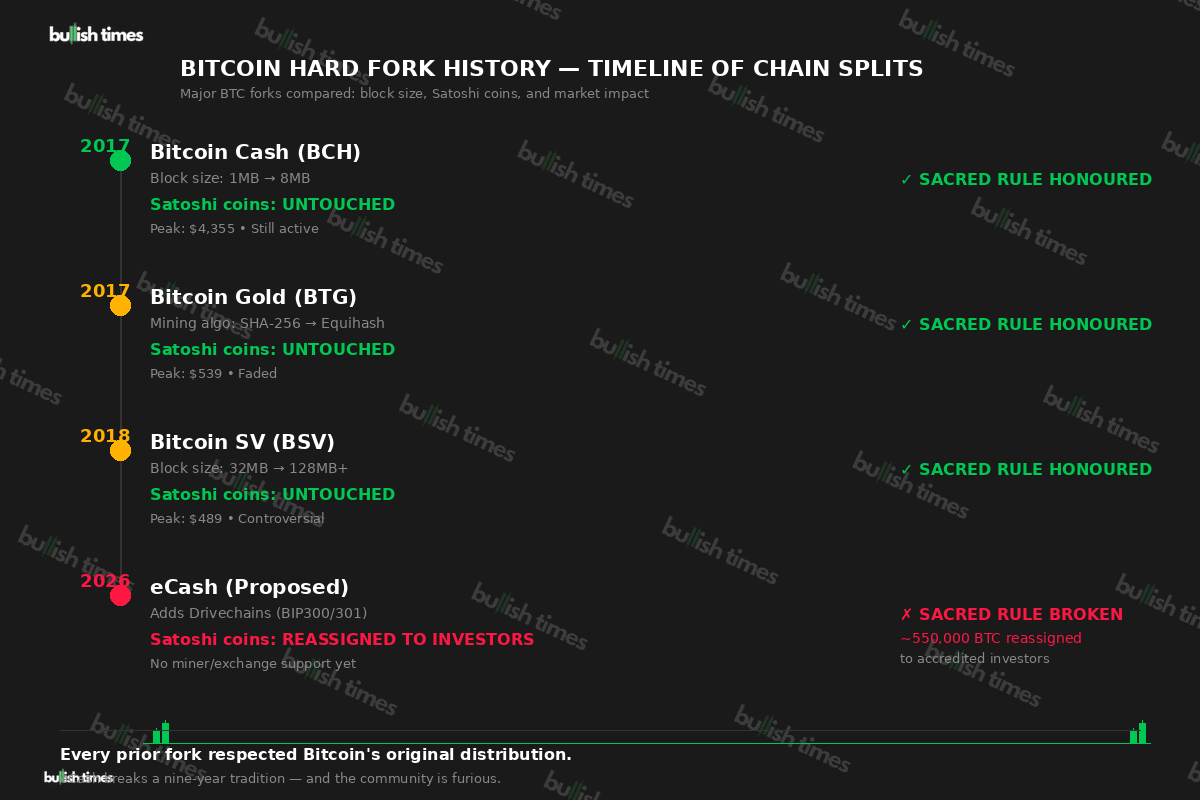
What makes this proposal so inflammatory is context. Bitcoin has been forked before — Bitcoin Cash in 2017, Bitcoin SV in 2018, Bitcoin Gold in 2017. Not one of those forks dared to touch Satoshi’s coins. The “Patoshi pattern” addresses, widely attributed to Bitcoin’s pseudonymous creator, have sat untouched since 2010. In the Bitcoin world, those coins are treated as something between a memorial and a founding artefact. Redistributing them — even on a forked chain — feels to many like desecrating a monument.
The questions pile up fast. Who are these “accredited investors”? What is the deal structure? Over what vesting period will the coins be released? What stops them from dumping en masse the moment the fork goes live? Sztorc has not provided answers to any of these, and critics argue the opacity itself is the problem.
Dead on Arrival — or Just Getting Started?
The practical reality is sobering. No miners, exchanges, or major ecosystem participants have signalled support for eCash. Without hash power, a Bitcoin fork is functionally dead. Without exchange listings, the tokens are worthless. And without community buy-in, Drivechains remain exactly what they have been for nine years: an interesting idea that nobody wants to implement.
Sztorc has since posted a second version of the proposal that reportedly does not involve Satoshi’s coins, though the final structure remains unconfirmed. Whether this was a strategic retreat or the plan all along is unclear. Some observers on X have speculated the Satoshi clause was deliberate rage-bait designed to generate attention for the fork — and on that metric alone, it has succeeded spectacularly.
But attention is not adoption. Bitcoin’s fork history suggests eCash faces near-impossible odds. Bitcoin Cash, the most successful fork by far, peaked at $4,355 and commanded serious mining support. It still trades at a fraction of Bitcoin’s price. Every subsequent fork has faded into irrelevance. The market has spoken repeatedly: there is one Bitcoin, and forks are footnotes.
The deeper question is whether Sztorc’s frustration reveals something genuine about Bitcoin’s ossification. If a credible developer spends nine years proposing improvements and gets nowhere, is the problem the proposal — or the process? Bitcoin maximalists will say the system is working as designed: conservative, resistant to change, incorruptible. Critics will say it is calcifying, unable to evolve, and losing ground to chains that ship faster.
Either way, raiding Satoshi’s wallet is not the answer. Some lines, even in crypto, should not be crossed.
This is a developing story. Bullish Times will update as the eCash fork proposal evolves and community responses continue to roll in.