The United States federal government is now suing its own states to protect your right to bet on anything from Super Bowl winners to presidential elections — and the crypto industry is cheering from the sidelines.
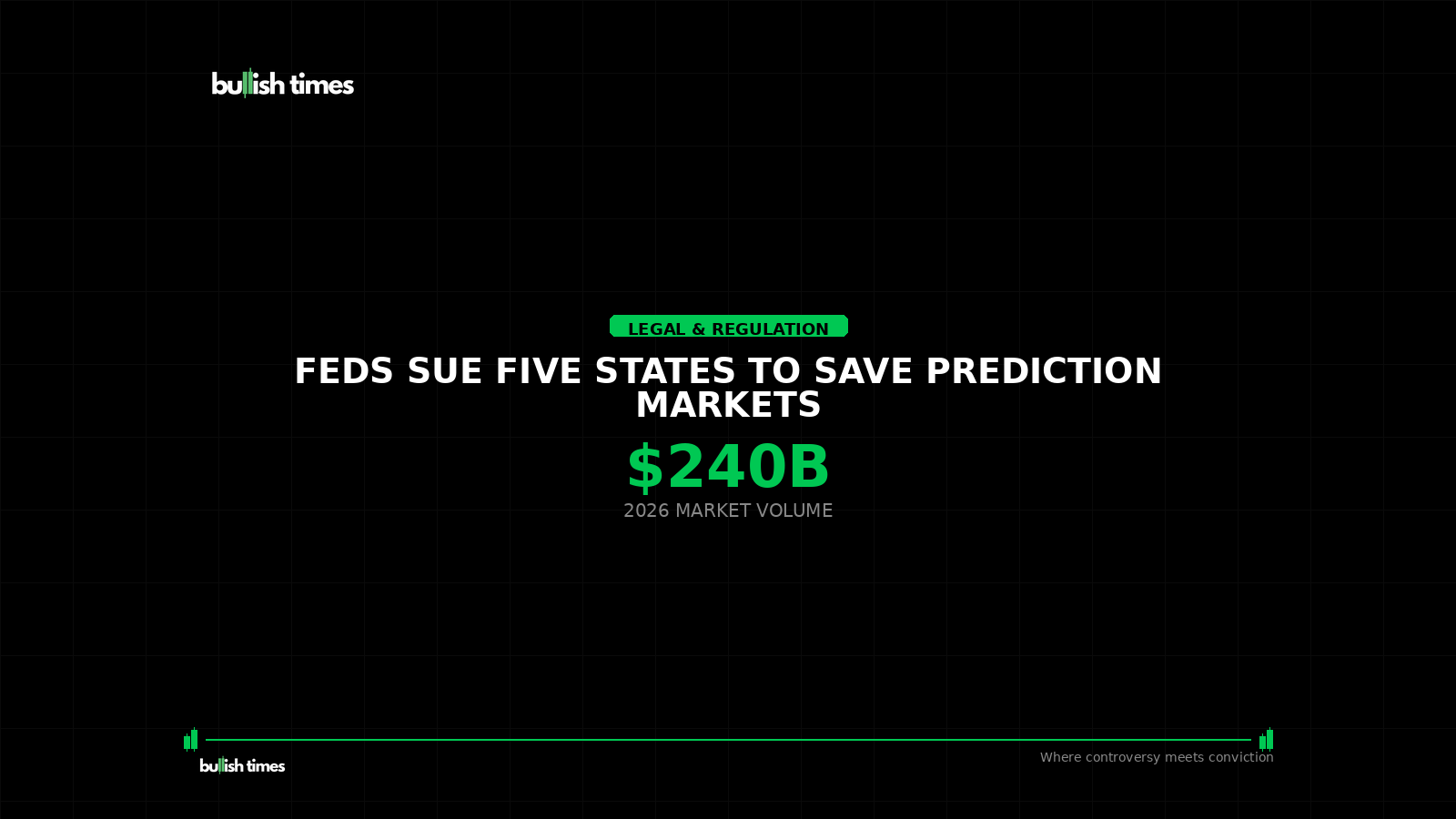
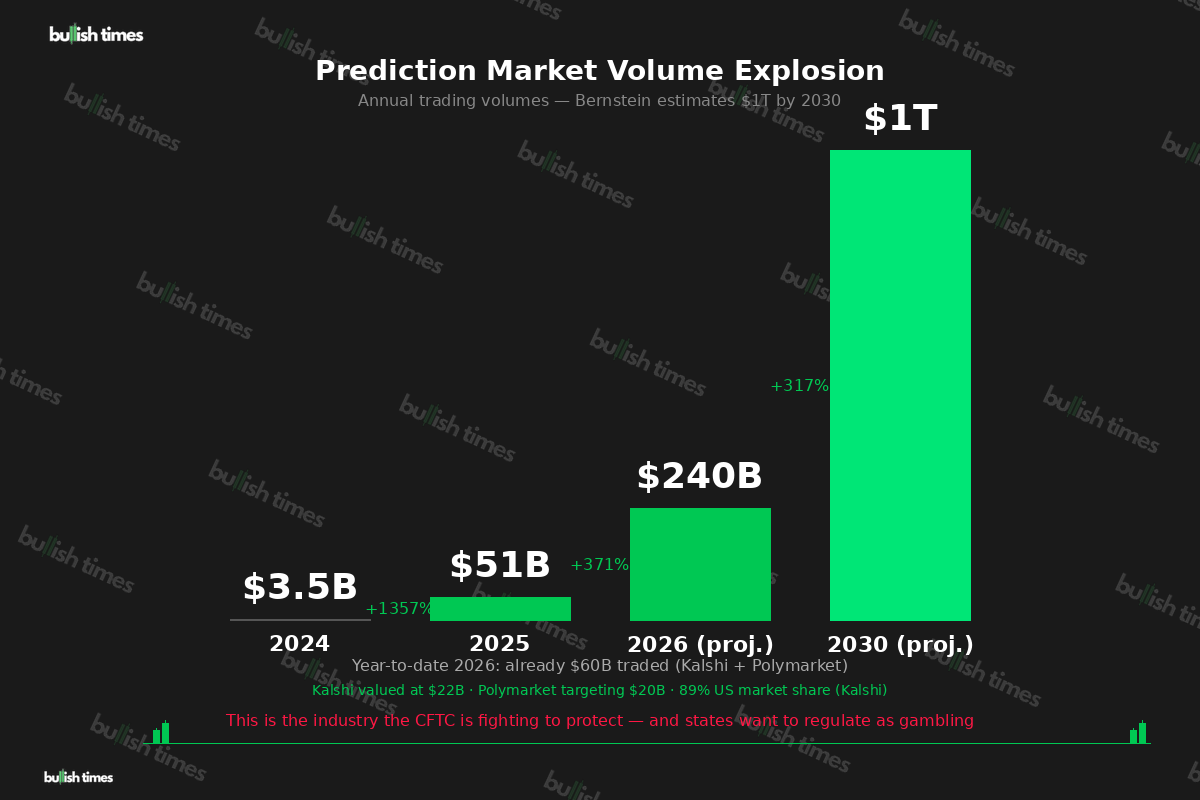
In the space of just three weeks, the Commodity Futures Trading Commission has filed lawsuits against five US states, triggering what may become the most consequential jurisdictional battle in the history of prediction markets. At stake: a $240 billion industry that states say is illegal gambling, and that Washington insists is a federally regulated financial market.
The CFTC Goes to War
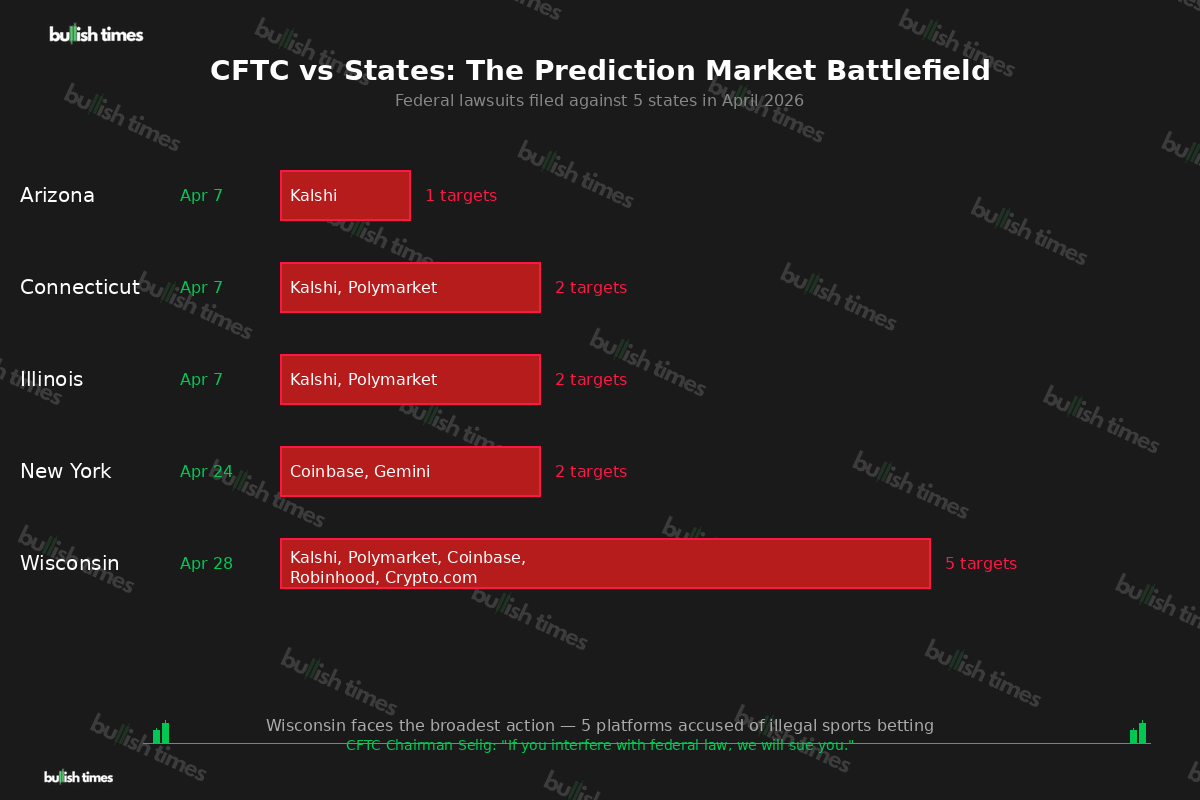
On 28 April 2026, the CFTC — backed by the US Department of Justice — filed suit against Wisconsin in the Eastern District of Wisconsin. The state’s crime? Suing five prediction market platforms: Kalshi, Polymarket, Crypto.com, Robinhood, and Coinbase. Wisconsin Attorney General Josh Kaul had filed three separate civil lawsuits just days earlier, accusing the platforms of running illegal sports betting operations in violation of state law.
Wisconsin was not alone. It became the fifth state to face a federal lawsuit, following Arizona, Connecticut, Illinois, and New York — all sued in April 2026 alone. Chairman Michael Selig, the sole sitting member of what is supposed to be a five-person commission, has made his position crystal clear.
“States cannot circumvent the clear directive of Congress,” Selig declared. “Our message to Wisconsin is the same as to New York, Arizona, and others: if you interfere with the operation of federal law in regulating financial markets, we will sue you.”
Gambling or Finance? The $240 Billion Question
The core dispute is deceptively simple: are prediction markets gambling, or are they federally regulated derivatives?
States like Wisconsin argue the answer is obvious. Under Wisconsin law, only tribal casinos — operating under formal compacts with the state government — can offer sports betting. Oneida Nation Chairman Tehassi Hill put it bluntly: “There’s a very large disparity between what tribes face and have to do to have regulated gambling in the state of Wisconsin, as opposed to what these prediction markets are putting forth.”
Governor Tony Evers signed legislation requiring online sports betting servers to sit on tribal land. Prediction market platforms, naturally, do not meet that condition. From Wisconsin’s perspective, Kalshi letting residents bet on NFL games is no different from an unlicensed casino operating out of a server farm in Virginia.
The CFTC sees it differently. The agency argues that event contracts — where users trade on the outcomes of real-world events — are derivatives, not wagers. They are traded on regulated exchanges, not between two people making a bet. And under the Commodity Exchange Act, only the CFTC has jurisdiction over derivatives markets.
“Unlawful conduct doesn’t suddenly become permissible just because you call it something different,” Wisconsin AG Kaul fired back.
A One-Man Commission With a Sledgehammer
Perhaps the most extraordinary element of this saga is who is wielding federal power. Michael Selig is operating as the sole commissioner of an agency designed to have five. Sworn in as the 16th CFTC Chairman on 22 December 2025, he has transformed the traditionally cautious regulator into an aggressive enforcer — but only in one direction.
Rather than policing market abuse or protecting consumers from dodgy prediction market operators, Selig has devoted his tenure to suing states that attempt their own enforcement. In Arizona, a federal court has already issued a temporary restraining order blocking the state’s criminal prosecution of Kalshi. The CFTC has also filed amicus briefs in Massachusetts and the Ninth Circuit Court of Appeals.
Coinbase’s head of legal, Ryan VanGrack, was ebullient: “By moving to block state encroachment, the commission has sent an unmistakable signal: the era of jurisdictional ambiguity is over. Federal law is not a suggestion — it is the exclusive authority governing these markets.”
But critics see something darker: a single, unconfirmed political appointee steamrolling state consumer protections to benefit a handful of well-connected tech companies. Kalshi is valued at $22 billion. Polymarket is targeting a $20 billion valuation. These are not scrappy startups — they are venture-capital-backed behemoths with armies of lobbyists and lawyers.
What Happens Next
The legal battle is far from settled. Kaul says he has the backing of attorneys general from multiple states and both political parties — a bipartisan coalition that views the CFTC’s actions as federal overreach. New York Attorney General Letitia James has been equally defiant, accusing the administration of “prioritising big corporations over consumers.”
The Arizona case may prove decisive. If the federal court ultimately rules that the Commodity Exchange Act pre-empts state gambling laws, it would effectively strip every state of the power to regulate prediction markets. That ruling would hand the CFTC — and its one-man leadership — total control over a trillion-dollar industry with virtually no congressional oversight.
Meanwhile, the industry is not waiting for legal clarity. Hyperliquid announced this week that it is preparing to launch its own prediction market product, and Robinhood has been aggressively expanding its event-contract offerings. The prediction market sector recorded $60 billion in trading volume in the first four months of 2026 alone — already exceeding the entire 2025 total of $51 billion.
For tribal gaming communities, the stakes are existential. Their exclusive compacts with state governments — hard-won through decades of negotiation — could be rendered meaningless if any tech company with a CFTC licence can offer sports betting nationwide.
For crypto believers, this is vindication: the federal government is fighting to protect decentralised finance from state overreach. For everyone else, it is a cautionary tale about what happens when regulatory power concentrates in the hands of one person, defending an industry that has mastered the art of calling a bet a derivative.
This is a developing story. The Wisconsin case is pending in the US District Court for the Eastern District of Wisconsin. Bullish Times will continue to track the legal proceedings.