Sam Altman built OpenAI into the most talked-about company on Earth. But his other venture — Worldcoin — is looking increasingly like the scandal that could define his legacy for all the wrong reasons.
On Monday, crypto’s most prolific on-chain investigator ZachXBT took aim at Worldcoin’s $WLD token in a thread that immediately went viral. His verdict was brutal: a “predatory low-float” structure “on par with SBF / FTX companies.” Hours later, Elon Musk — already locked in a bitter legal war with Altman over OpenAI — amplified the attack by branding his former co-founder “Scam Altman” to his 200 million followers.
The ZachXBT Dossier: FTX Parallels and Predatory Tokenomics
ZachXBT’s allegations are not vague hand-waving. The pseudonymous investigator — an advisor to Paradigm and widely regarded as crypto’s most effective fraud detective — laid out a systematic case against Worldcoin’s token model.
At its core, Worldcoin launched $WLD with a deliberately low circulating supply, a tactic that inflates early price action and creates the illusion of value before insiders begin offloading through over-the-counter (OTC) deals. ZachXBT had flagged the same pattern back in July 2024, calling WLD “the biggest scam token of the bull run” and accusing the team and its venture capital backers of complicity in price manipulation.
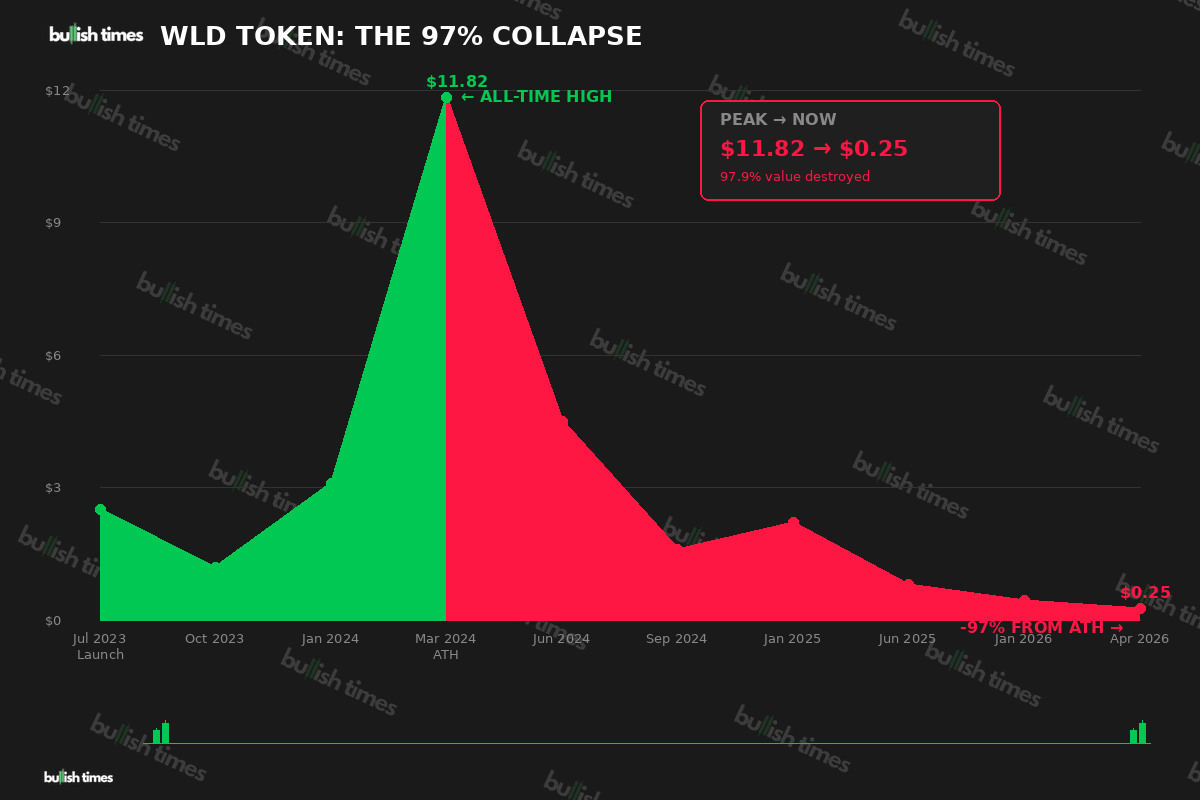
The numbers are damning. $WLD peaked at $11.82 in March 2024, riding a wave of AI hype and low-float mania. Since then, it has collapsed by over 97%, now trading around $0.25 — flirting with all-time lows. Heavy token unlocks, unsustainable inflation, and reported insider OTC sales have compounded the sell pressure, leaving retail holders devastated.
Iris Scans for Pennies: The Exploitation Machine
Worldcoin’s pitch was seductive: prove you’re human in an age of AI bots by scanning your iris with a silver orb, and receive free crypto in return. The project, rebranded simply as “World,” positioned itself as a public utility for the AI era.
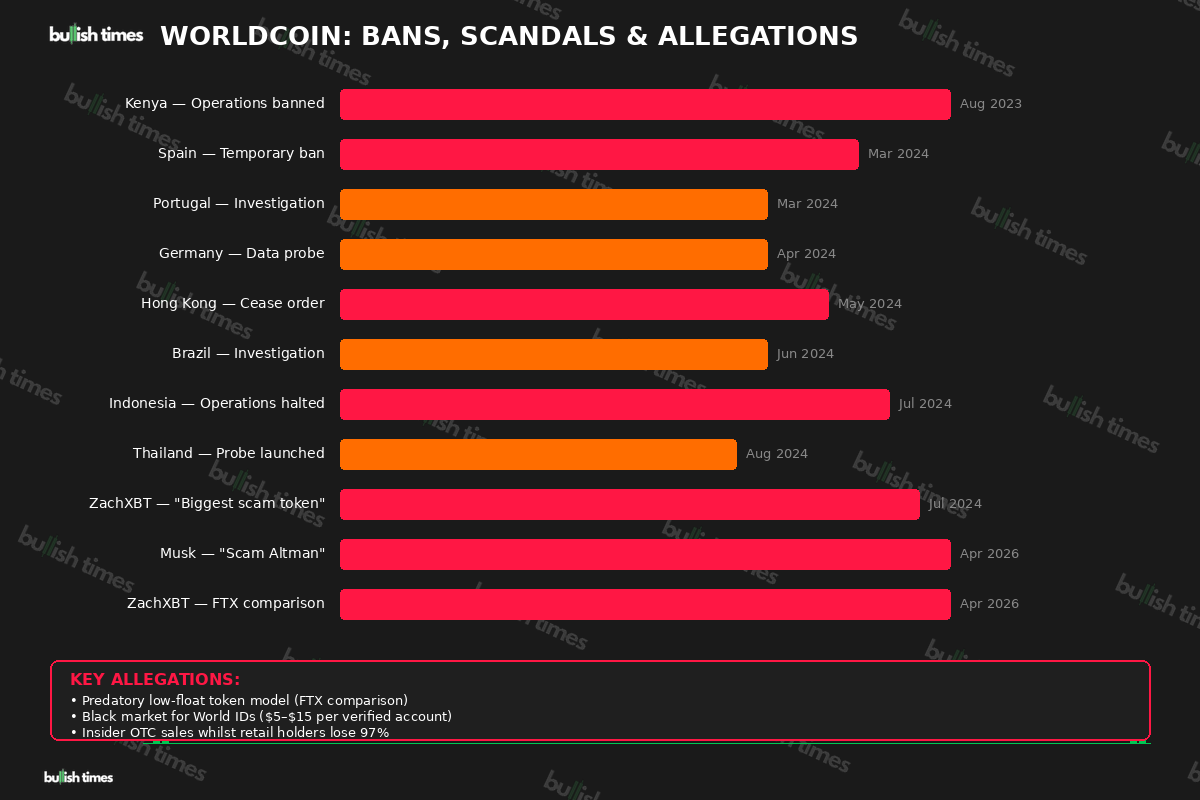
The reality has been considerably darker. Worldcoin aggressively targeted residents of lower-income countries — Kenya, Indonesia, Thailand, and across Sub-Saharan Africa — offering modest amounts of WLD in exchange for irreversible biometric data. Reports emerged of AirPods being given away to boost sign-ups, often targeting young or economically vulnerable participants with incomplete explanations of what they were consenting to.
Perhaps most damningly, the project spawned a thriving black market for verified World IDs. Accounts were reportedly trading for as little as $5 to $15 — a grim irony for a system designed to prove unique human identity. The very infrastructure meant to combat fraud became a marketplace for it.
Eight Countries, One Verdict: Ban It
Regulators have not been kind. Kenya became the first country to ban Worldcoin operations in August 2023, citing data security concerns. Spain followed with a temporary ban in March 2024. Since then, Portugal, Germany, Hong Kong, Brazil, Indonesia, and Thailand have all launched investigations or issued cease-and-desist orders.
The common thread across every jurisdiction is the same: biometric data was collected from vulnerable populations without adequate consent, transparency, or safeguards. Several regulators have ordered the deletion of collected iris-scan data — a particularly awkward demand given that Worldcoin’s entire value proposition rests on that very dataset.
Musk’s Vendetta — Or Legitimate Concern?
Elon Musk’s “Scam Altman” jab arrived in response to Ronan Farrow’s explosive 18-month New Yorker investigation into Altman’s leadership. The report drew on internal documents including Ilya Sutskever’s 70-page memos — which opened with “Sam exhibits a consistent pattern of” and listed “Lying” first — and Dario Amodei’s notes alleging systematic deception of executives on safety matters.
One particularly damaging anecdote: when Amodei presented safety demands for a roughly $1 billion Microsoft investment in 2019, Altman agreed — then quietly added a provision giving Microsoft the power to block mergers, directly contradicting OpenAI’s charter. When confronted, Altman initially denied the provision existed until Amodei read it aloud. Amodei called it an “80% betrayal” of the charter. He and his sister Daniela left to found Anthropic shortly after.
Musk’s motivations are hardly pure — he is suing OpenAI and has his own AI venture, xAI, to promote. But ZachXBT’s involvement strips away the personal vendetta narrative. The on-chain investigator has no horse in the Musk-Altman race; his track record of exposing rug pulls, hacks, and insider fraud speaks for itself. When ZachXBT draws FTX parallels, the crypto community listens.
What Happens Next
Worldcoin now faces a perfect storm: a 97% token collapse, bans in eight countries, a thriving black market for its core product, and crypto’s most respected detective publicly comparing it to FTX. The Musk-Altman trial, scheduled to intensify through 2026, will only amplify scrutiny on every Altman venture.
The broader question is whether Worldcoin represents a genuine failure of execution or something more deliberate. ZachXBT’s framing — predatory tokenomics, insider dumping, exploitation of vulnerable populations — paints a picture that goes beyond incompetence. If regulators in the US or EU decide to take a closer look at the insider OTC sales ZachXBT has flagged, the “Scam Altman” label could graduate from Musk’s personal insult to a legal reality.
For now, the hashtags #BoycottOpenAI, #BoycottGPT4, and #ScamAltman are trending. A memecoin called $SCAM (“Scam Altman”) has even launched — because of course it has. The internet has already rendered its verdict. The regulators are just catching up.
This is a developing story. Worldcoin has not responded to requests for comment from multiple outlets.