OpenAI cannot buy local consent with a jobs projection. Its new community compact deserves to be judged by who pays the electricity bill, what residents can inspect and what happens when promises fail.
On 5 November, OpenAI published a National Community Compact and a Compute Campus Policy Blueprint, offering new commitments and proposals for hosting its infrastructure. The timing makes the political problem obvious, but the substantive question is harder: can a company’s assurances become protections communities can actually enforce?
The ballot backlash is specific, not universal
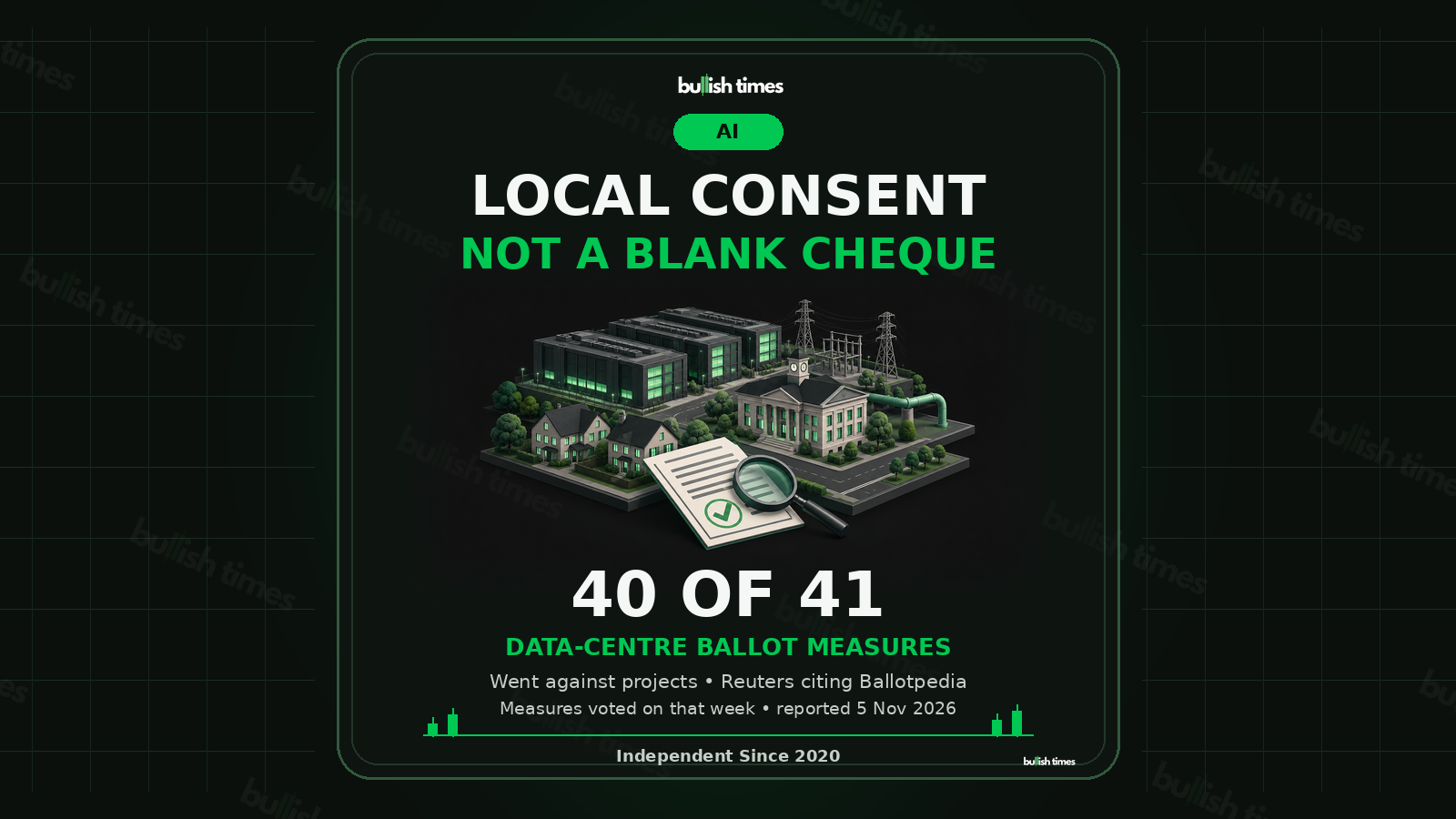
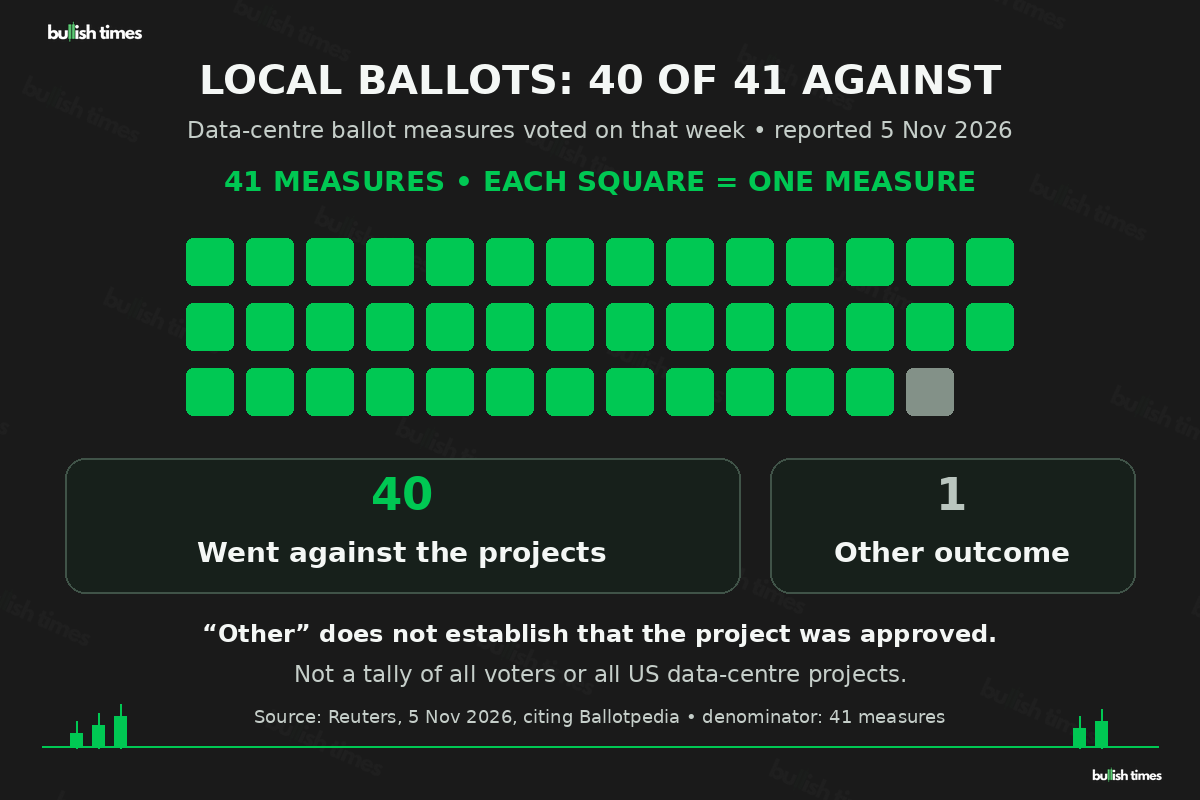
Reuters reported that 40 of the 41 data-centre-related ballot measures voted on that week went against data centres, citing Ballotpedia. That is a striking tally within the measures identified, not a survey of every American voter or a verdict on every proposed campus.
It does not establish that all opposition has the same cause. Nor should separate local measures be mistaken for a single national referendum. What it does undermine is the assumption that announcing a large development and its anticipated benefits will automatically secure acceptance.
OpenAI president Greg Brockman told a separate event, according to Reuters: “We need to do a better job of really communicating to people, to local communities, about why data centers can be beneficial to them.” Communication matters. But treating resistance chiefly as a messaging deficit risks missing legitimate questions about costs, disclosure and control.
A forecast is not a local employment contract
The strongest counterargument is that these campuses could create worthwhile employment and business opportunities. OpenAI’s policy blueprint projects 2,500 long-term operating jobs at its Pike County, Ohio campus, with average annual salaries of $80,000, alongside 26,000 construction jobs.
Those are company projections, not independently verified jobs already delivered. Construction employment and long-term operating positions also have different time bases; adding them together would obscure the distinction rather than illuminate the benefit.
The sensible response is neither to dismiss the forecasts nor accept them as payment in advance for disruption. Residents need to know which jobs are expected, when they arise, how local people can qualify and how actual hiring compares with the promise.
OpenAI’s compact addresses part of that problem by promising workforce strategies and annual progress reports. That is useful. But an expectation of economic benefit cannot substitute for specific protections against an electricity-cost increase or a poorly explained planning decision.
Follow the bill, then the information
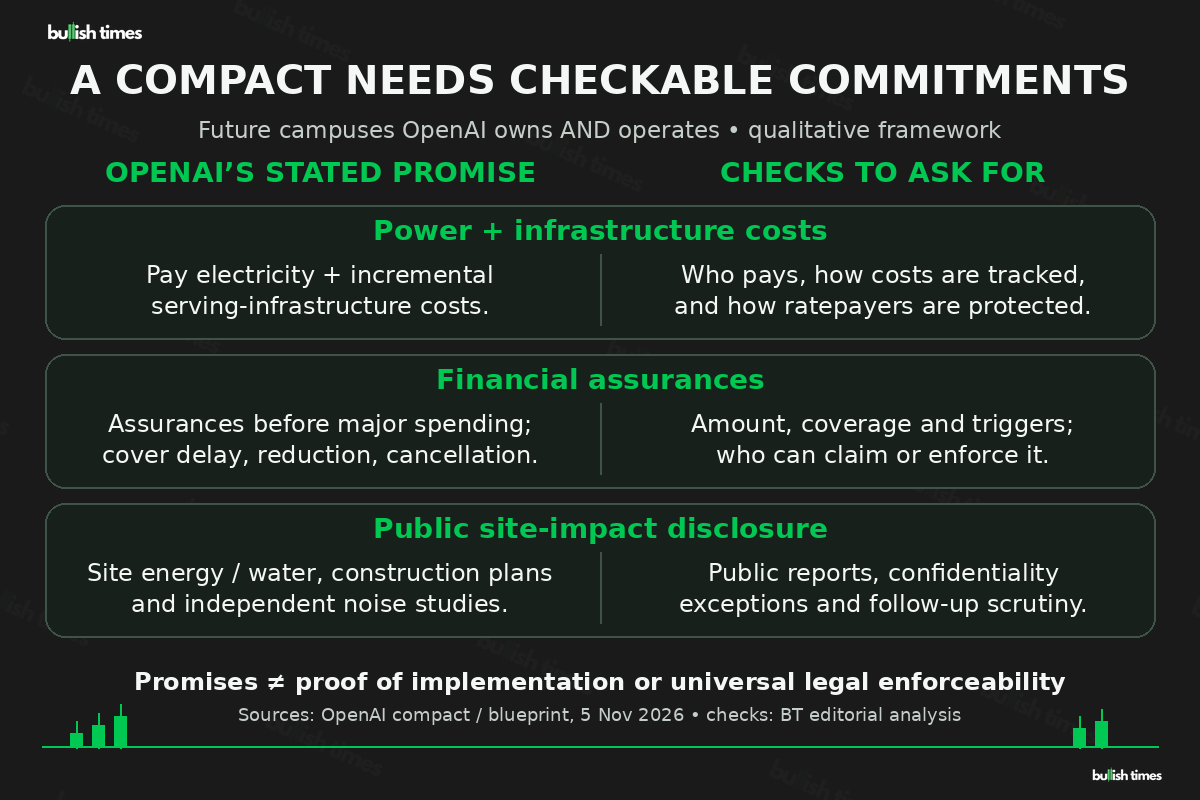
OpenAI’s National Community Compact says it will pay the full cost of powering its compute campuses and the incremental infrastructure costs required to serve them. It also promises financial assurances before major spending, protecting other customers if a project is delayed, reduced or cancelled.
That last commitment is more consequential than a reassuring slogan. Electricity infrastructure can require spending before a campus reaches its expected demand. The meaningful test is whether the arrangements protect other customers if that demand never materialises, not simply whether the developer promises to pay while operations go to plan.
For local scrutiny, the questions should be concrete: what costs are covered, how much assurance is provided, who can call on it and under what conditions? These are tests for implementation, not claims that the published documents already answer every contractual question.
Information is the other half of accountability. The compact promises site-level water and electricity reporting, construction plans, and independent noise studies before operations and annually afterwards. It says public officials will not be required to sign non-disclosure agreements, while allowing narrow protections for security, trade secrets and proprietary or competitively sensitive information.
Those exceptions deserve scrutiny without pretending that all confidentiality is improper. The boundary should protect genuinely sensitive material without swallowing the information residents need to assess the project.
Local consent needs consequences, not just contact details
Scope matters. OpenAI’s announcement describes commitments for future campuses it owns and operates. Reuters notes that partners including Oracle build and own much of its infrastructure. The compact should not therefore be presented as an automatically enforceable guarantee covering every facility serving OpenAI.
The blueprint itself recognises the limits of voluntary promises by calling for public rules. It proposes ratepayer protections and public tax-incentive terms with measurable commitments and ways to recover benefits if developers fall short. Proposals are not enacted safeguards, but this is the right direction of travel.
The commercial case for accountability is straightforward: clearer obligations give communities a basis for judging a project and developers a basis for demonstrating delivery. A local contact and an annual report help; neither alone establishes a remedy when a commitment is missed.
OpenAI’s charm offensive becomes credible when residents can verify the promise and enforce the consequence.