Abstract says it processed more than 325 million transactions and helped power businesses reporting over $40 million in revenue. Yet its Ethereum layer 2 is closing. The uncomfortable lesson: impressive activity is not the same thing as a sustainable network.
Abstract will stop operating on 15 December 2026, and users have been told to migrate their assets before then. The announcement is a sharp reversal for a chain launched in January 2025 and backed by Igloo, the company behind Pudgy Penguins. It also lands amid a wider question for Ethereum layer 2s: when usage looks substantial, who is actually earning enough to keep the infrastructure running?
Big numbers, but what did they measure?
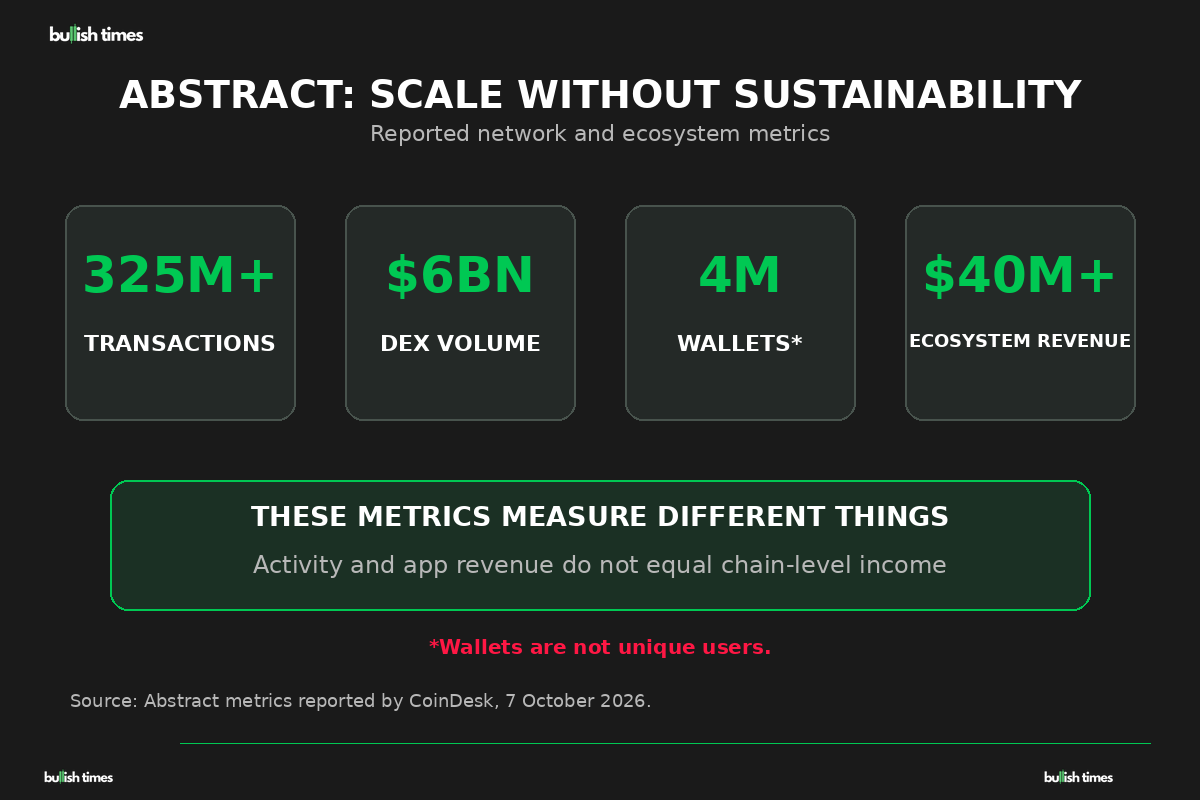
Abstract’s own reported figures are striking: more than 325 million transactions, $6 billion in decentralised-exchange volume, four million wallets and more than $40 million in ecosystem-business revenue. These are meaningful signs of activity and commercial output. They are not, however, a single measure of revenue accruing to the chain itself.
That distinction matters. A transaction total records activity; DEX volume records the value traded; wallet counts refer to wallets, not necessarily unique people. Ecosystem-business revenue says something about applications and businesses operating around Abstract, but it cannot automatically be treated as income available to pay the network’s operating bills.
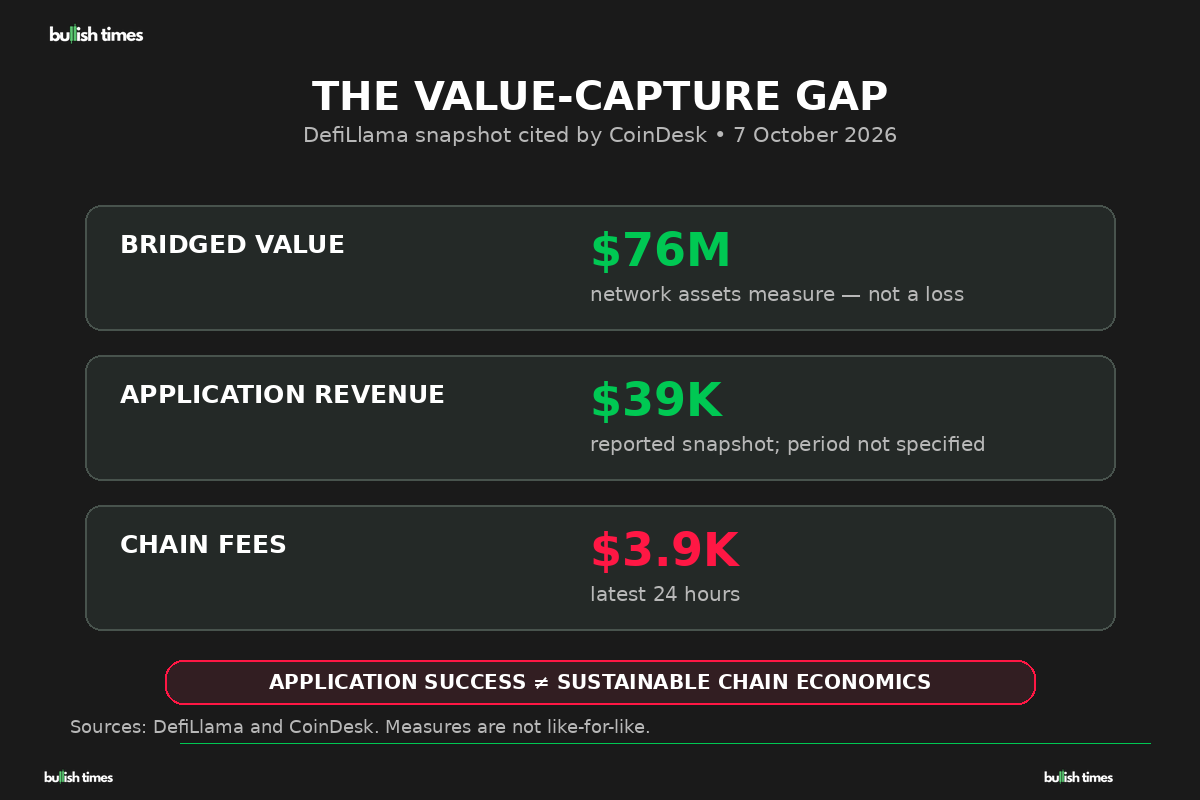
The CoinDesk report, citing a DefiLlama snapshot, offered a more immediate view for 7 October: about $76 million in bridged value, roughly $3,900 in 24-hour chain fees and around $39,000 in application revenue. The measures have different meanings, and not every period is specified here; the bridged-value figure is not a loss estimate or the exact amount at risk. But the snapshot helps explain the central tension: application activity and chain-level fee income can sit far apart.
The economics beneath the activity
Abstract has cited stalled growth, thin trading markets, limited institutional activity and a small decentralised-finance market. Those are not cosmetic weaknesses. They help determine whether a network can convert attention into recurring demand, and whether enough of that demand reaches the infrastructure layer to cover the cost of operating it.
Abstract’s creator and chief executive, Luca Netz, said Igloo had lost eight figures funding the network. He said the company chose not to launch a token or pursue an initial coin offering in order to continue funding it. That choice may have avoided one source of capital, but the available facts do not establish that launching a token would have made the operation sustainable. A fundraising event can extend a runway; it cannot by itself prove that the underlying business works.
Nor should the roughly $39,000 application-revenue figure be casually compared with the more than $40 million ecosystem-business revenue claim as though they share a time period or definition. They are separately attributed metrics, and the brief does not establish that they are like-for-like. The point is not that one figure disproves the other. It is that headline totals can obscure the practical question: how much recurring value does the chain capture, and is it enough?
A migration deadline is part of the product
Abstract has told users to move assets before 15 December. It says funds left on-chain after closure would become inaccessible. That is a consequential deadline, and it turns the shutdown from a company-level decision into an operational responsibility for every user, application and service still relying on the network.
The official announcement is the primary source for the closure plan. Users should follow its current migration instructions directly and check application-specific guidance; a chain’s shutdown is not a cue to assume that every asset or app migrates in the same way. The practical reminder is that infrastructure risk includes continuity and exit arrangements, not just whether a network has been busy.
There is a sobering precedent close at hand. Blast announced its own closure days earlier, saying its operating costs exceeded revenue. Two shutdowns in quick succession do not prove every layer 2 has the same problem. They do make it harder to wave away sustainability as a distant concern that can be settled by quoting transaction counts alone.
The real test is who controls the runway
Abstract’s shutdown does not erase its past activity, nor does it prove the network was a failure in every respect. Its businesses generated reported revenue and the chain attracted millions of wallets. But a network can succeed at attracting use while failing to build a durable way to fund the service that supports that use. That is not a contradiction; it is the business-model question the metrics leave unanswered.
The broader Ethereum layer 2 sustainability debate should therefore move beyond a race to publish the largest transaction or wallet number. Users and builders need to understand who pays for operations, how those costs are matched by recurring revenue, and what happens when a sponsor decides it will no longer subsidise the gap. Abstract’s reported roughly 18-month funding period from Igloo makes that question especially concrete, and underlines the difference between a network’s operating life and the length of time its sponsor funds it.
For now, the clearest takeaway is less dramatic than a hack headline, but more useful: usage is evidence of demand, not proof of financial durability. The test for an L2 is whether it can keep serving that demand without relying indefinitely on a backer willing to absorb eight-figure losses.
Abstract’s final months will show whether an active ecosystem can execute an orderly exit—and whether the next layer 2 can make its economics as legible as its activity metrics.