The United Kingdom has done something no Western government has ever done before: slapped banking-style sanctions on a top-tier cryptocurrency exchange. The target is HTX, the $3.3-trillion-volume behemoth tied to Justin Sun — and the allegations involve $1.5 billion in flows linked to the Kremlin.
On 26 May 2026, the UK’s Foreign, Commonwealth & Development Office designated Huobi Global S.A. — the Panama-registered entity operating HTX — under its Russia sanctions regime. The exchange now sits alongside sanctioned Russian banks, arms dealers and intelligence operatives. Its UK-held assets are frozen, its payment channels severed, and every financial institution in Britain is legally barred from touching it.
This is not a slap on the wrist. This is a declaration that crypto exchanges are no longer beyond the reach of geopolitical enforcement.
What Britain Is Alleging
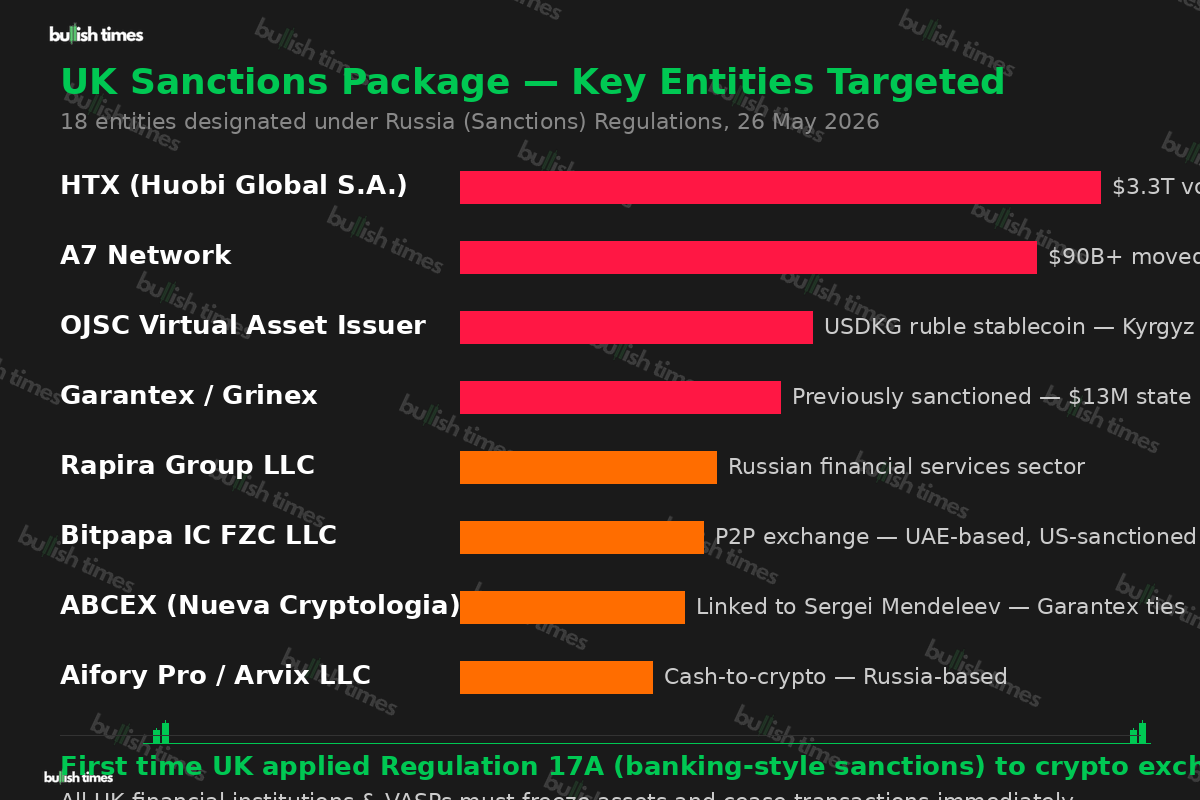
The sanctions package targets 18 entities and individuals accused of sustaining Russia’s “illicit financial infrastructure.” HTX is the headline name, but the network it allegedly serviced is the real story.
At its centre sits A7, a Kremlin-backed payments network that British officials say processed over $90 billion last year — roughly half of Russia’s annual military expenditure. The A7 network operates A7A5, a rouble-pegged stablecoin that blockchain analysts have identified as a primary tool for Russian sanctions evasion since late 2024.
HTX is accused of providing financial services to both A7 and Garantex, the Russian exchange previously sanctioned by the US Treasury. Garantex rebranded to Grinex earlier this year before suffering a $13 million “state-backed” hack in April that finally halted its operations.
The $1.5 billion figure represents the alleged volume of flows linked to Russian networks that passed through HTX’s infrastructure. For context, HTX reported $3.3 trillion in total trading volume during 2025, making it one of the five largest exchanges on the planet.
“If the Kremlin thinks it can evade our sanctions by hiding behind crypto networks and shadow financial systems, it is gravely mistaken,” said Yvette Cooper, Britain’s Foreign Secretary, in a statement that left precisely zero room for ambiguity.
Why Regulation 17A Changes Everything
The technical details matter here, because they reveal a paradigm shift in how governments intend to police crypto.
For the first time, Britain applied Regulation 17A of its Russia sanctions framework to cryptocurrency exchanges. This regulation was previously reserved exclusively for sanctioned banks. It imposes correspondent banking-style prohibitions — meaning UK financial institutions cannot process any payment that has, at any point in its journey, touched HTX.
According to blockchain analytics firm Elliptic, this creates a compliance nightmare of unprecedented scope. “The prohibition applies even where the sending and receiving account holders are not themselves sanctioned,” Elliptic noted. If HTX appears anywhere in a transaction chain — as sender, intermediary or recipient — the entire transaction is prohibited under UK law.
In practical terms, UK-based virtual asset service providers must now trace funds across multiple blockchain “hops” to identify HTX exposure. Simple name-screening is no longer sufficient. The compliance bar has shifted from “know your customer” to “know your customer’s customer’s customer.”
Other sanctioned entities in the package include Rapira Group, Bitpapa (a UAE-based P2P exchange already sanctioned by the US in 2024), ABCEX, Aifory Pro, Arvix, and OJSC Virtual Asset Issuer — the entity behind USDKG, a Kyrgyz state-linked gold-backed stablecoin suspected of servicing Russian interests.
The Justin Sun Problem
Justin Sun himself was not personally designated — a detail HTX was quick to emphasise. Sun, who serves as HTX’s “Global Advisor” despite wielding significant ownership influence, responded on X with characteristic confidence: “We believe in full compliance with all applicable laws and cooperation with law-enforcement agencies worldwide.”
HTX’s official statement was blunter, claiming the designation came “without prior notice or any supporting evidence” and insisting that Huobi Global S.A. is “distinct” from the online HTX exchange. The exchange also claimed it had refused to list the A7A5 rouble stablecoin — a curious defence that implicitly acknowledges the approach was made.
But the timing of these sanctions is politically explosive. Sun’s 2026 has been a rollercoaster of regulatory entanglements that reads like a geopolitical thriller.
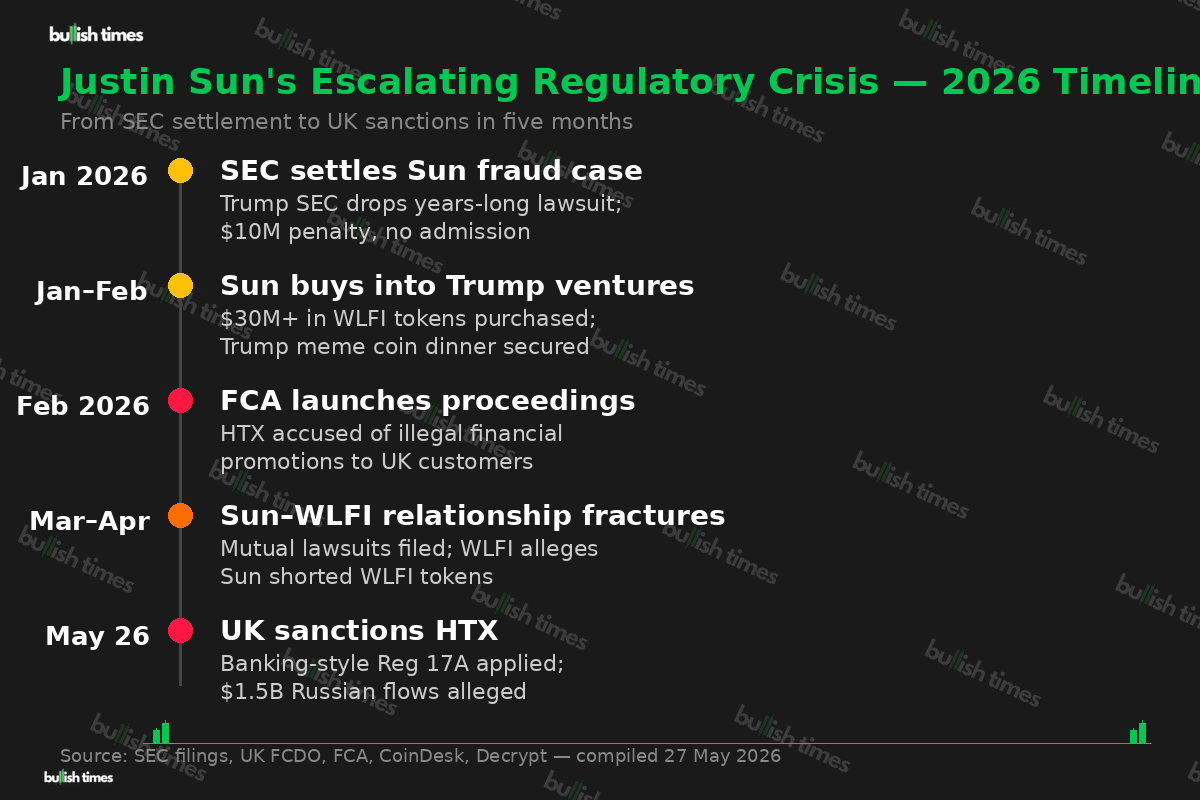
In January, the Trump-era SEC abruptly settled its years-long fraud case against Sun for a mere $10 million — widely interpreted as a favour after Sun spent tens of millions buying tokens from Trump’s World Liberty Financial and attending the President’s meme coin dinner. By March, that relationship had disintegrated. Sun and WLFI are now locked in multiple lawsuits, with the Trump family alleging Sun deliberately shorted WLFI tokens to crash their price.
What Happens Next
The immediate fallout is already visible. Banking partners and payment processors across jurisdictions that honour British sanctions will begin distancing themselves from HTX. Counterparties, market makers and institutional traders typically reduce exposure to sanctioned entities as a precautionary measure, thinning order books and widening spreads.
Rival exchanges — Binance, OKX, Bybit — stand to absorb displaced trading volume. Compliance-focused platforms like Coinbase and Kraken will point to this moment as vindication that regulatory alignment is a competitive advantage, not a handicap.
But the bigger question is whether this is the beginning of something larger. Elliptic warned that “other jurisdictions will be watching closely” as Britain tests this new model. If the US, EU or Asian regulators follow suit with similar designation tools, the era of major exchanges operating in regulatory grey zones may be over.
For Justin Sun, the walls are closing in from every direction. The FCA launched enforcement proceedings against HTX in February for illegal financial promotions. The SEC settlement bought him time in America but not goodwill. And now his exchange sits on a sanctions list alongside entities accused of funding Russia’s war machine.
The question is no longer whether governments can reach into the crypto ecosystem to enforce geopolitical sanctions. They just proved they can. The question now is who’s next.
This is a developing story. Bullish Times will update as HTX’s legal response and market impact become clearer.