The most valuable AI company on Earth just threatened to sue the most valuable company on Earth — and somehow, that’s only the fourth-worst thing to happen to OpenAI this month.
Sam Altman’s empire is cracking. On Wednesday, Bloomberg revealed that OpenAI’s lawyers have engaged an outside firm to prepare possible legal action against Apple over the companies’ crumbling Siri–ChatGPT partnership. It is a stunning escalation between two titans that once stood side by side at WWDC 2024 (Apple’s annual developer conference, where the Siri–ChatGPT integration was first unveiled to the world), promising to reshape how a billion iPhone owners interact with artificial intelligence.
The Deal That Was Supposed to Change Everything
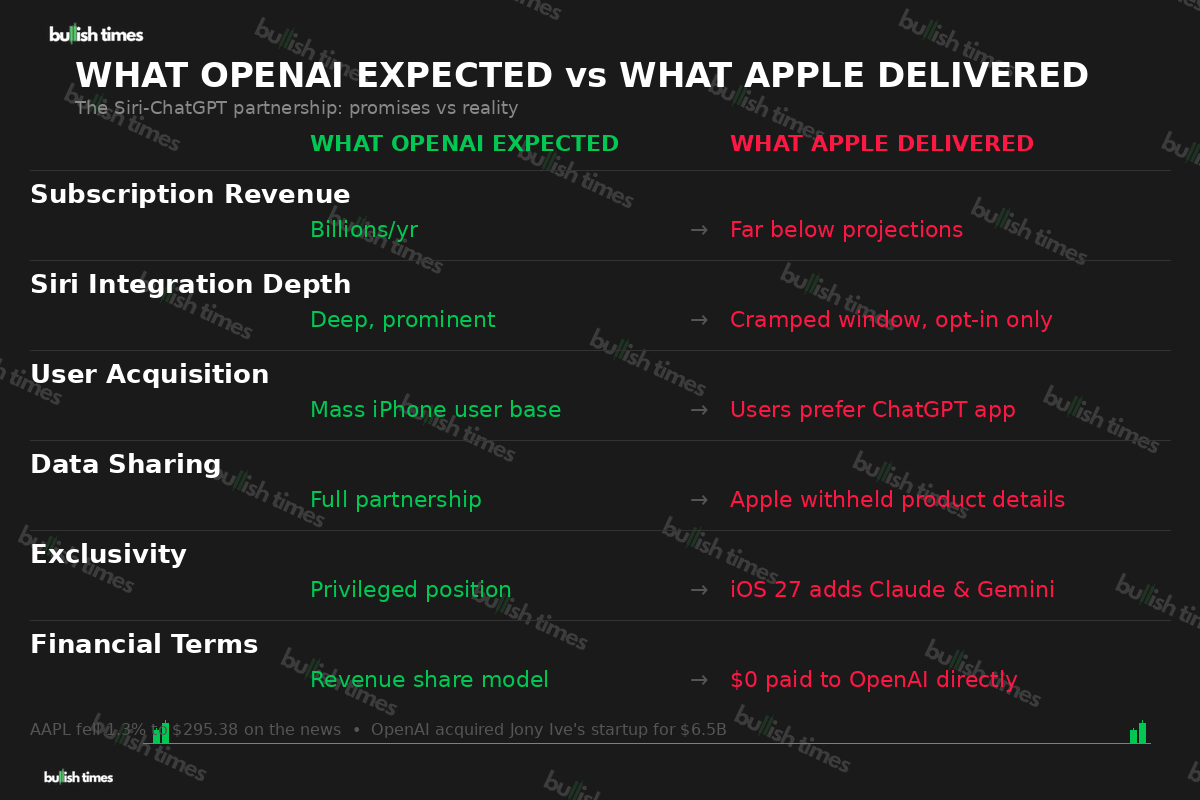
In June 2024, Apple and OpenAI announced a landmark integration: ChatGPT would be woven into Siri, Visual Intelligence, and the iPhone’s settings menu, giving users a seamless path to paid ChatGPT subscriptions. OpenAI believed the arrangement could generate billions of dollars per year in new revenue — a critical lifeline as the company sprinted towards an IPO reportedly planned for late 2026.
The reality has been dismal. Internal research shared with Bloomberg shows iPhone owners overwhelmingly reach for the standalone ChatGPT app rather than encountering OpenAI’s technology through Siri. The integration surfaces ChatGPT results only when users explicitly type or say the word “ChatGPT,” cramming replies into a truncated window that displays far less than OpenAI’s own interface.
“We have done everything from a product perspective,” an unnamed OpenAI executive told Bloomberg. “They have not, and worse, they haven’t even made an honest effort.”
No money changes hands between the two companies — Apple simply takes a cut of any subscriptions generated through iOS settings. Revenue from the arrangement is described as “far below projections.”
Apple Didn’t Just Underdeliver — It Moved On
The betrayal, from OpenAI’s perspective, runs deeper than lacklustre integration. iOS 27, expected to be unveiled at WWDC next month, will reportedly bring Anthropic’s Claude and Google’s Gemini directly into Apple’s ecosystem — effectively dismantling the privileged position ChatGPT has held since the original deal.
Apple struck a separate agreement with Google worth approximately $1 billion per year to underpin its broader AI ambitions with Gemini technology. OpenAI was offered a similar deeper role but declined, having “soured on Apple after its experience with the original deal.”
The animosity cuts both ways. Apple executives have reportedly been “fuming for more than a year” over OpenAI’s aggressive recruitment of Apple engineers. The startup poached former Apple design chief Jony Ive, acquiring his hardware venture for roughly $6.5 billion, and has been offering compensation packages worth millions more than Apple provides. Ive is now leading OpenAI’s push into consumer hardware — a direct competitive threat to the iPhone maker.
From Apple’s side, the friction also stems from “longstanding doubts about how rigorously OpenAI protects user data.” When the partnership was first negotiated, Apple reportedly refused to share product specifics, telling OpenAI to “take a leap of faith and trust us.”
That trust has now evaporated entirely.
The Bigger Picture: Altman Under Siege
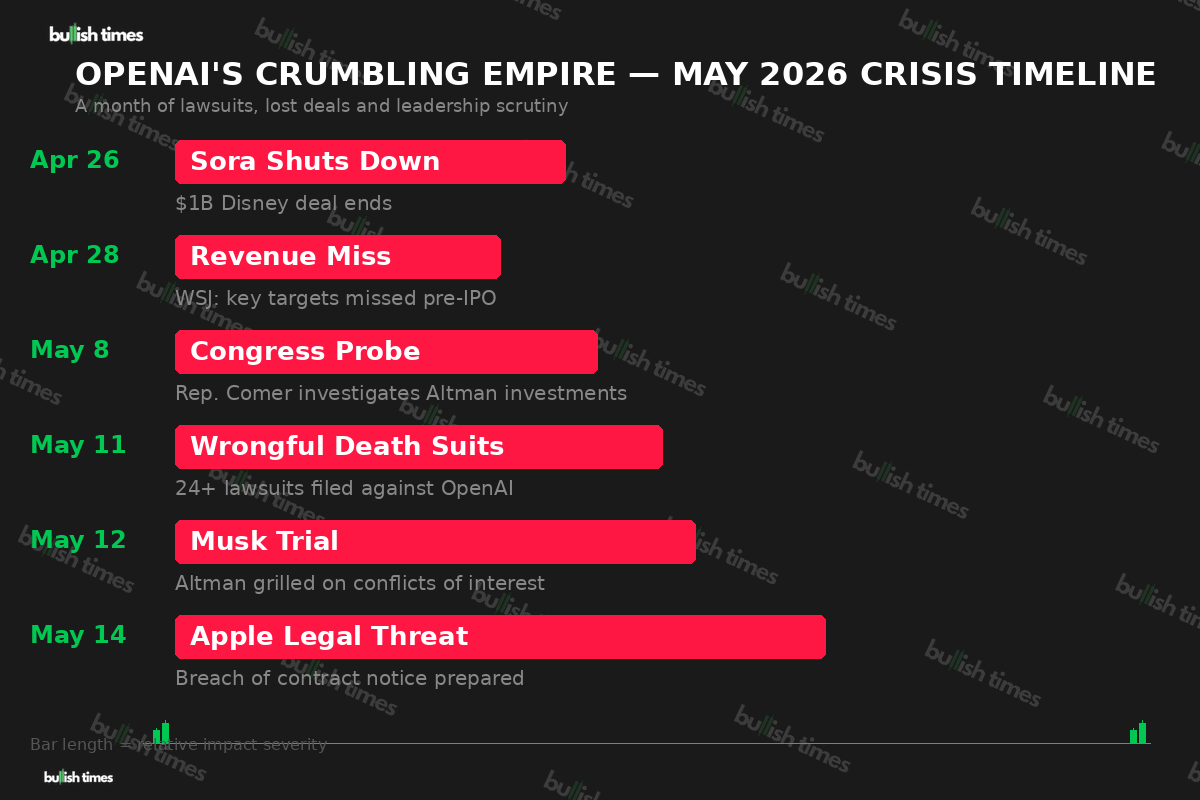
The Apple fallout is merely the latest front in what has become the worst month in OpenAI’s turbulent history. The company is simultaneously fighting Elon Musk in a California courtroom, where Musk alleges Altman and co-founders deceived him into funding OpenAI as a non-profit before converting it into a for-profit venture. Jury deliberations begin next week, and the stakes are existential: a ruling for Musk could force OpenAI to revert to its original non-profit structure and remove Altman from the board.
Meanwhile, House Oversight Committee chairman James Comer has launched an investigation into Altman’s personal investments, which Forbes values at over $3.5 billion — none of which comes from direct equity in OpenAI. State attorneys general have separately asked the SEC to investigate potential conflicts of interest ahead of the IPO. Altman testified under oath that he “always” recuses himself from conflicted matters.
The Wall Street Journal reported on 28 April that OpenAI had missed key revenue and user growth targets, raising questions about whether the company can secure the computing power it needs without significant growth. Altman and CFO Sarah Friar dismissed the reporting as “ridiculous,” insisting OpenAI is “firing on all cylinders.”
Then there are the lawsuits. More than two dozen wrongful death cases have been filed against OpenAI in recent months, including one alleging ChatGPT gave a man advice that led to a fatal drug overdose, and another claiming the chatbot assisted a mass shooter at Florida State University.
And on 26 April, Sora — OpenAI’s much-hyped video generation tool — officially ceased operations, ending a $1 billion deal with Disney around use of its characters on the platform.
What Happens Next
OpenAI’s legal options range from a formal breach-of-contract notice — a shot across the bow — to a full lawsuit against the world’s most valuable company. Bloomberg reports OpenAI is unlikely to act before the Musk trial concludes, and “still hopes to resolve its issues with Apple outside of court.”
But the damage may already be done. Apple stock fell 1.2% to $295.38 on the news, and the broader signal is devastating: the company that was supposed to be OpenAI’s greatest distribution partner has become its most dangerous competitor. Apple is now building its own AI stack with Google and Anthropic, whilst OpenAI — armed with Jony Ive and a war chest — is building hardware to compete with the iPhone.
The irony is exquisite. Two years ago, Tim Cook and Sam Altman stood on stage together, painting a picture of harmonious AI integration. Today, their lawyers are sharpening knives.
For Altman, the Apple crisis is the one that could truly hurt. Musk’s lawsuit is ideological. The congressional probe is political theatre. The wrongful death suits are tragic but legally manageable. But losing Apple’s billion-user distribution platform — and watching it hand that access to Claude and Gemini instead — threatens the revenue growth OpenAI desperately needs before its IPO.
The most important AI company in the world is now fighting on five fronts simultaneously. History suggests that rarely ends well.
This is a developing story. Bullish Times will update as OpenAI’s legal strategy becomes clearer.