Half a billion dollars in tokens just walked out of one of the world’s largest exchanges in twelve hours — and the crypto industry’s most feared detective wants you to know exactly who he blames.
On 12 May 2026, on-chain investigator ZachXBT publicly named Bitget founder and chairman Shawn Liu as the man who “allows these scams to operate behind the scenes,” branding the exchange part of a “Chinese CEX cartel” and signalling an all-out war against the platform. The accusation landed hours after blockchain analytics firm Lookonchain flagged a staggering withdrawal: ten freshly created wallets had drained 100 million $LAB tokens — worth roughly $480 million — from Bitget’s hot wallet in a single 12-hour window. That represents 32.26% of the token’s entire circulating supply.
The $480 Million Disappearing Act
The numbers are jaw-dropping even by crypto standards. Arkham Intelligence confirmed that all ten receiving addresses were brand-new wallets with zero prior transaction history, each pulling between 8.6 million and 10.8 million LAB tokens in individual transfers worth $41.5 million to $52.9 million apiece.
This is not a normal withdrawal pattern. No retail investor creates ten virgin wallets to split a $480 million position. The coordination screams institutional positioning — or something far worse.
The LAB token itself has been under scrutiny for weeks. On-chain analysts estimate that approximately 95% of the total 1 billion LAB supply sits with team members and insiders, leaving just 309.95 million tokens in circulation. Of that, on-chain liquidity amounts to a paltry $4.75 million — a 0.35% liquidity-to-market-cap ratio for a token valued at $1.47 billion. That means a relatively modest sell order could crater the price, whilst coordinated buying with minimal capital can send it skyward.
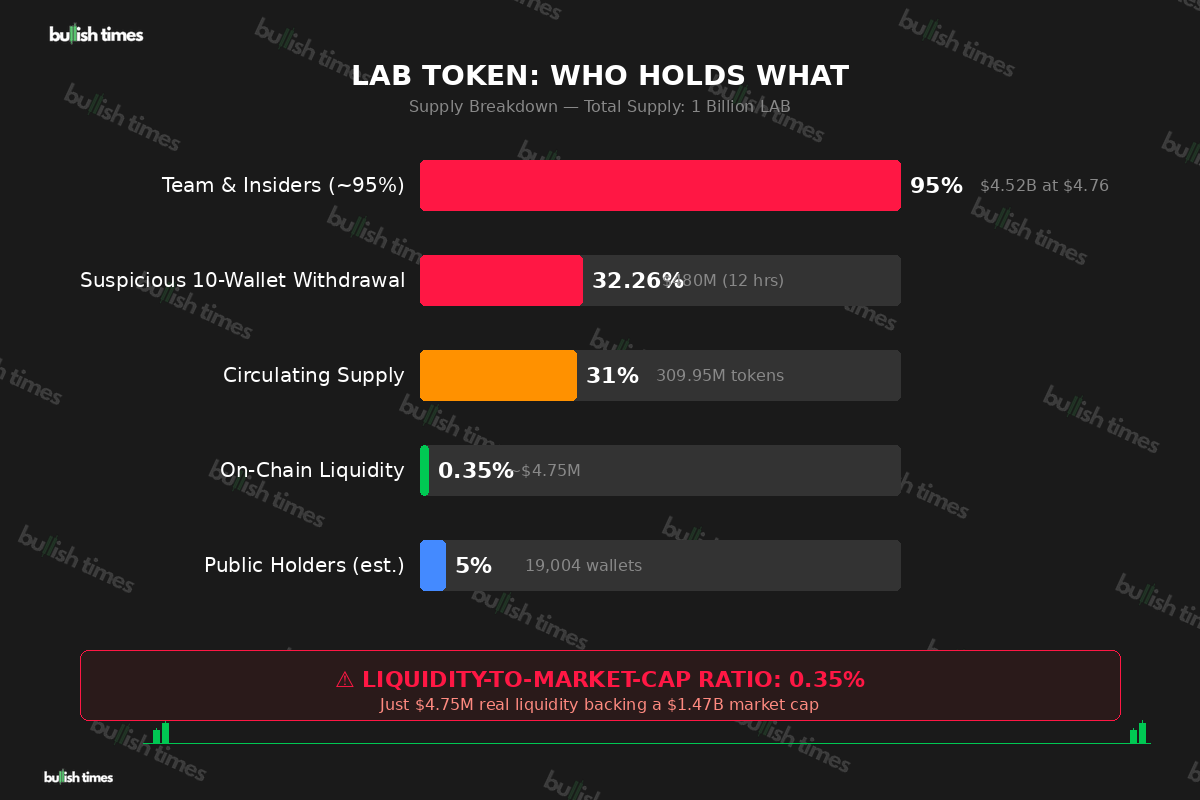
And that is precisely what happened. LAB surged from $0.33 to nearly $6.60 in early May — a 3,700% pump — before settling around $4.76. Peak 24-hour trading volume hit $147.86 million during the run-up. The token has just 19,004 holders.
ZachXBT Goes Nuclear
The investigator’s post on X was characteristically blunt: “Shawn Liu is the Bitget big boss who allows these scams to operate behind the scenes while Gracy Chen is only the face of it. The Chinese CEX cartel has gone unchallenged for years and doesn’t care as long as they benefit from the activity. I think it is almost time to increase public attacks against Bitget.”
This marks a critical escalation. ZachXBT has previously tagged Bitget CEO Gracy Chen directly and demanded investigation updates. But by naming Shawn Liu — the founder-chairman who rarely surfaces publicly — and framing the problem as systemic rather than operational, he has shifted his crosshairs from individual token projects to exchange-level accountability.
The move drew predictable pushback. One X user accused ZachXBT of racism for using the phrase “Chinese CEX cartel.” His response was swift: “Funny how your default response is to call it ‘racism’ but you have zero evidence to support that statement. When I criticised decisions from other exchanges in the past such as Coinbase you were silent.”
Last week, ZachXBT posted a $10,000 personal bounty for the identity of @vsadkovv, the anonymous LAB founder, requesting a passport or ID and insider details of the market maker behind LAB’s listings on Bitget spot, Bybit perps, Binance perps, and OKX perps. That scope — naming four major exchanges — suggests the alleged manipulation extends well beyond a single venue.
A Pattern That Should Terrify You
This is not Bitget’s first rodeo with manipulation allegations in 2026, and the pattern is becoming impossible to ignore.
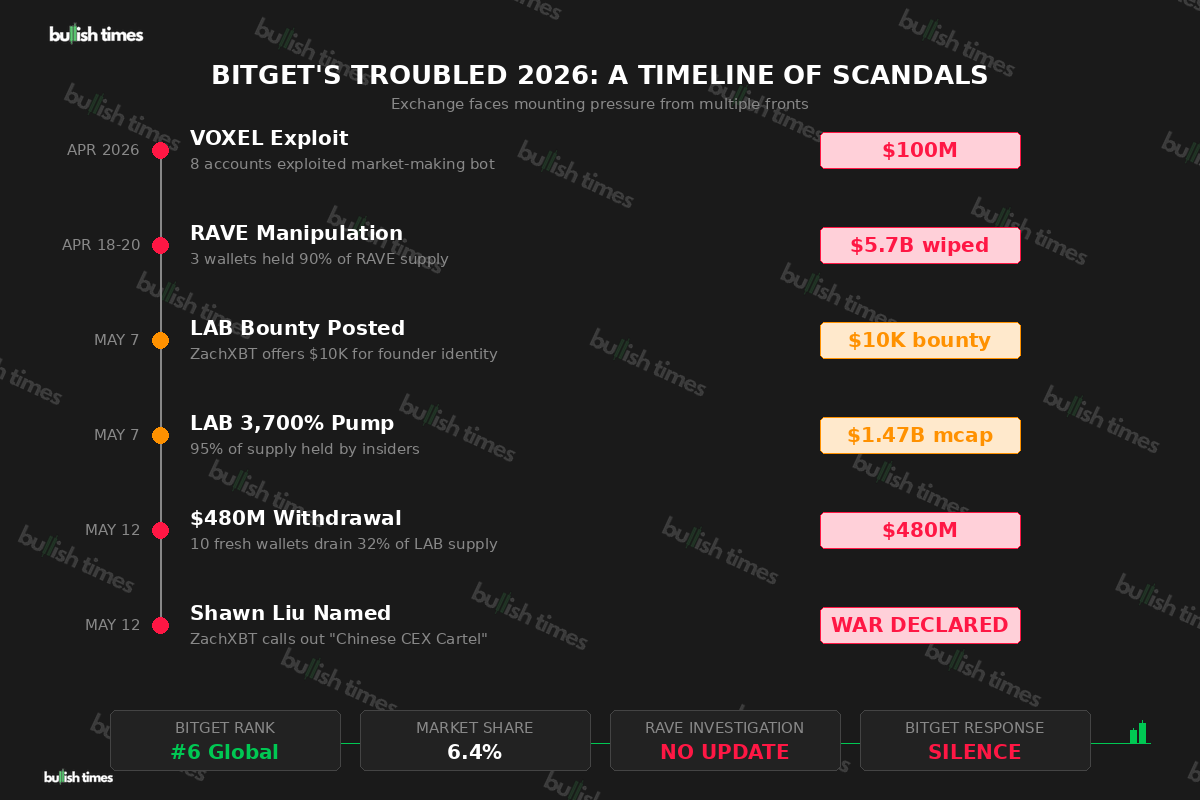
In April, the RAVE token imploded after ZachXBT exposed insider manipulation. Three wallets had held 90% of the RAVE supply, orchestrated a 10,800% pump, then a 95% crash that wiped billions in value. Bitget publicly acknowledged an investigation into RAVE — but weeks later, no update has been published.
Also in April, Bitget disclosed a roughly $100 million loss tied to a VOXEL market manipulation exploit. Eight accounts had exploited a flaw in Bitget’s internal market-making bot logic to extract outsized, low-risk profits. The exchange sued the accounts but the damage was done.
On-chain analyst SpecterAnalyst has linked the $LAB wallet activity to a pattern previously observed in $SkyAI, another token that surged over 1,000% before collapsing. The playbook appears identical: concentrate supply, list on major CEXs, pump with minimal liquidity, then distribute to fresh wallets before the inevitable dump.
The Sixth-Largest Exchange Has Gone Silent
As of publication, neither Gracy Chen, Shawn Liu, nor Bitget has issued any public statement regarding ZachXBT’s latest accusations. The LAB founder @vsadkovv remains silent — reports indicate deleted posts and ignored direct messages.
Bitget currently ranks as the sixth-largest centralised exchange by trading volume, commanding 6.4% global market share according to CoinGecko. That is not a fringe platform. Millions of retail traders use Bitget daily, many of whom may be completely unaware that the tokens they are trading have been flagged for potential manipulation by the industry’s most prominent investigator.
The structural problem ZachXBT is highlighting goes beyond one token or one exchange. When 95% of a token’s supply is controlled by insiders, when on-chain liquidity is less than half a percent of market cap, and when a third of the circulating supply can be drained to anonymous wallets overnight — the exchange listing that token bears responsibility. Listing fees and trading volume cannot be the only metrics that matter.
What Happens Next
ZachXBT has made his intentions crystal clear: this is the beginning, not the end. His track record speaks for itself — previous exposés have led to delistings, liquidity withdrawals, public boycotts, and regulatory inquiries. When ZachXBT escalates, exchanges tend to eventually respond.
The immediate question for $LAB holders is stark. With $480 million worth of tokens now sitting in ten untraceable wallets, a dump could be catastrophic given the razor-thin liquidity. The 0.35% liquidity-to-market-cap ratio means there is simply not enough real money in the system to absorb a large sell-off without the price cratering.
For the broader market, the episode raises uncomfortable questions about how many other tokens on how many other exchanges are operating with the same playbook. If ZachXBT’s “Chinese CEX cartel” framing sticks — and his evidence continues to mount — the consequences for centralised exchange governance could be profound.
Bitget’s silence, meanwhile, speaks volumes. In crypto, saying nothing is still saying something.
This story is developing. ZachXBT has signalled further investigations and bounty campaigns targeting Bitget-linked token activity.