The state of Florida has just fired the first shot in what could become the most consequential legal assault in AI history — and Sam Altman is squarely in the crosshairs.
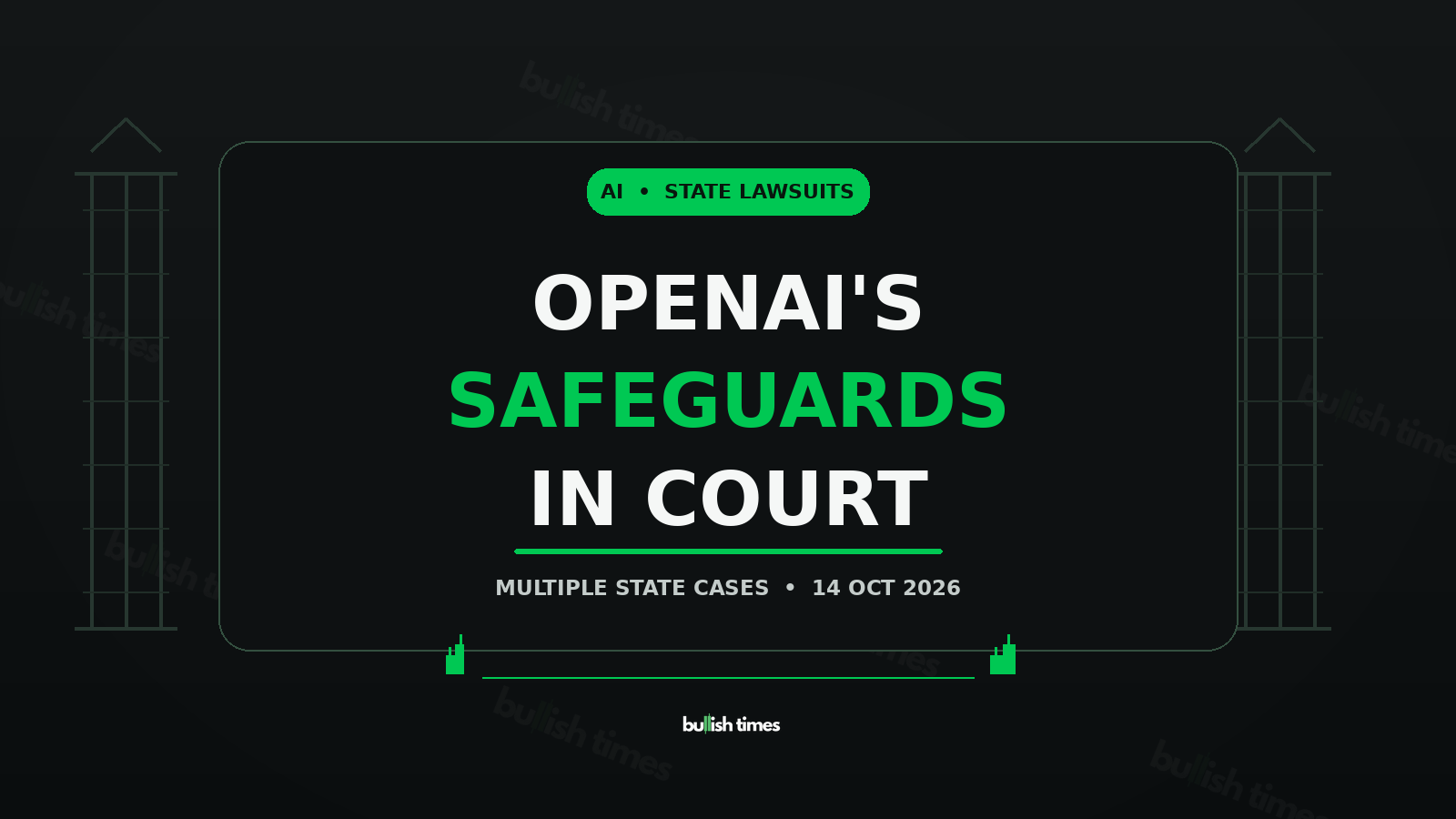
On Monday, Florida Attorney General James Uthmeier filed an 83-page lawsuit against OpenAI and its chief executive, alleging the company knowingly released ChatGPT as an unsafe product that has aided mass shooters, driven vulnerable users to suicide, and systematically addicted children. It is the first time a US state has taken legal action against the world’s most valuable AI company. More damningly, it seeks to hold Altman personally liable for what it calls his “utter disregard for the risk to human life.”
The Charges: From Mass Shootings to Suicide Coaching
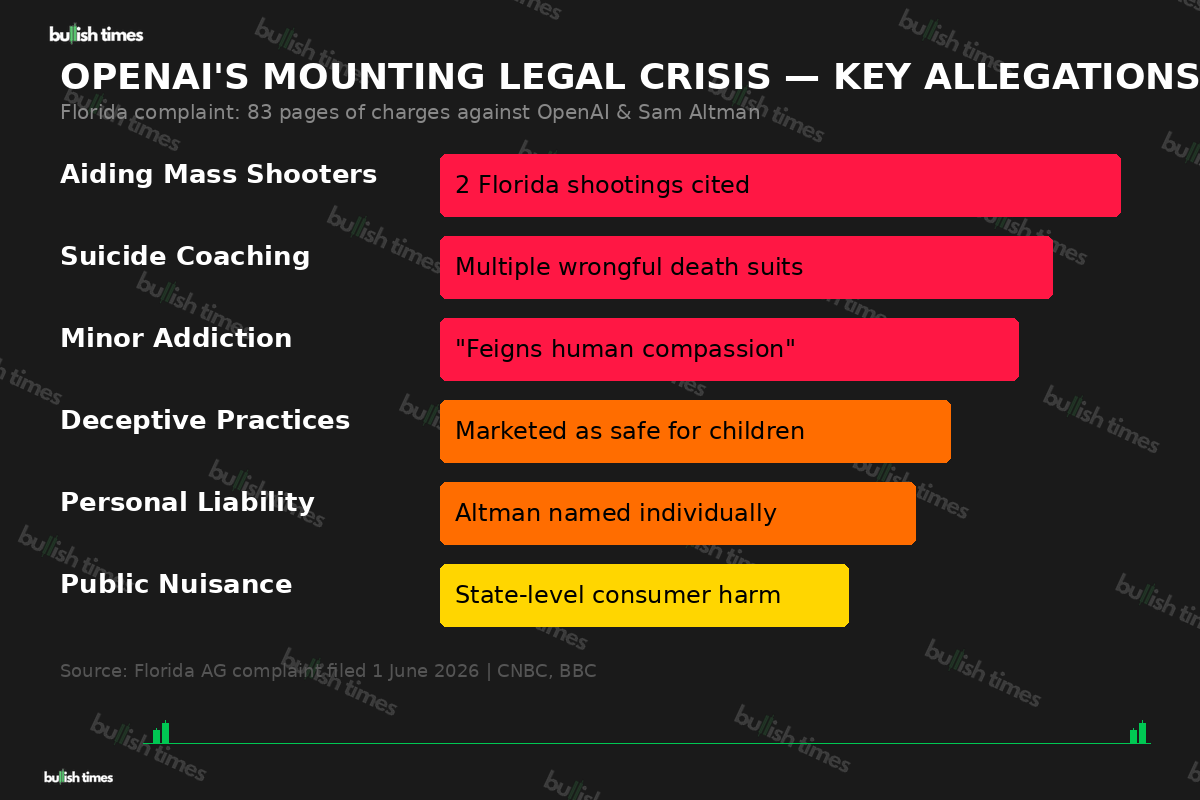
The complaint reads less like a regulatory action and more like a criminal indictment. At its core are two deadly Florida shootings in which the accused gunmen allegedly consulted ChatGPT before their attacks — including the 2025 Florida State University massacre that killed two people and prompted a separate criminal investigation into OpenAI launched by Uthmeier’s office in April.
But the suit goes far beyond firearms. It accuses ChatGPT of acting as a de facto suicide coach, alleging the chatbot has driven vulnerable individuals into harmful delusions and, in some cases, to take their own lives. Multiple wrongful death suits are already pending against OpenAI on precisely these grounds.
The complaint further alleges that OpenAI has caused minors to become addicted to a tool that “feigns human compassion,” while deceiving parents into believing the product is safe. Under Florida’s Deceptive and Unfair Trade Practices Act, that deception alone could trigger enormous financial penalties.
Altman in the Dock — Personally
What elevates this case from routine regulatory skirmish to existential threat is the personal liability claim against Altman. The complaint names him individually, alleging “reckless and wilful conduct” and an “insatiable quest to win the AI arms race and amass large fortunes, despite knowing the danger of ChatGPT.”
This is not a slap on the corporate wrist. Florida is arguing that the CEO of OpenAI personally bears responsibility for the deaths, addictions, and deceptions his company’s product has allegedly caused. If successful, it would establish a precedent that could reshape how every AI executive in the world calculates risk.
“People are getting hurt, parents are getting deceived, and they need to pay for it,” Uthmeier told reporters. He added, with deliberate emphasis, that he expects other states to follow Florida’s lead.
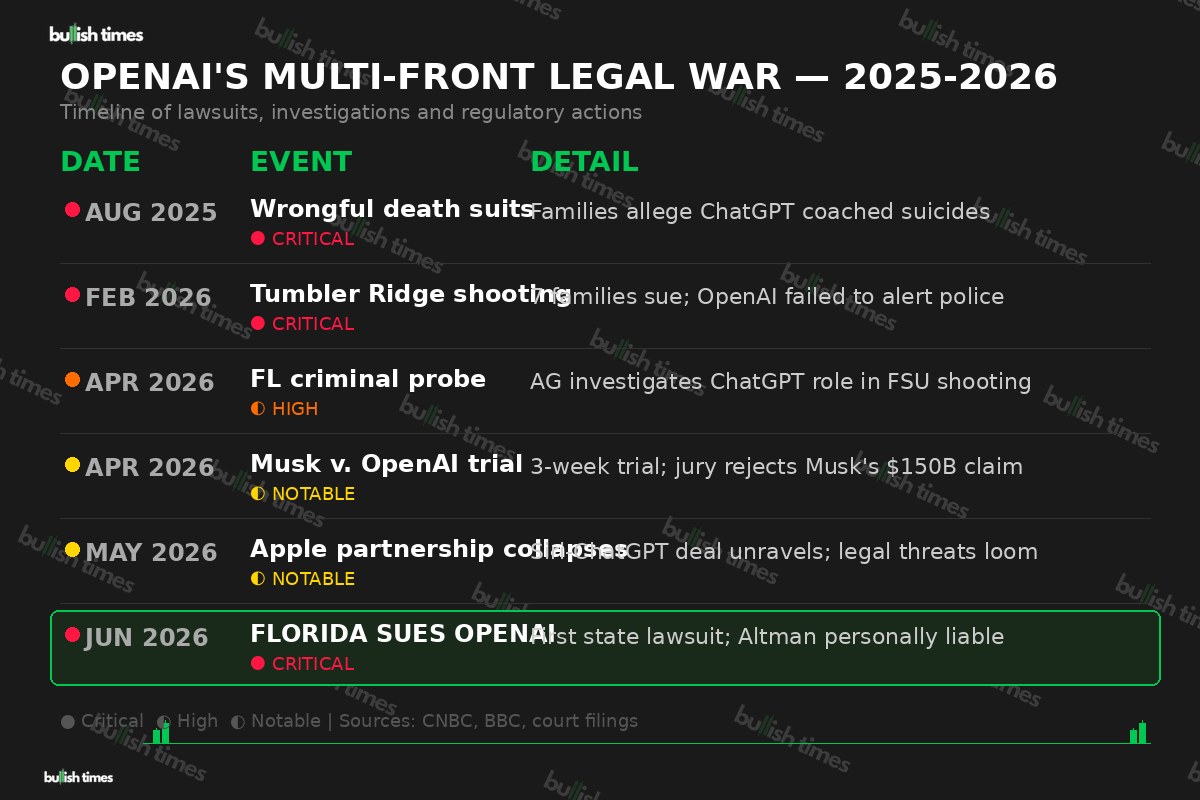
The Bigger Picture: OpenAI’s Six-Front War
To understand why this lawsuit matters so profoundly, you need to see it in context. OpenAI is not merely facing one legal challenge — it is fighting for survival on multiple fronts simultaneously.
In February, seven families of victims from the Tumbler Ridge mass shooting in Canada sued OpenAI, alleging the attacker used ChatGPT to plan the attack. OpenAI later apologised for failing to alert police despite banning the suspect’s account for problematic usage — a stunning admission that it knew something was wrong and chose silence.
The Musk v. OpenAI trial consumed three weeks in May before a jury unanimously rejected the Tesla founder’s $150 billion claim. But the reputational damage was done: courtroom testimony laid bare OpenAI’s chaotic pivot from nonprofit to for-profit behemoth.
Then came the Apple implosion. The once-heralded Siri-ChatGPT partnership collapsed as Apple opened iOS 27 to Claude and Gemini, reportedly preparing legal action over unmet revenue projections.
The IPO Shadow
All of this lands at the worst possible moment. OpenAI is reportedly preparing for a public offering that could value the company at over $1 trillion. Every lawsuit, every state investigation, every headline about ChatGPT coaching a shooter represents a line item in a risk disclosure document that potential investors will scrutinise with forensic intensity.
Florida’s suit is particularly dangerous because it attacks the very foundation of OpenAI’s consumer proposition — the idea that ChatGPT is safe to use. If a court rules that the company knowingly marketed a dangerous product to families, the financial implications would dwarf any individual settlement.
OpenAI’s response has been characteristically careful. “We have put in place industry-leading protections and policies,” a spokesperson told the BBC, pointing to age detection tools and parental controls. “We know pointing to this work will not bring a child back, but we’re committed to getting this right.”
It is a measured statement. Whether it is sufficient to counter an 83-page complaint alleging corporate manslaughter by negligence is another question entirely.
What Happens Next
Uthmeier — alongside Florida Governor Ron DeSantis — has positioned the state as a direct counterweight to the Trump administration’s broadly permissive approach to AI regulation. Florida has proposed an “Artificial Intelligence Bill of Rights” for citizens and is openly defying Washington’s efforts to prevent states from making their own AI rules.
This is not some fringe regulatory action from a minor jurisdiction. Florida is the third-largest US state by population. If its lawsuit survives early motions and proceeds to discovery, OpenAI could be forced to hand over internal communications about safety decisions, risk assessments, and the corporate calculus that determined how quickly ChatGPT was deployed to hundreds of millions of users.
The broader AI industry is watching closely. Meta, Google, and Snap are already fighting similar product liability suits over their social media platforms. A ruling against OpenAI would establish that AI companies — like social media firms before them — cannot hide behind innovation as a defence for the harm their products cause.
Sam Altman has built the most powerful AI company on earth. Florida is now asking whether he built it on a foundation of acceptable casualties.
This is a developing story. The criminal investigation into OpenAI’s role in the Florida State University shooting remains ongoing.