Ethereum is so broke it wants to tax the very people keeping it alive — and if 51% of validators agree, the other 49% have no choice but to pay up.
A radical new proposal published on Ethereum’s research forum would create a protocol-level funding mechanism that forces validators to hand over a slice of their staking rewards. The “Validator Redirected Revenue” plan, authored by Kleros founder Clément Lesaege, has split the community down the middle — and landed squarely in the middle of Ethereum’s worst existential crisis in years.
The Ethereum Validator Tax: How It Works
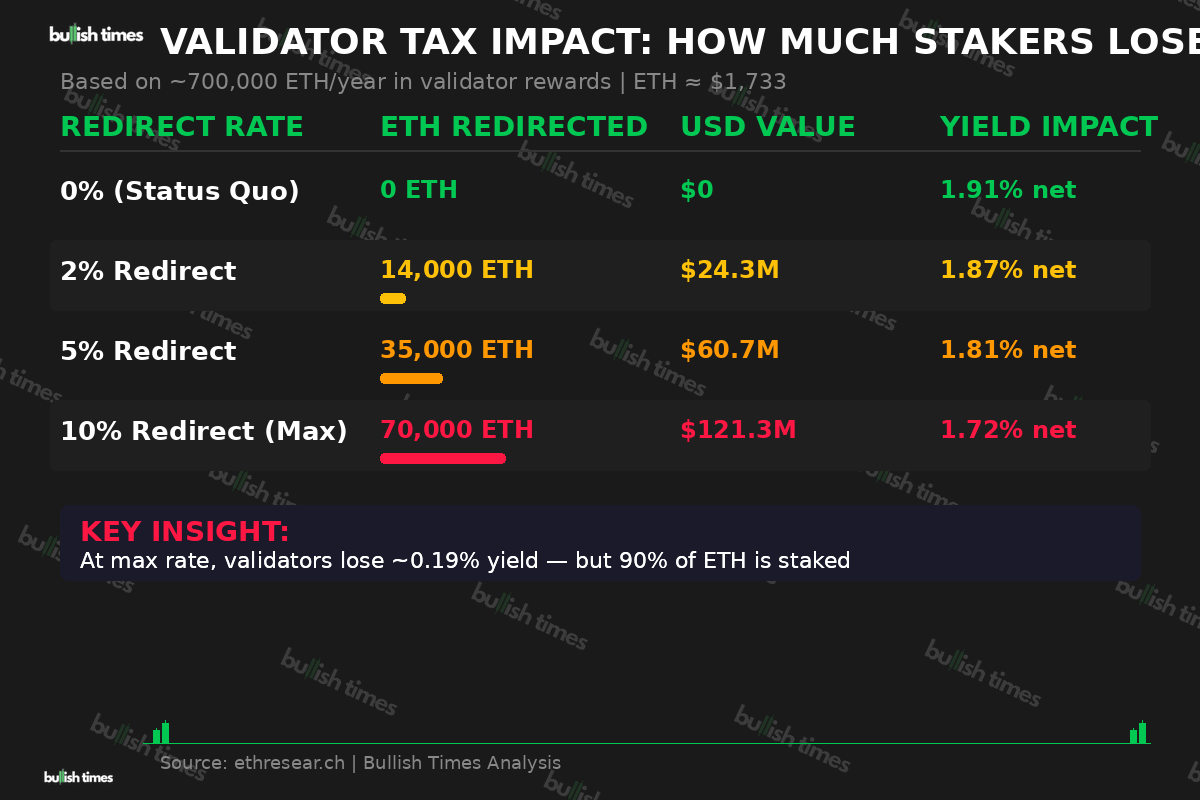
The mechanics are deceptively simple. Each validator signals a preferred contribution rate between 0% and 10% of their staking rewards. If more than 50% of validators signal a rate above zero, that rate becomes mandatory for all validators — including those who voted against it.
The redirected ETH flows into a “splitter” smart contract that distributes funds among recipients based on validators’ stated preferences. Lesaege frames this as a solution to Ethereum’s chronic free-rider problem: everyone benefits from shared infrastructure, security research, and developer tooling, but nobody wants to foot the bill.
The numbers are substantial. With roughly 700,000 ETH flowing to validators annually in staking rewards, a 5% to 10% redirect would channel between 35,000 and 70,000 ETH per year into ecosystem funding — worth approximately $60 million to $131 million at current prices.
A Foundation in Freefall
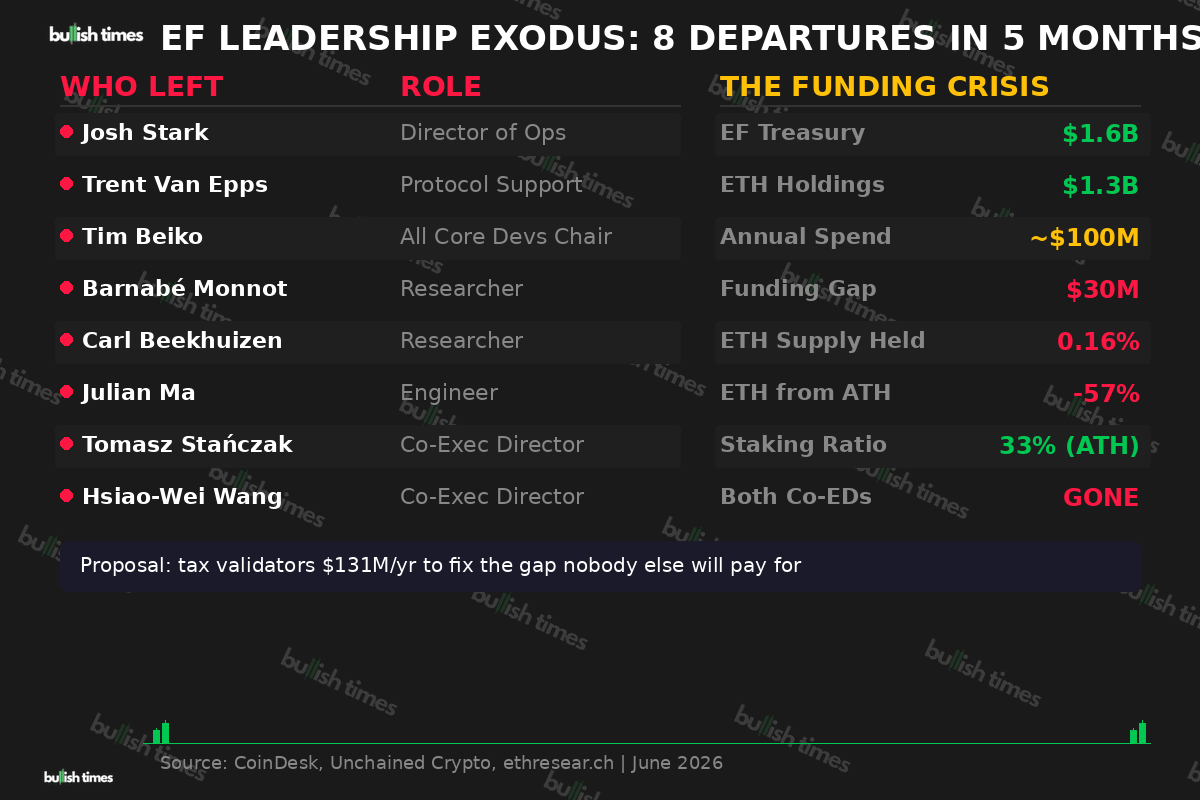
The proposal does not exist in a vacuum. It arrives as the Ethereum Foundation staggers through its most turbulent period since the network launched. Eight senior leaders have departed in just five months, including both co-executive directors — Tomasz Stańczak earlier this year and Hsiao-Wei Wang on 18 June. The exodus includes Tim Beiko, who chaired All Core Devs calls, and researchers Barnabé Monnot and Carl Beekhuizen.
The Foundation currently holds roughly $1.6 billion in its treasury, with $1.3 billion in crypto assets. That sounds healthy until you consider the confirmed $30 million funding gap and annual spending of approximately $100 million. Former EF contributor Anders Elowsson has warned that Ethereum core-dev funding could run dry within three to nine months.
Vitalik Buterin has acknowledged the Foundation controls just 0.16% of all ETH — far below the 10% to 50% that competing Layer 1s typically retain. His response has been to advocate for a “smaller, sharper” Foundation rather than a better-funded one. Critics argue that is a euphemism for managed decline.
“The people who are leaving the Ethereum Foundation are CROPS believers,” former EF researcher Dankrad Feist wrote on X. “The problem isn’t with the strategy, it’s with management. The exodus of talent is truly bearish for Ethereum, sadly.”
The Cartel Problem Nobody Can Solve
Opposition to the Ethereum validator staking rewards redirect has been fierce, and the objections go deeper than the headline percentage. The most alarming risk is validator cartelisation. Approximately 90% of staked ETH flows through operators — staking firms, liquid-staking protocols like Lido, and exchanges like Coinbase — rather than solo stakers. Those operators would set the funding preferences, but the lost yield comes directly from the pockets of ETH holders who delegated to them.
MetaLeX Labs CEO Gabriel Shapiro argued the proposal comes from “insiders trying to preserve influence as Ethereum turns more capitalistic.” Developer MicahZoltu warned on ethresear.ch that the cartel problem remains fundamentally unsolved.
Not everyone is hostile. Gnosis co-founder Martin Köppelmann called it “the first public-goods funding proposal I wouldn’t dismiss immediately,” praising its lack of a hardcoded recipient or minimum threshold. He has a point: the design deliberately avoids naming any specific beneficiary, relying instead on emergent validator preferences.
But that flexibility is also a vulnerability. A coordinated coalition holding a majority of stake could steer the entire redirected pool toward projects they own. In a network where Lido alone controls roughly 28% of staked ETH, the distance between “collective funding” and “oligarch capture” is uncomfortably short.
The Bigger Question Ethereum Cannot Dodge
Buried beneath the debate over redirect percentages and splitter contracts lies a genuinely uncomfortable question: has Ethereum’s governance model failed?
The validator tax proposal is not just a funding mechanism — it is an admission that the existing model of foundation grants, voluntary donations, and good vibes cannot sustain a $200 billion network. Ethereum has spent a decade arguing that decentralisation means no single entity should control the purse strings. The result is a network where nobody holds the purse strings, the treasury is haemorrhaging talent, and a forum post from a dispute-resolution protocol founder is the best idea anyone has come up with.
Critics who argue Ethereum should simply reduce issuance instead of redirecting rewards have a legitimate point. If validators are willing to give up 10% of their income, why not just burn that ETH instead? The answer reveals the proposal’s true purpose: this is not about efficiency. It is about control. Whoever directs the $131 million shapes Ethereum’s roadmap, and that is a power too valuable to leave on the table.
The proposal remains at the research-forum stage with no implementation timeline. Ethereum’s path from idea to live protocol is deliberately slow, requiring formal specification, client-team review, security analysis, and broad social consensus. Plenty of forum proposals never make it past the discussion thread.
But the fact that it exists — that serious builders are openly proposing mandatory taxes on the consensus layer — tells you everything about where Ethereum stands in June 2026. The world’s leading smart-contract platform is watching its leadership walk out the door, its token languish 57% below all-time highs, and its community reach for increasingly desperate measures.
Whether the Ethereum validator tax proposal advances or dies on the forum, the crisis it was designed to solve is only getting worse. This story is developing.