The prediction market that promised radical transparency has been caught running one of the most brazen deception campaigns in crypto history — and it targeted the one country where it is banned from operating.
A Wall Street Journal investigation published on 21 June has exposed Polymarket for paying dozens of influencers to film fabricated winning bets on dummy clone websites, then flooding social media with the content to lure new users. The total value of the staged wins? Roughly $1.9 million. The number that were real? Zero.
The Clone Site Playbook
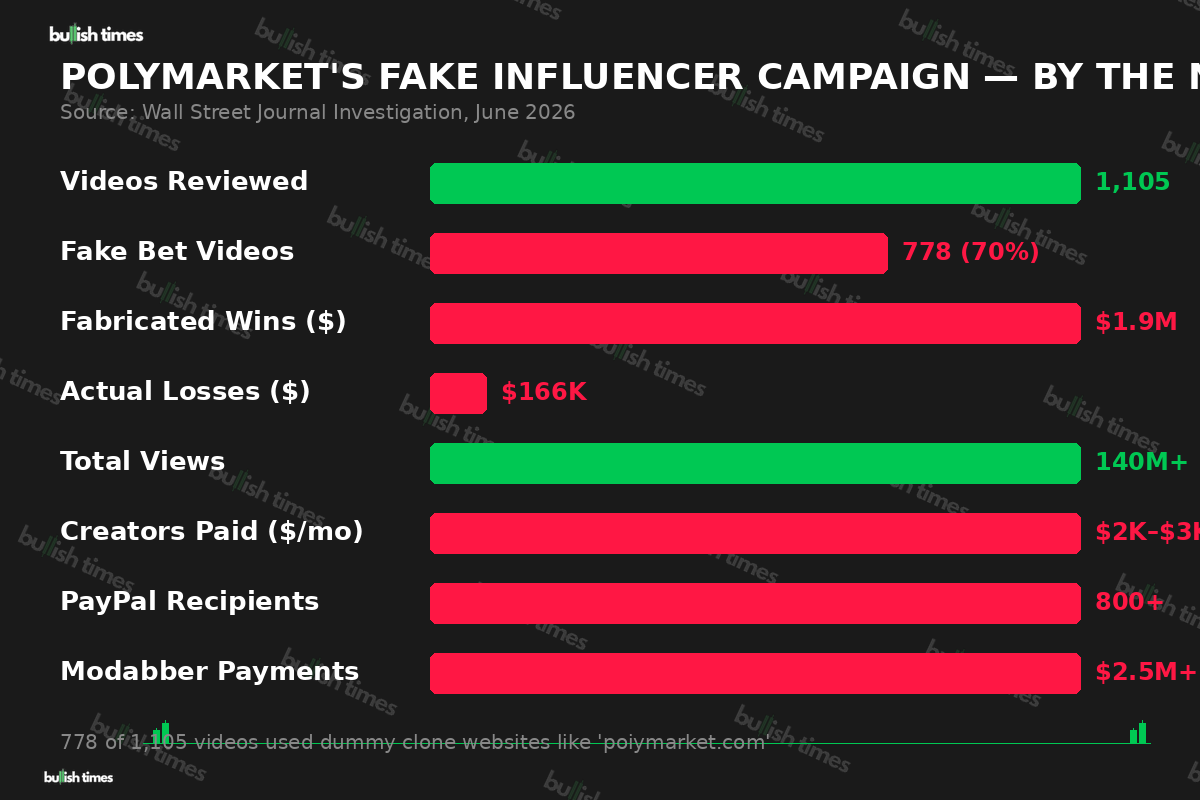
The scheme was elegant in its dishonesty. Polymarket created near-identical copies of its own website — complete with altered URLs such as “poiymarket.com” — and handed them to content creators. These influencers, predominantly college-aged and paid between $2,000 and $3,000 per month, filmed themselves appearing to place and win bets on what looked like the real Polymarket interface.
The WSJ reviewed 1,105 pro-Polymarket TikTok videos published between December 2025 and mid-May 2026. Of those, 778 — a full 70 per cent — showed bets being placed on dummy websites, not the actual platform. The bets were not verifiable on-chain because they never happened.
Across 118 videos where creators celebrated specific “wins,” the fabricated winnings totalled approximately $900,000. In reality, those same bets — had they been placed on the real Polymarket — would have resulted in losses exceeding $166,000. One particularly brazen example: in January 2026, student George Makihara filmed a $100,000 “win” on a bet that President Trump would say “McDonald’s.” Trump never said it in January. The video was two months old. Every real Polymarket user who placed the same bet lost.
Targeting Americans From the Shadows
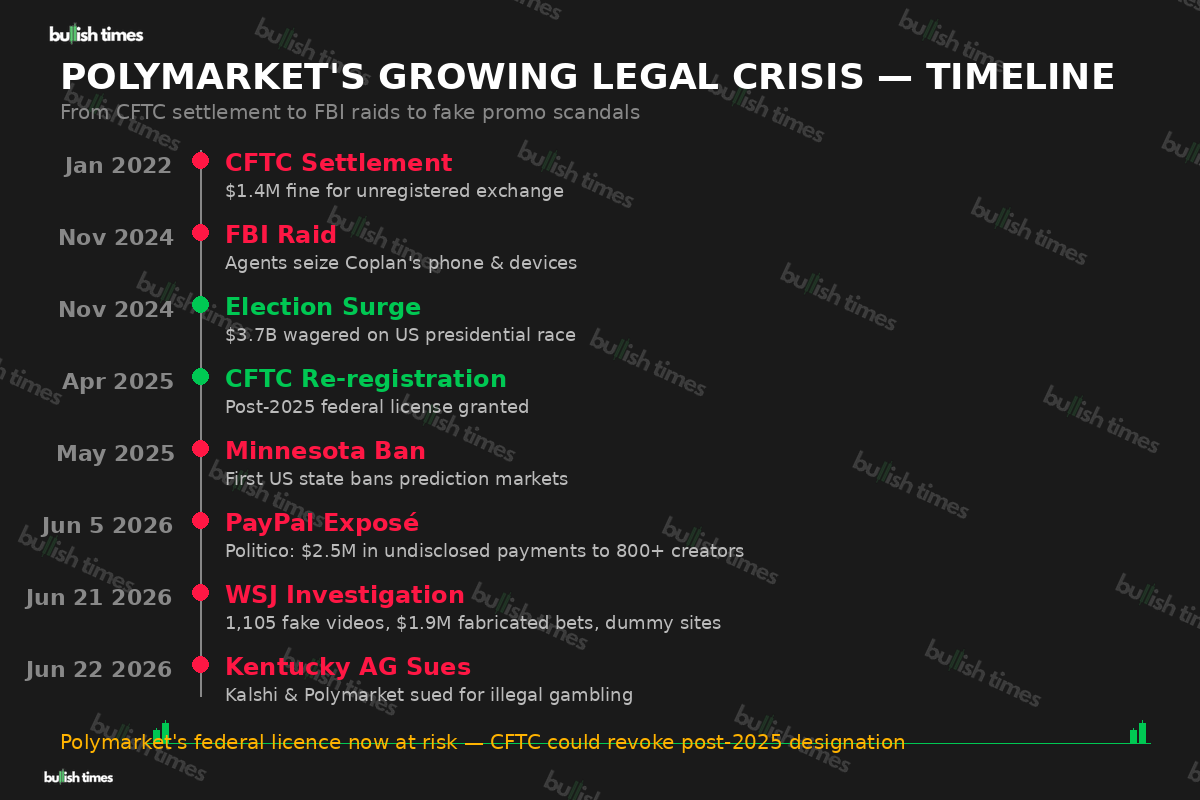
Here is where the scandal moves from embarrassing to potentially criminal. Polymarket has been explicitly banned from serving American users since its 2022 CFTC settlement, in which the platform paid a $1.4 million penalty for operating an illegal, unregistered events market. Yet the marketing campaign was specifically engineered to reach US audiences.
The marketing agency running the operation, Virality, paid influencers only if at least 60 per cent of their viewership was based in the United States. The videos racked up more than 140 million views across TikTok, YouTube, and Instagram — platforms where American teenagers are the primary audience.
Polymarket’s defence has always been that US users can view its data but cannot trade. In practice, anyone with a VPN can bypass those restrictions. Running a targeted advertising campaign aimed at a market where you are legally prohibited from operating is, at best, reckless. At worst, it is a deliberate attempt to build an American user pipeline through the back door.
Two Scandals in One Month
The WSJ investigation is not even the first Polymarket marketing exposé this month. On 5 June, Politico reported that Polymarket’s marketing director, Matthew Modabber, used a personal PayPal account to pay content creators promoting the platform’s quotes on X without disclosing the commercial relationship. According to that report, Modabber funnelled at least $2.5 million through his account to more than 800 recipients.
The WSJ also revealed that streamer Adin Ross holds a multimillion-dollar contract with Polymarket, and that the platform paid influencers to promote at least 19 videos discussing insider trading — despite publicly claiming it prohibits trading on stolen or confidential information.
This pattern is deeply corrosive. Polymarket’s entire value proposition rests on the idea that prediction markets are transparent, on-chain, and verifiable. Every bet settles on Polygon in USDC. Every outcome is publicly traceable. That is the pitch. But if the company’s marketing arm is built on fabricated content, spoofed websites, and undisclosed payments, the transparency claim collapses into theatre.
The Licence Is Now at Stake
The timing could not be worse for Shayne Coplan’s $9 billion baby. Polymarket secured a post-2025 federal licence from the CFTC — essentially a second chance after the 2022 debacle. That designation legitimised the platform and cleared its path toward eventually re-entering the regulated US market.
But the CFTC now has fresh ammunition. If regulators determine that the influencer campaign constitutes a “pattern of deceptive practice,” they could move to revoke Polymarket’s designation entirely. Any finding of systematic misrepresentation puts the federal licence at risk.
And the threats are piling up from multiple directions. On the same weekend the WSJ investigation dropped, Kentucky’s Attorney General filed suit against both Polymarket and rival Kalshi over alleged illegal gambling. Minnesota has already become the first US state to ban prediction markets outright. The Google engineer insider-trading indictment from May — in which Michele Spagnuolo allegedly used confidential Year in Search data to win $1.2 million on Polymarket — remains an active federal case.
Polymarket has promised to “conduct a full audit of its promotional content.” Given that the content in question was deliberately fabricated on websites the company itself created, one wonders what exactly there is left to audit.
Transparency Theatre Has an Expiry Date
Prediction markets represent one of the most genuinely useful innovations in crypto. When they work honestly, they aggregate information better than polls, pundits, or experts. Polymarket proved this spectacularly during the 2024 US presidential election, when $3.7 billion in wagering activity produced forecasts that outperformed every major polling model.
But that legitimacy was hard-won and is easily destroyed. You cannot simultaneously claim to be the world’s most transparent marketplace and run a shadow marketing operation built on clone websites, fake bets, and undisclosed influencer payments targeting a country where you are legally banned from operating.
Shayne Coplan is 28 years old, reportedly the world’s youngest self-made billionaire, and presiding over a platform that has never turned a profit. The 2024 election made Polymarket famous. The 2026 WSJ investigation may well be what makes it infamous.
This story is developing. The CFTC has not yet publicly responded to the WSJ findings. Polymarket’s “full audit” timeline remains unspecified.