Tomorrow, the world’s largest crypto exchange will be locked out of the European Union — and 450 million potential customers with it. Binance’s MiCA licence bid has collapsed, and the fallout is only just beginning.
The clock struck midnight on Binance’s European ambitions this week when the exchange quietly withdrew its Markets in Crypto-Assets (MiCA) licence application in Greece — just days before the 1 July enforcement deadline. Without approval in a single EU member state, Binance will suspend services for European users starting tomorrow. New sign-ups, deposits, spot orders, staking, and Earn products: all frozen.
The Great MiCA Cull
The scale of the Binance EU exit is staggering, but it is merely the most visible casualty of Europe’s regulatory reckoning. MiCA — the EU’s first comprehensive crypto framework — demands that every exchange, broker, and wallet provider secure a formal licence to operate across the bloc. The transition window closes tomorrow, and the numbers paint a brutal picture.
According to the European Securities and Markets Authority (ESMA), only around 210 firms had obtained full MiCA authorisation by May 2026 — out of more than 1,200 that previously held national crypto registrations. That is an 83% failure rate. The vast majority of the old market has been wiped off the European map.
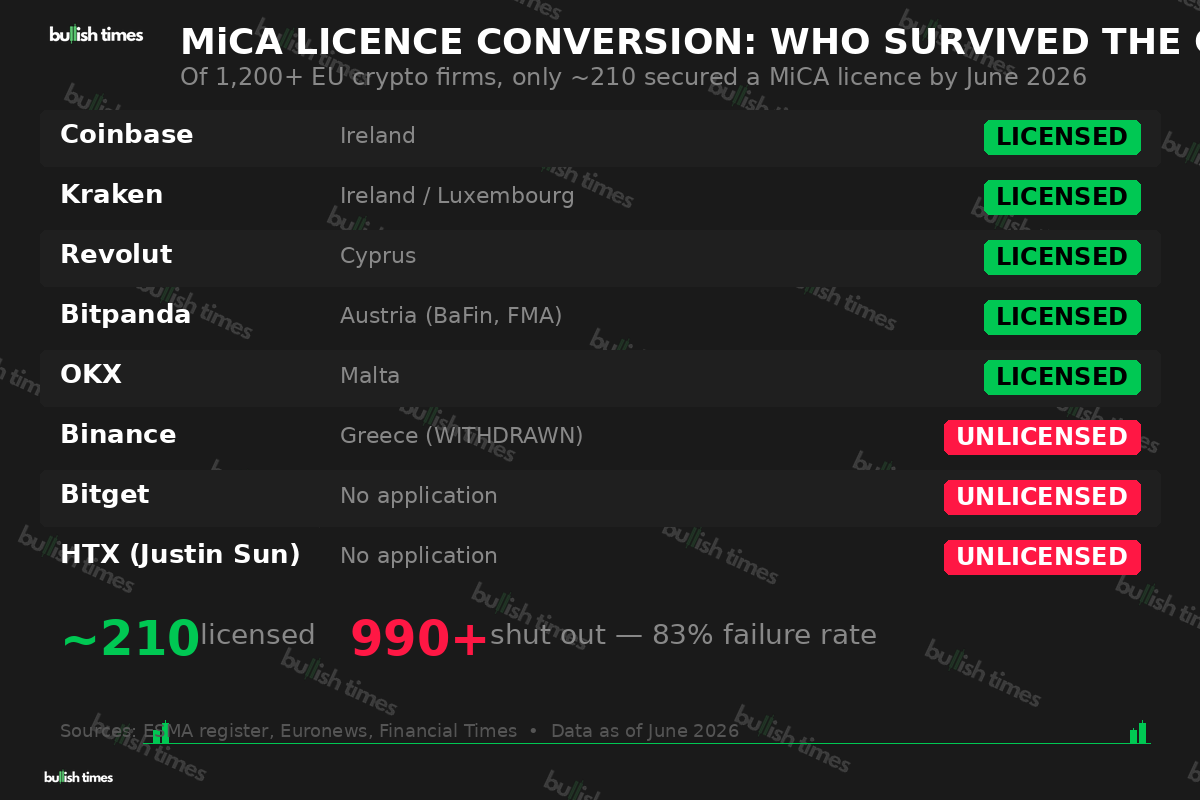
Coinbase secured its licence in Ireland. Kraken got approved in Ireland and Luxembourg. Revolut obtained authorisation through Cyprus. Bitpanda, already established across Austrian, German, and Maltese regulators, sailed through. These firms now stand to absorb millions of displaced Binance users — a regulatory windfall that competitors could only have dreamt of.
A Rap Sheet That Writes Itself
Binance’s European ejection did not happen in a vacuum. The exchange carries a regulatory rap sheet that reads like a cautionary tale for the entire industry.
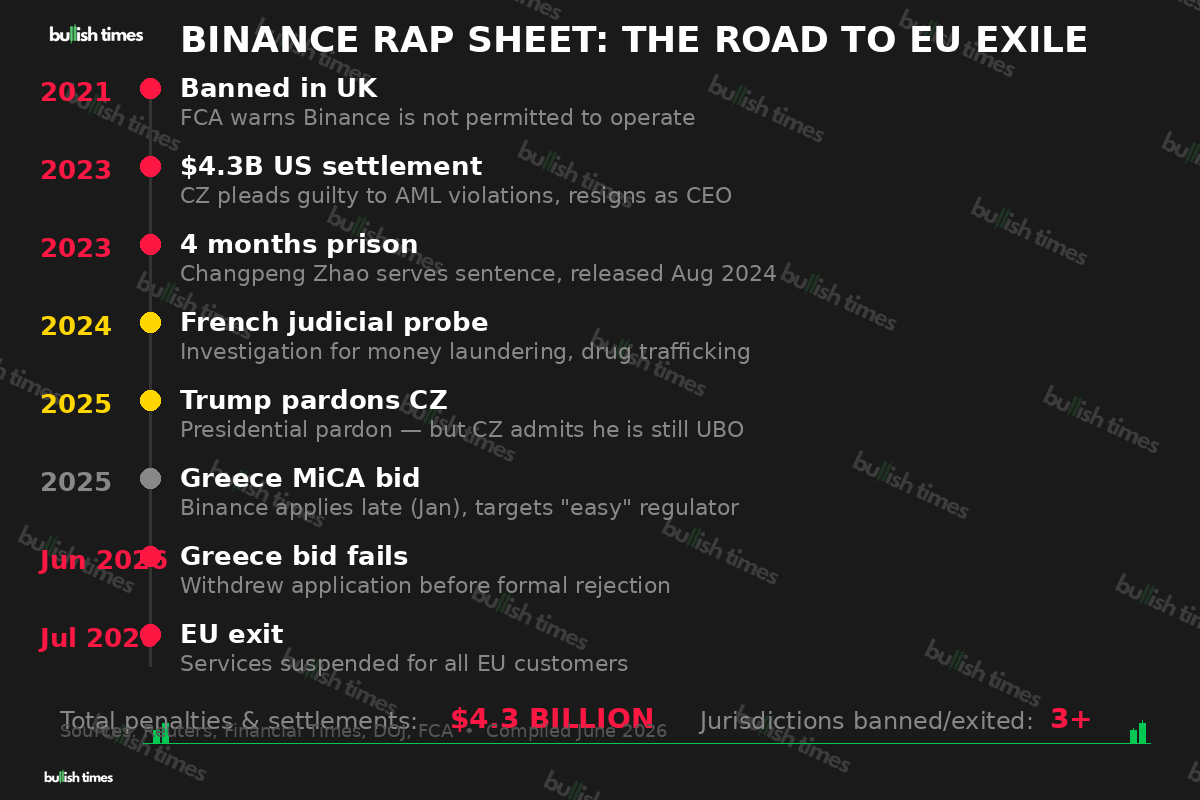
In 2021, the UK’s Financial Conduct Authority effectively banned Binance from operating in Britain. In 2023, founder Changpeng Zhao (CZ) pleaded guilty to anti-money laundering violations in the United States and agreed to a jaw-dropping $4.3 billion settlement — the largest in crypto history. CZ served four months in federal prison and resigned as CEO, handing the reins to Richard Teng.
Then came the plot twist. Despite Binance’s insistence that CZ has been “100% removed” from operations, CZ himself admitted in a February 2025 podcast that he remains the “ultimate beneficial owner” of the exchange. For European regulators already sceptical of Binance’s governance, that admission was petrol on a smouldering fire.
France launched a judicial investigation into Binance for alleged money laundering linked to drug trafficking and tax fraud. And when the exchange finally submitted its Greek MiCA application in early 2025 — widely seen as targeting what insiders described as a “friendlier” regulator — it was too little, too late. According to French crypto publication The Big Whale, ECB President Christine Lagarde herself allegedly opposed the bid, though neither the ECB nor Greece has publicly confirmed this.
The Bigger Picture: Europe’s Crypto Power Play
Here is the uncomfortable truth that neither Binance critics nor MiCA cheerleaders want to acknowledge: Europe’s regulatory experiment is simultaneously a consumer protection triumph and a competitive disaster.
On one hand, every European crypto holder who survives the transition will be on “safer rails,” as Crossmint’s Head Counsel Miguel Zapatero put it. Licensed exchanges must meet capital requirements, segregate customer funds, and comply with anti-money laundering standards that previously existed only on paper.
On the other hand, the EU just handed the world’s largest crypto exchange to its competitors on a silver platter. Binance’s 4 million-plus EU app downloads from last year alone represent a colossal user base now up for grabs. The exchange insists it will return — “our ambitions in Europe remain the same,” a company statement read — but every day offline is a day its rivals entrench themselves.
The India parallel is instructive. When Indian regulators cracked down on offshore exchanges, USDT premiums spiked above 8.5% as users scrambled for on-ramps. Europe’s wealthier, more regulated market is unlikely to see such extreme dislocations, but displaced Binance users will feel the friction of forced migrations, potential tax events, and the sheer hassle of re-verifying identities on new platforms.
What Happens Next
Binance says it is exploring a fresh MiCA application — reportedly in France, of all places, given the active judicial investigation there. If the irony is lost on Binance’s compliance team, it certainly is not lost on the market.
The reality is that MiCA has drawn a hard line between the exchanges that played the regulatory game early and those that thought they could muscle through on brand recognition alone. Coinbase, Kraken, and Bitpanda did the paperwork. Binance, the exchange that once boasted it had no headquarters at all, discovered that “decentralised” is not a compliance strategy.
For Europe’s 450 million citizens, the Binance EU exit is either a sign that regulation works or proof that Brussels is building a walled garden that locks out innovation. The truth, as ever, sits somewhere in between — but Binance’s empty European offices tell their own story.
This is a developing story. Binance has until midnight tonight to communicate directly with affected EU users about the transition. We will update this article as the deadline passes.