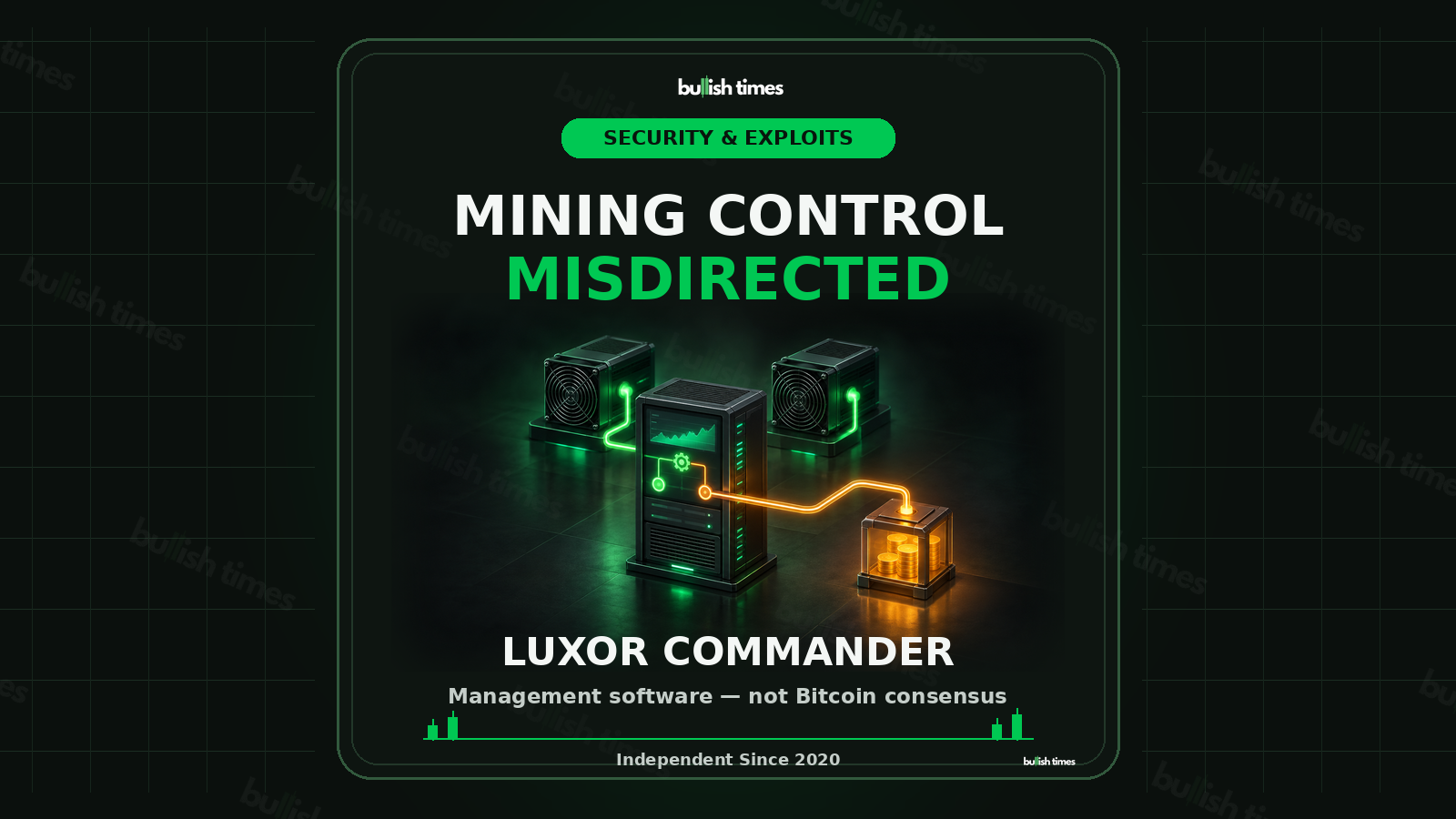
Bitcoin can validate every block correctly while a miner’s machines earn money for somebody else. Luxor’s Commander incident exposes the gap between a secure network and the management controls deciding where computing power goes.
The reported failure was not Bitcoin’s consensus mechanism, the rules through which its network agrees on valid transactions and blocks. It was the software layer directing miners’ work and reward settings. Calling that distinction a defence of Bitcoin misses the point: it identifies who must answer the operational questions.
The machines kept working, but for whom?
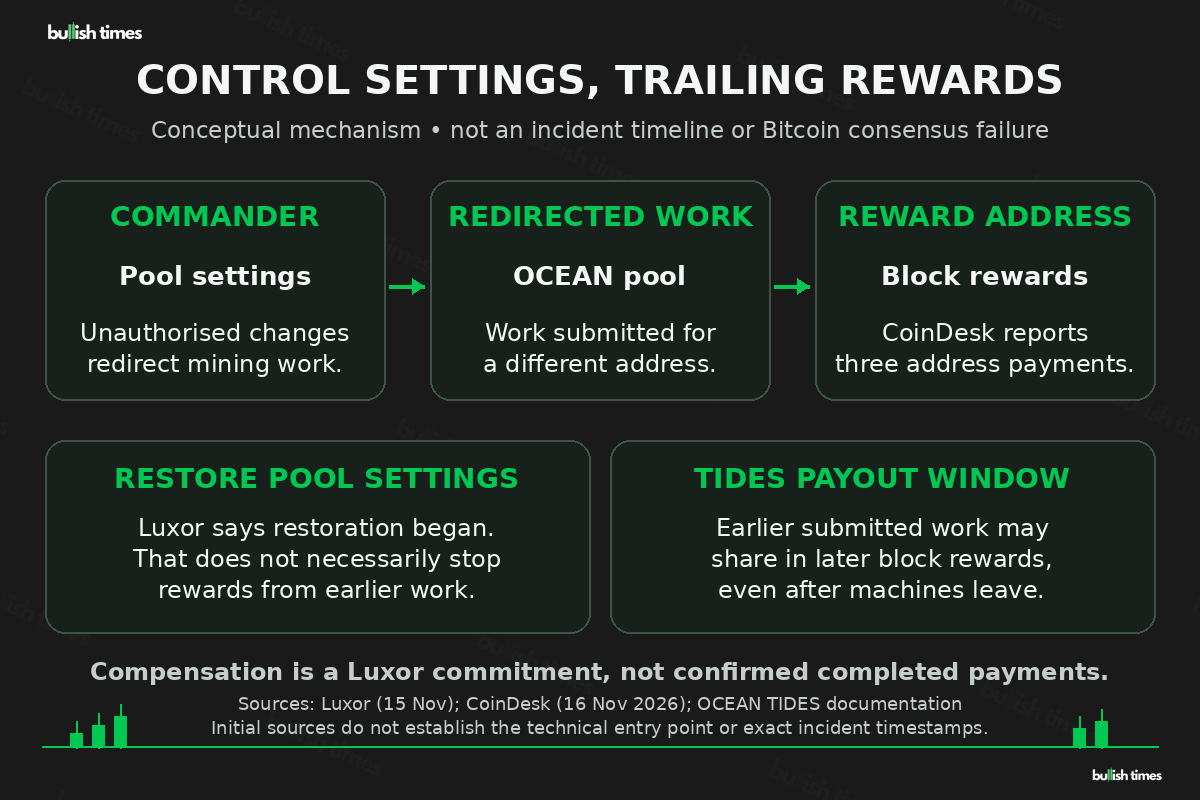
In its 15 November statement, Luxor said internal monitoring detected an unauthorised redirection of hashrate through Commander. Hashrate is computing power devoted to mining; Commander lets operators manage mining machines and change settings remotely.
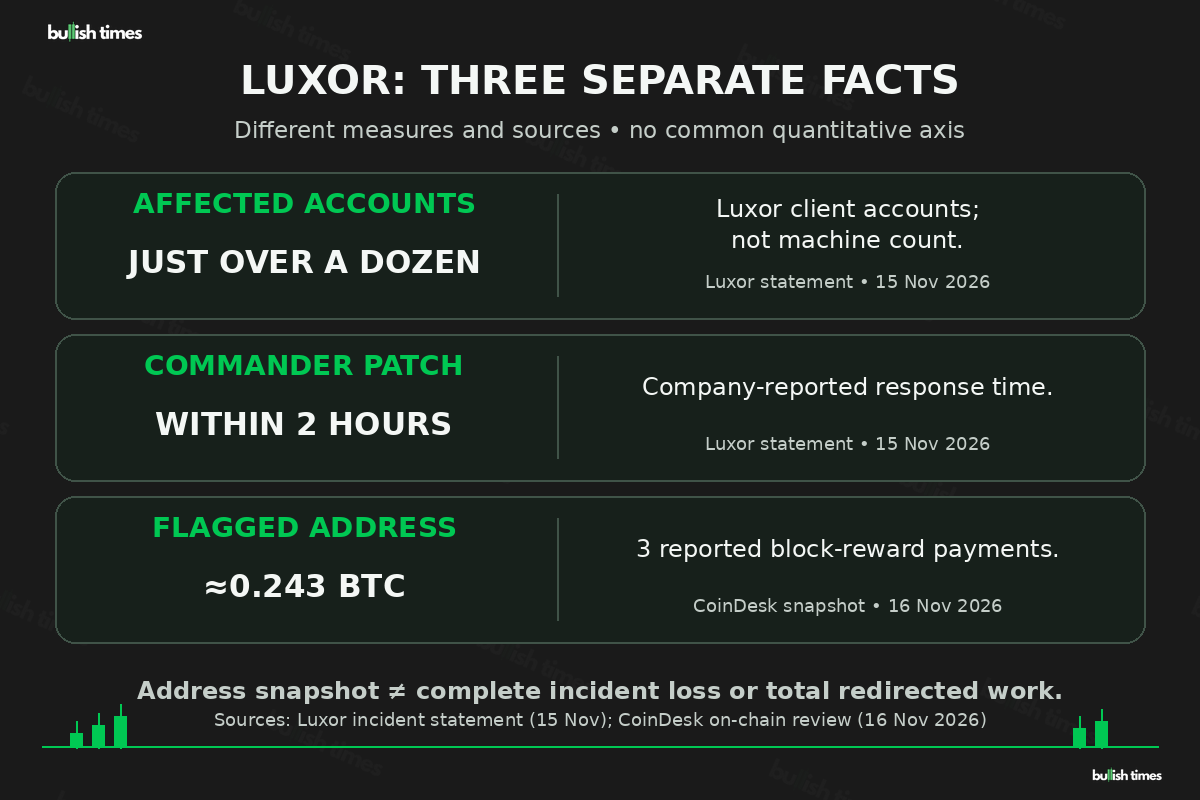
Luxor put the impact at “just over a dozen client accounts”, with affected machines pointed to a different mining pool for a limited window. A pool combines miners’ work and distributes rewards. Accounts are not machines: the statement does not establish an exact fleet size or the proportion of customers’ computing power diverted.
CoinDesk reports that machines were redirected to OCEAN and explains the consequence: changing pool and payout settings can assign earnings elsewhere without switching the equipment off. Owners can keep supplying electricity while losing the economic benefit of their work.
That is why a management console is not merely an administrative convenience. Its control plane, meaning the software deciding how machines operate, can exercise authority over income even without holding an existing bitcoin balance. The security boundary is where that authority can be changed, not simply where coins are stored.
A visible address is not the incident balance sheet
CoinDesk says an address flagged by mining host CoreX Hosting received three block-reward payments totalling approximately 0.243 bitcoin (BTC), worth roughly $15,700 at its reporting-time valuation. Its Monday-morning assessment found those coins unspent.
That is a reported-address snapshot, not an independently established total incident loss. It does not measure all diverted work, prove there were no other destinations, or settle what every affected customer should receive. An unspent balance also does not mean the earnings were returned.
The payout timing needs equal care. OCEAN’s TIDES documentation describes the Transparent Index of Distinct Extended Shares, its system for tracking submitted mining work and allocating rewards. A share is evidence of work submitted to the pool, not ownership of a company.
The documentation explicitly says shares can continue receiving rewards after a miner stops mining, until they leave the relevant rolling window. Its described window covers eight blocks’ worth of work, not a fixed eight-block waiting period or a guaranteed payment schedule.
Later receipts therefore do not, by themselves, prove machines are still redirected. Equally, an early lack of receipts would not prove that diverted work earned nothing. Incident accounting must reconcile submitted work, reward eligibility and actual payments rather than declaring victory from one address check.
A quick patch deserves credit, not a blank cheque
Luxor says Commander was patched within two hours and it began restoring affected machines to their original pool settings. It also says no data was leaked or exfiltrated, meaning taken from its systems. These are company claims, not findings from a published independent investigation.
A prompt response matters. So does Luxor’s commitment that “every affected client will be paid in full for the redirected hashrate, as if it had mined normally”. But a promise to compensate is not confirmation that compensation has been paid.
Nor does patching the software establish when every machine was restored or every consequence reconciled. The statement supplies a response interval, not a complete incident timeline. At the time of the reviewed sources, Luxor had promised a full post-mortem; the technical entry point remained undisclosed.
The post-mortem must explain the authority
The useful questions are concrete: what permitted unauthorised setting changes, which controls should have stopped them, and what evidence establishes the affected work? Customers also need a clear compensation calculation and confirmation of payment, not merely an assurance that the dashboard is operating normally.
Those are accountability tests, not allegations that particular safeguards were absent. Without the technical report, prescribing a specific failed credential, permission or exploit would be invention. A serious explanation should distinguish initial access, authority to alter settings and detection, rather than compressing them into one dramatic label.
The wider lesson is sharper than “Bitcoin was hacked” or “Bitcoin worked, so nothing important failed”. Network validation and an operator’s commercial security solve different problems. A correctly validated reward can still reflect work redirected without its owner’s permission.
Luxor’s response will be judged by restored control, evidenced accounting and completed compensation. Bitcoin’s rules cannot substitute for any of them.