A stablecoin can be fully backed and still leave holders waiting for redemption. In a cross-border crisis, the hard question is not only whether reserves exist, but whether they can reach the people entitled to redeem them in time.
That is the commercial fault line in the Financial Stability Board’s 12 October note on global stablecoins, released ahead of the G20 finance ministers’ and central bank governors’ meeting on 15 October. The FSB is not alleging that a named coin is failing; it is warning that round-the-clock tokens may outrun the legal, banking and settlement arrangements expected to support them.
A reserve is not a redemption route
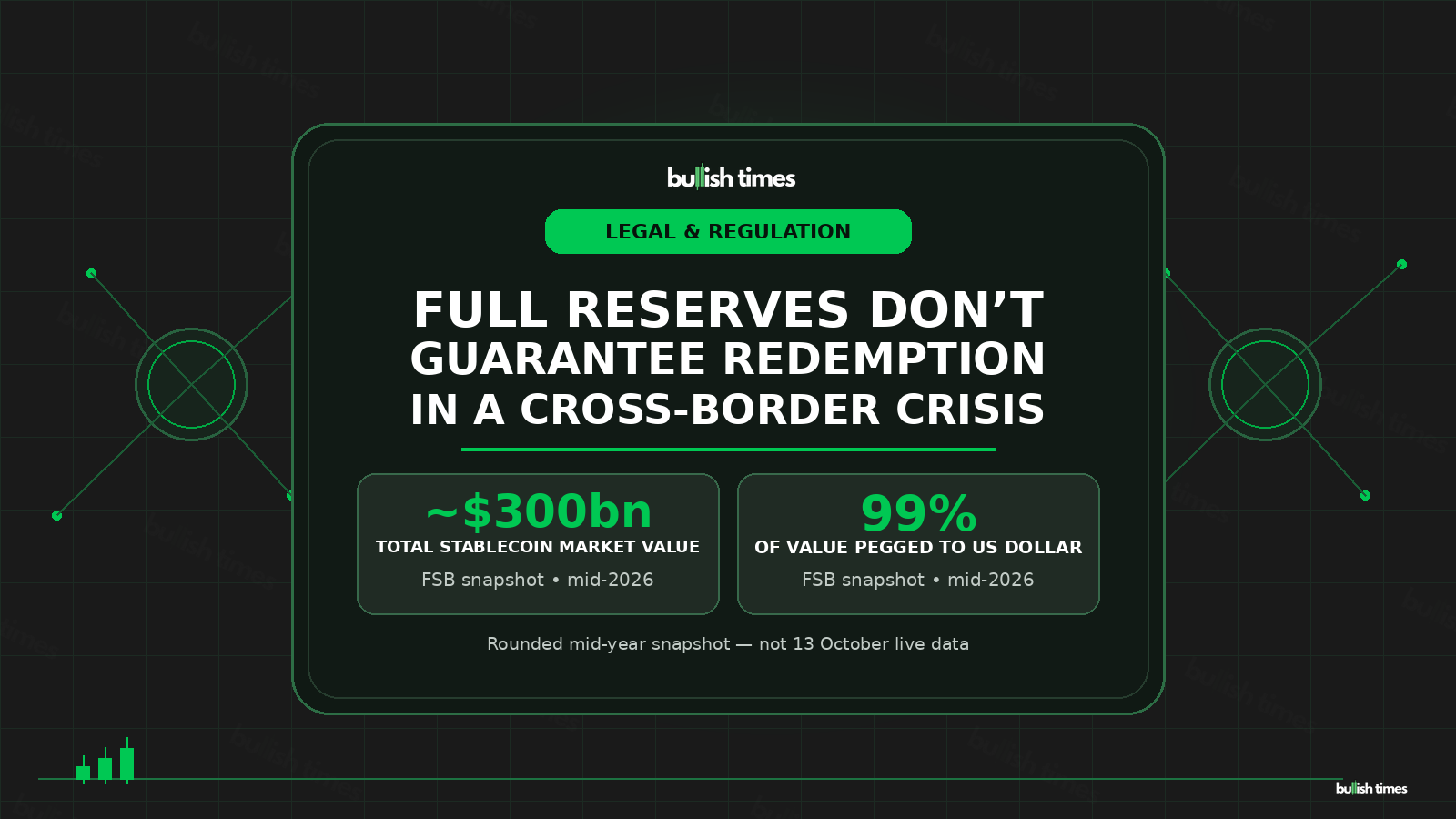
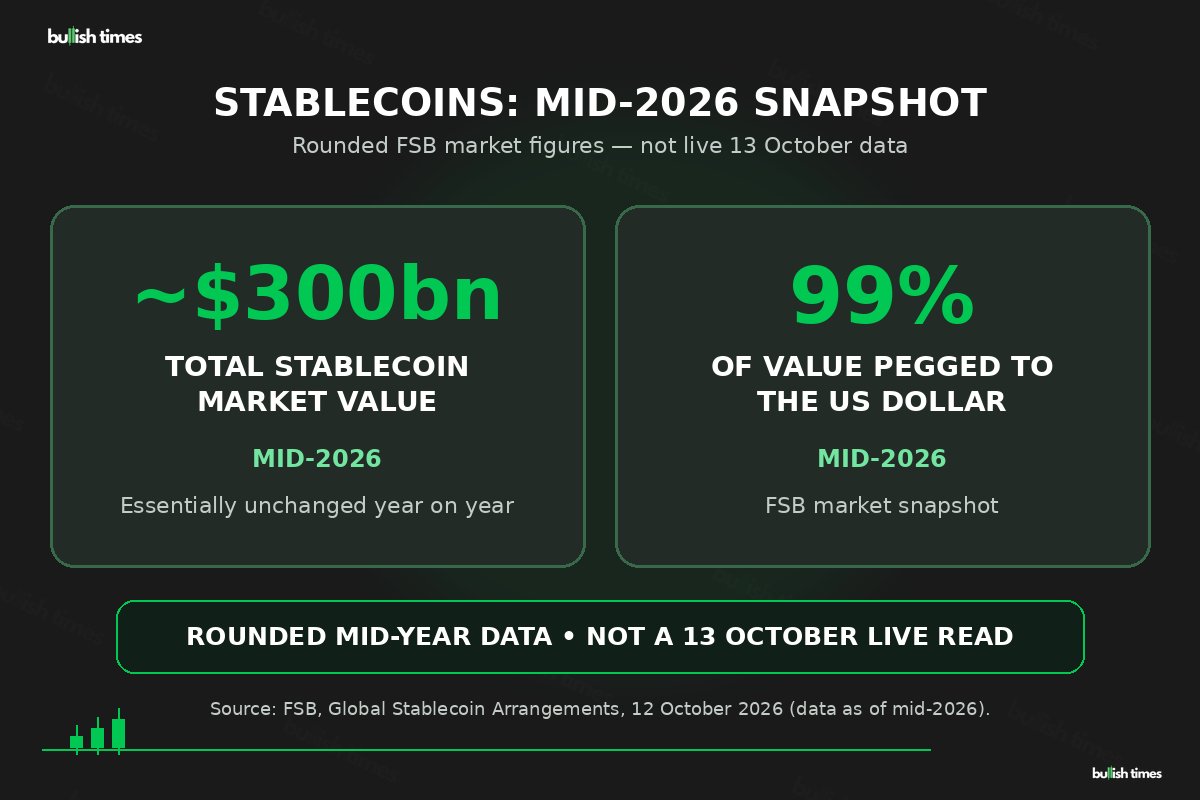
The scale makes the question hard to dismiss. The FSB report puts the stablecoin market at around $300 billion as of mid-2026, essentially unchanged from a year earlier, with 99 per cent of value pegged to the US dollar. Those are rounded mid-year figures, not a live market reading for 13 October.
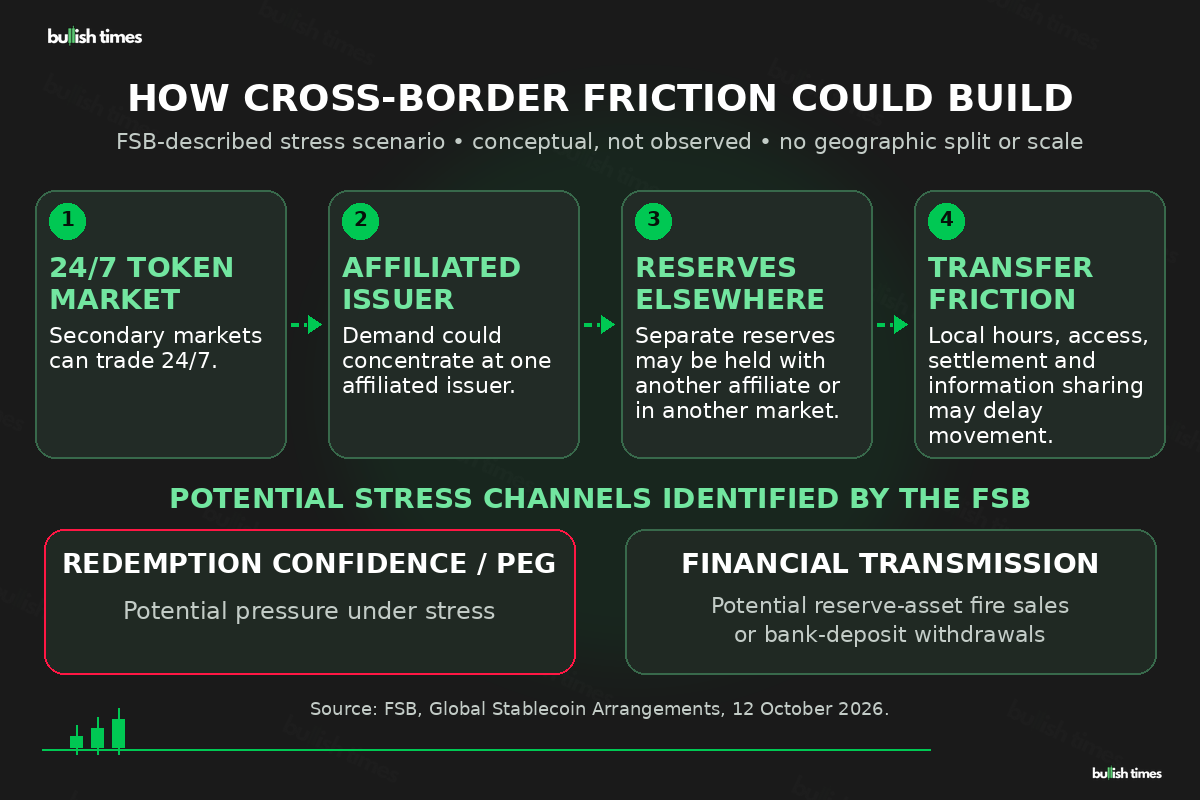
Its more important point is structural. In a multi-issuer arrangement, affiliated issuers may share liability for one stablecoin while holding separate reserves. Holders may be able to redeem through any affiliated issuer; if requests concentrate at one entity while reserves sit elsewhere, the system must move liquidity across the relevant legal and banking rails. The FSB uses “global stablecoin” for arrangements reaching and used across multiple jurisdictions, with potential systemic importance in one or more.
That is the gap between stablecoin reserves and cross-border redemptions. An aggregate reserve total can look adequate while saying little about which entity holds each asset, whether it can be transferred promptly, or which insolvency rules apply if an affiliate fails. The FSB describes a potential vulnerability, not a finding that every issuer uses this structure or that any particular reserve is misplaced.
Twenty-four-hour tokens meet local-market clocks
Stablecoins can trade on secondary markets 24 hours a day, seven days a week. Reserve assets, redemption channels and settlement, however, remain subject to local market hours and practices. When users seek cash at speed, round-the-clock trading does not make bank transfers, asset sales or cross-border approvals instantaneous. The FSB’s cross-border vulnerability analysis treats that mismatch as a stress channel, not a claim that every stablecoin faces it.
The FSB says rebalancing can depend on reserve mobility, market access, timely information and coordination between firms and authorities. In a multi-issuer structure, a rush of redemptions at one issuer could therefore meet assets held by an affiliate in another market. If those assets cannot be mobilised smoothly, confidence and the secondary-market price may come under pressure even without evidence that the system is under-reserved.
The possible spillovers are wider than a temporary discount. The FSB identifies reserve-asset fire sales, bank-deposit withdrawals to fund redemptions, reliance on stablecoins in payments and settlement, and foreign-exchange markets where stablecoins support cross-border transactions. These are transmission channels to monitor, not losses the FSB says have already occurred.
Nor should this policy debate assume that stablecoins already dominate everyday payments. The FSB says current use is mainly to enter, exit and trade crypto markets; a broader role in lower-cost payments remains prospective.
The visibility gap is a governance problem
Even a well-designed crisis plan is difficult to test if supervisors cannot see where exposure sits. The FSB says a single jurisdiction may be unable fully to assess or address vulnerabilities in a global stablecoin arrangement, while national rules are developing at different speeds. A cross-border issuer structure needs more than a reserve attestation: it needs a shared picture of who can redeem, where assets are held and how quickly they can move.
FSB Chair Andrew Bailey put the coordination problem plainly in his letter to G20 ministers and governors: “Global stablecoin arrangements are inherently cross-border, yet national regulations are taking shape at different speeds and cross-border cooperation in this area is still in its infancy.” That is an institutional warning, not proof that cooperation has failed in a specific case.
Measurement itself is imperfect. Public-chain activity is often pseudonymous, and private data providers use different methods, creating problems of attribution, coverage and comparability. Holder geography and cross-border flows can be hard to verify; a dashboard that appears precise may therefore conceal gaps in the underlying evidence.
Resilience means proving liquidity can move
The FSB’s proposed next steps are practical: continue implementing its 2023 recommendations, especially cooperation and information-sharing; improve monitoring of market depth and liquidity; and gather information on the geographic distribution of holdings, redemptions and reserves. It also calls for more crisis planning for distress or failure. These measures test whether a reserve can be made usable across borders, not merely counted.
There is a counterweight. The FSB notes that deep, liquid secondary markets can support arbitrage that helps restore a peg, and that reserve quality and the regulatory regime remain important to resilience. The note is a stress-risk analysis, not a forecast of a depeg or a claim that any named stablecoin is currently under-reserved.
Its warning that global stablecoin arrangements and national frameworks remain “untested in severe stress and insolvency” should be read literally: the test has not yet come. The note is non-binding, creates no new rule and sets no crisis-planning deadline; the 15 October G20 meeting is a policy milestone, not a confirmed rulemaking date.
For issuers and supervisors alike, the decisive reserve question is not only “how much?” but “where, under whose authority, and how fast can it be redeemed?”