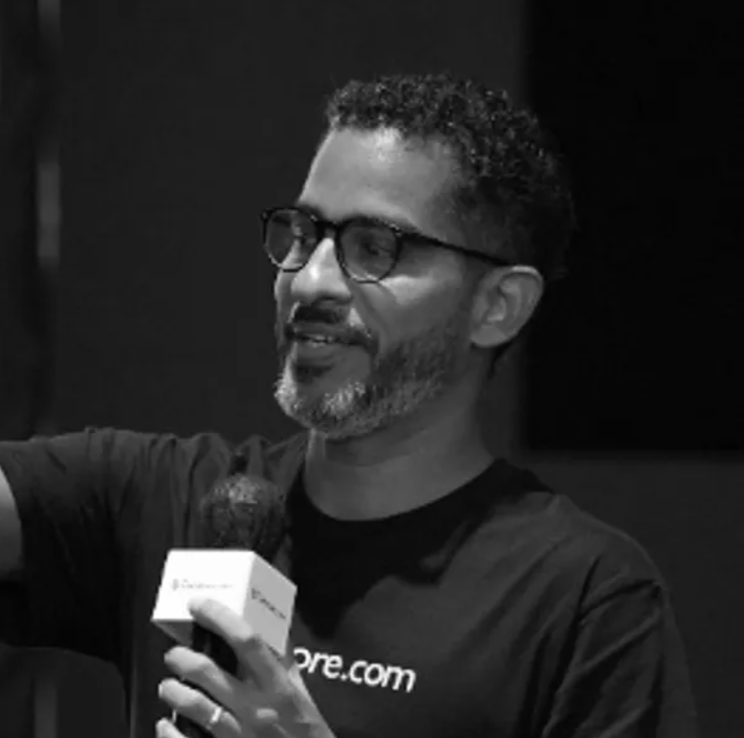
The man who could “send a stock tumbling with a single tweet” just discovered that tweeting isn’t a constitutional right when you’re secretly trading the other way. Andrew Left, founder of Citron Research, has been convicted on 13 counts of securities fraud — and the implications for crypto’s influencer economy are staggering.
A Los Angeles jury took just two days to deliver a verdict that sent shockwaves through both Wall Street and crypto Twitter. Left, 55, was found guilty of running a five-year market manipulation scheme that netted him at least $21 million, using sensationalised social media posts to move stock prices before quietly cashing out on the opposite side.
The Tweet-and-Trade Playbook
The mechanics of Left’s scheme read like a crypto KOL’s instruction manual. Between March 2018 and October 2023, the Citron Research founder would identify a stock, build a position using cheap, short-dated options — sometimes expiring the same day — then publish inflammatory commentary designed to move the price.
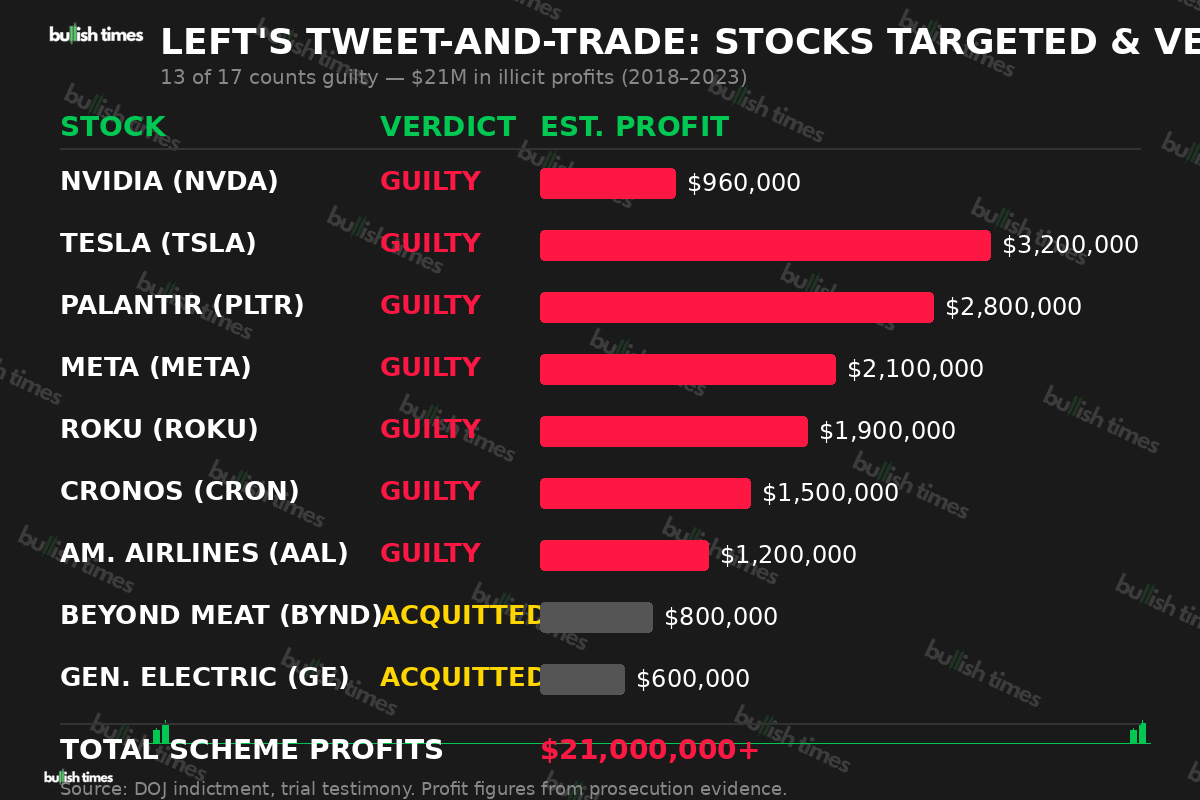
His targets included some of the biggest names in the market: Nvidia, Tesla, Palantir, Meta, Roku, Cronos Group, and American Airlines. The jury convicted him on counts tied to all seven, whilst acquitting him on trades involving Beyond Meat and General Electric.
The Nvidia trade was particularly brazen. In November 2018, Left messaged a hedge fund manager: “Do you want to make some fast money. Put together a thesis why NVDA is oversold… We can destroy it.” He then took long positions, tweeted “Citron buys $NVDA” with a $165 target price, and sold everything within two hours at $150–$151 — pocketing $960,000 whilst the stock fell back to $144 the next day.
‘Taking Candy From a Baby’
Prosecutors painted Left as a man who viewed retail investors as marks. He reportedly boasted that his post-publication trades were like “taking candy from a baby” — a phrase that resonated with jurors who heard testimony from Billy Banks, a retired firefighter who lost $110,000 of his retirement savings after Left publicly savaged a company he’d invested in.
“I just feel redeemed,” Banks told reporters after the verdict. “I’m sorry he has to go to prison. I don’t want to see anybody go to prison. But I lost a lot of money, and that’s not right.”
Behind the scenes, Left’s operation was even more calculated than his public persona suggested. Prosecutors revealed he tipped off hedge funds before publishing his positions, concealed coordination using fake invoices, and lied to law enforcement investigators — telling them Citron had “never” exchanged compensation with a hedge fund.
Left took the stand in his own defence, insisting he genuinely believed his stock calls and had no legal obligation to hold until his stated target prices. His lawyer Eric Rosen argued: “The government wants you to convict a trader for trading like a trader.”
The jury disagreed. Left now faces a statutory maximum of 25 years in federal prison at his 31 August sentencing hearing.
The Crypto Elephant in the Room
Here’s where it gets uncomfortable for the digital asset industry. Everything Left did in traditional markets — publish inflammatory opinions, secretly trade opposite to stated positions, tip off insiders before publication, conceal paid relationships — happens in crypto markets every single day.
The difference? Left is going to prison. Crypto’s paid shillers are still posting.
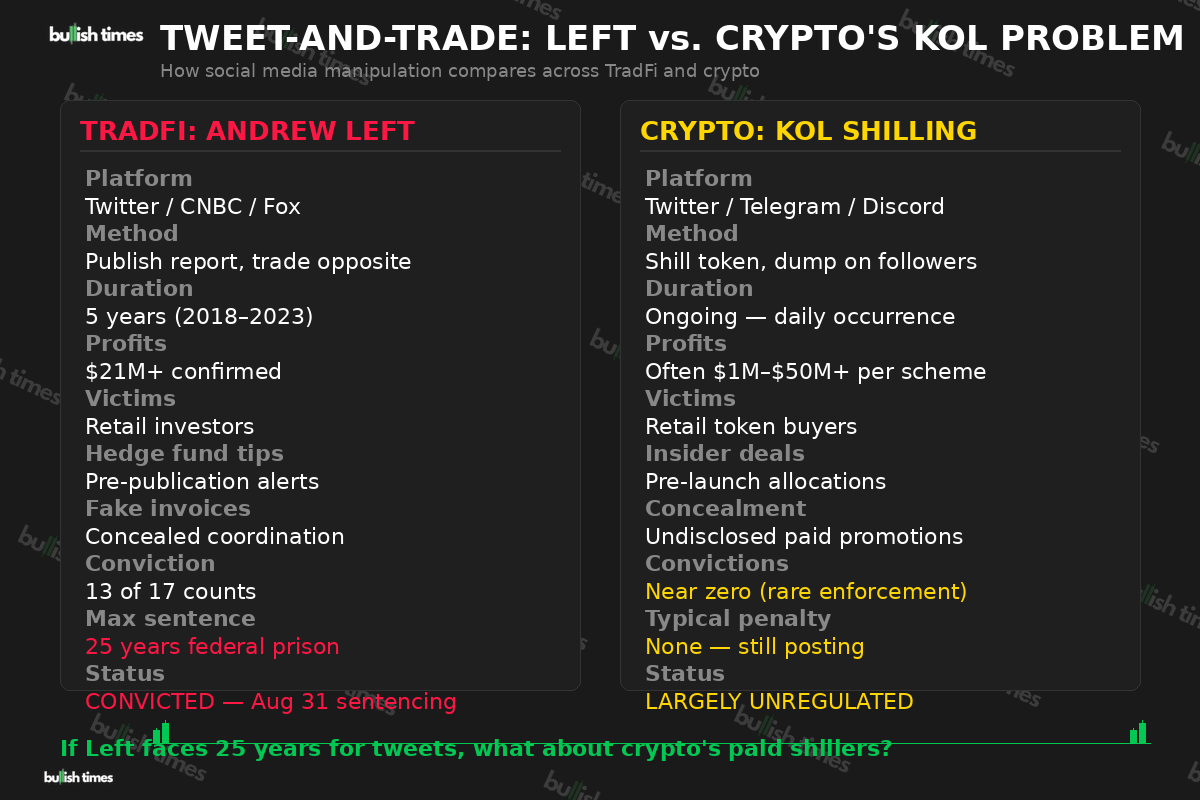
Token influencers routinely receive pre-launch allocations, publish bullish threads to inflate prices, then dump on their followers. Undisclosed paid promotions are the industry’s worst-kept secret. Telegram groups coordinate pump-and-dump schemes with impunity. ZachXBT has documented hundreds of cases where influencers extracted millions — yet criminal prosecutions remain vanishingly rare.
Marc Cohodes, the veteran short seller, declared that Left’s conviction “will mark the END of Smash and Grab, and Short Selling Reports.” But Gordon Johnson of GLJ Research offered a sharper observation: “I know a few folks who do this nearly daily. He was only charged because he’s seen as focused on short-selling. The rules are different when you bet against stocks.”
If the rules are different for shorts versus longs in TradFi, they’re essentially non-existent in crypto.
What Happens Next
Left isn’t going quietly. “Not once did anyone say I lied… There were no false statements,” he posted on X under the Citron Research account. “We disagree with the jury and this does not stop here. We will keep fighting for free, honest speech and opportunity.”
His legal team is expected to appeal on First Amendment grounds, arguing that publishing stock opinions — even sensationalised ones — is protected speech. It’s a defence that will be watched closely by every crypto influencer with a Telegram alpha group and a suspiciously timed token portfolio.
The Left verdict arrives at a peculiar moment for financial regulation. The DOJ is aggressively prosecuting traditional market manipulation whilst crypto’s influencer economy — which operates on precisely the same mechanics, often at larger scale — remains a regulatory blind spot. The SEC has the tools: Section 17(a) of the Securities Act doesn’t distinguish between stocks and tokens when it comes to fraud. It simply hasn’t been deployed with any consistency against crypto’s opinion-for-hire market.
If Left faces 25 years for tweeting about Nvidia and Tesla, the question every paid crypto shill should be asking themselves is simple: what makes you think you’re exempt?
Andrew Left is scheduled for sentencing on 31 August 2026. This story is developing.