A counterfeiting vulnerability sat inside Zcash’s flagship privacy pool for four years, survived multiple audits by world-class cryptographers, and was finally caught by an AI model building a working exploit. ZEC holders just paid the price.
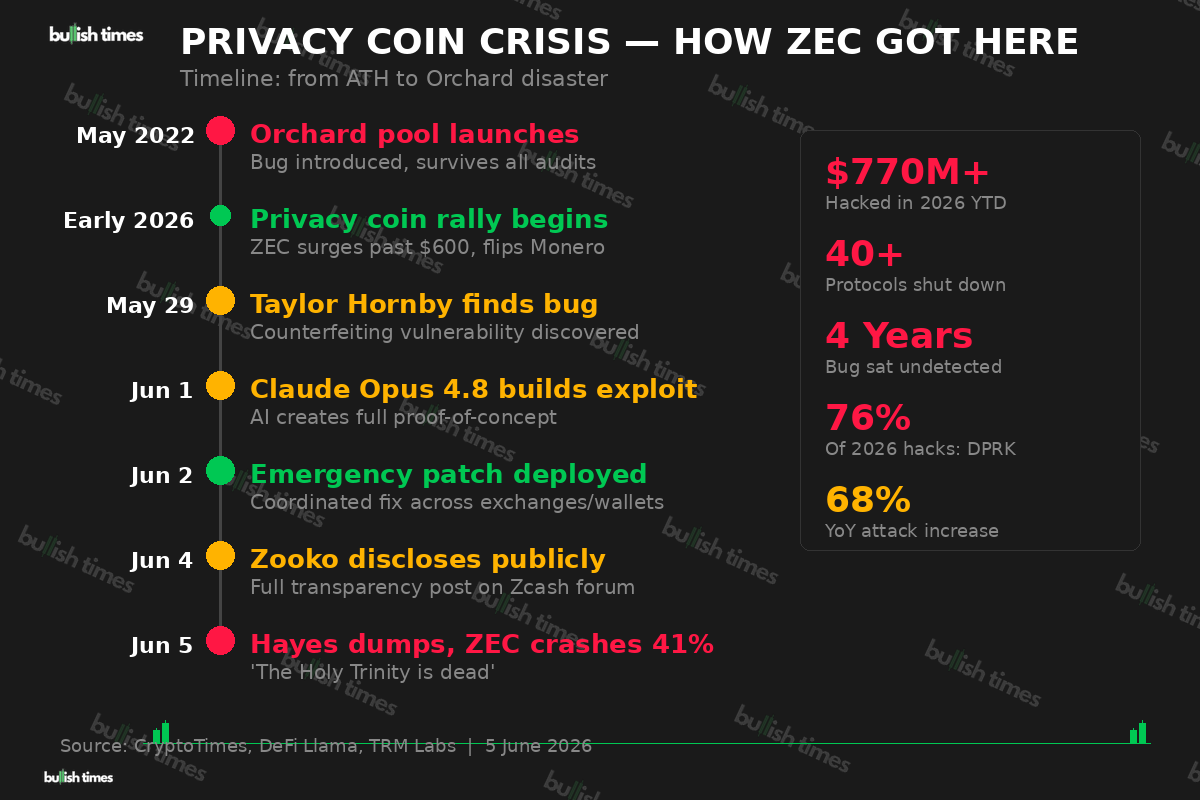
On 5 June 2026, Zcash’s native token ZEC plunged as much as 41% in a single day after founder Zooko Wilcox confirmed that security researcher Taylor Hornby had discovered a critical flaw in the Orchard shielded pool — one that could have allowed an attacker to mint unlimited counterfeit ZEC without anyone knowing. Arthur Hayes, one of crypto’s most vocal privacy-coin advocates, promptly dumped his entire position.
The Bug That Auditors Couldn’t See
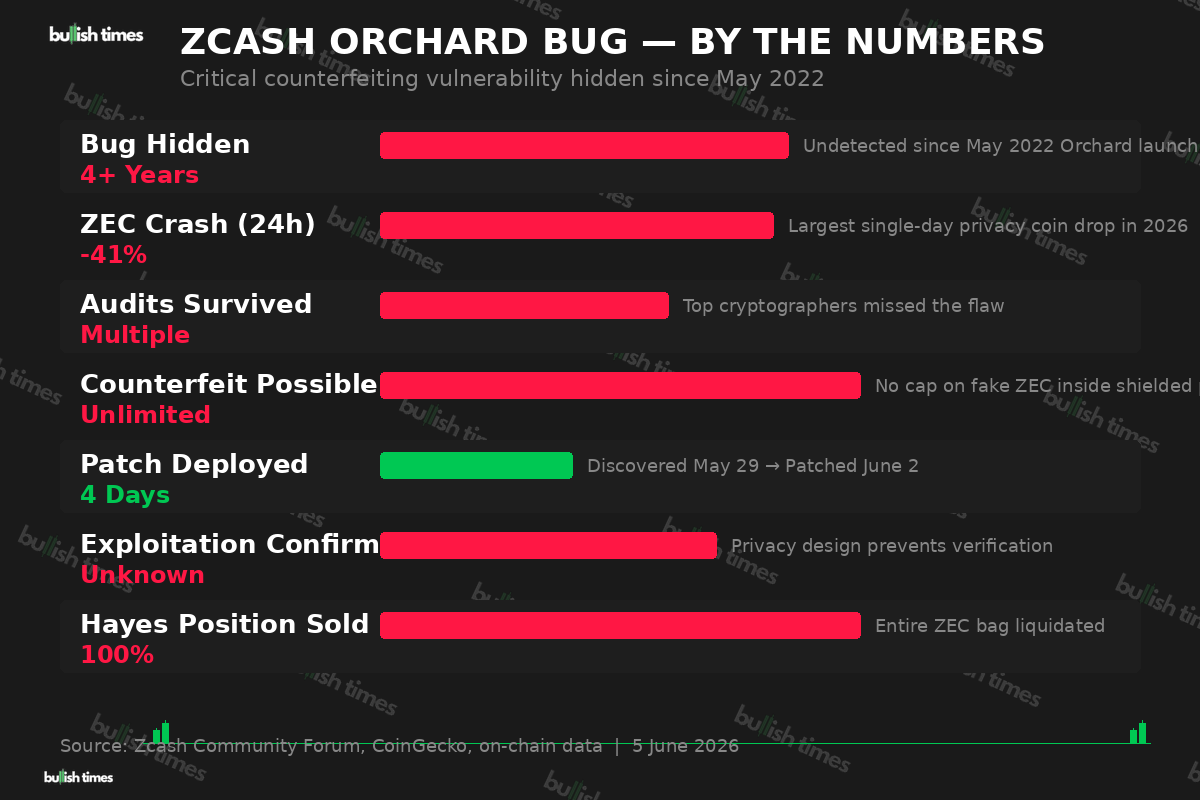
Hornby disclosed the vulnerability privately to Wilcox on 29 May, but the flaw itself dates back to May 2022 — the very month the Orchard pool went live. For roughly four years, the counterfeiting bug sat undetected through repeated specialist audits. Nobody found it. Not the Zcash Open Development Lab, not the external cryptographers hired to review the protocol’s zero-knowledge proof system.
What ultimately cracked it was an AI model. Working with Anthropic’s Claude, Hornby didn’t just identify the theoretical vulnerability — he built a complete, functioning exploit and successfully generated unlimited counterfeit ZEC in a local testing environment. The implications are staggering: a bug that eluded the best human cryptographers for years was weaponised in days with machine assistance.
The Zcash Open Development Lab coordinated an emergency response, shipping a patch on 2 June across wallets, exchanges, and node operators. Zooko’s public disclosure followed on 4 June via the Zcash community forum, where the team walked through the vulnerability and outlined proposals for supply-verification upgrades.
The Unsolvable Problem With Shielded Privacy
Here’s where it gets genuinely uncomfortable. The Orchard pool is “fully shielded” — balances and transfers are cryptographically hidden from public view. That’s the entire point of Zcash. But it means there is no way to independently verify whether the bug was ever exploited before the patch landed.
On a transparent ledger like Bitcoin, anyone can audit the total supply against protocol rules and confirm nothing was fabricated. In a shielded pool, that certainty is precisely what you sacrifice for privacy. The absence of visible theft is not proof of integrity — it’s just silence.
Shielded Labs, which helps maintain Zcash, said it was “not overly concerned” that counterfeiting had actually occurred, reasoning that the world’s most capable cryptographers reviewed the code for years without spotting it. The logic: if nobody found it, nobody exploited it. That’s a reasonable inference, but it’s not a proof — and the market clearly didn’t find it reassuring enough.
Hayes Walks: ‘The Holy Trinity Is Dead’
Arthur Hayes’s exit was the headline that broke the dam. The BitMEX co-founder had been one of ZEC’s most prominent supporters, publicly advocating for privacy coins as a philosophical necessity. His decision to sell everything wasn’t framed as a price call — it was a trust call.
“A privacy network only matters if its privacy is provable,” Hayes wrote, adding that the Orchard episode raised enough doubt for him to step aside entirely. He left the door open to rebuying lower, positioning it as risk management rather than a permanent verdict. But the signal was devastating: when your loudest evangelist walks because he can’t verify the accounting, the reputational damage runs deeper than any price chart.
The crash hit during one of the weakest tape backdrops of the year. Bitcoin sat near $62,300 (down ~15% on the week), Ether around $1,657, and the Fear & Greed Index read 17 — deep in Extreme Fear territory. Thin liquidity, forced sellers, and a high-profile exit stacked on top of each other. ZEC holders had no cushion.
What This Means for Privacy Coins — and for AI in Security
Two narratives are colliding here, and both matter.
The first is the privacy-coin trust problem. Zcash’s entire pitch rests on mathematical certainty. An assurance that reads “we’re reasonably confident nobody counterfeited” is categorically softer than the airtight guarantees the privacy sector advertises to buyers. The proposed supply-verification upgrades could help — but they’re an admission that the current architecture has a fundamental accountability gap. Every shielded protocol now faces the same question: how do you prove a negative inside a system designed to hide everything?
The second narrative is arguably more consequential. An AI model found — and exploited — a critical vulnerability that the world’s best human auditors missed for four years. This isn’t a theoretical concern any more. If Claude can build a working counterfeiting exploit for Zcash, what else is lurking in DeFi smart contracts, cross-chain bridges, and zero-knowledge proof systems that no human has caught yet? The barrier to discovering — and weaponising — protocol-level bugs just collapsed.
The counterargument is that the disclosure process worked exactly as intended: an independent researcher found the flaw and reported it before any confirmed abuse. Major networks from Bitcoin to Ethereum have weathered serious bugs too, all caught and fixed before weaponisation. If Zcash ships the supply-verification upgrades convincingly, this could become a credibility win rather than a lasting stain.
But right now, with ZEC down 41%, Hayes gone, and no way to prove the shielded pool is clean, “trust us” is a hard sell.
This is a developing story. Zcash developers have proposed supply-verification upgrades that could address the fundamental accountability gap — but until those ship, the question of whether counterfeit ZEC exists inside the Orchard pool remains unanswerable.