A $200 million memecoin empire built on celebrity clout, phantom casinos, and promises of “real-world utility” — and now a federal courtroom is being asked to sort through the wreckage.
Iggy Azalea, the Australian rapper whose career highlight remains a single chart-topper from 2014, is facing a class action lawsuit in New York over her Solana-based MOTHER token. Filed on 5 May 2026 by consumer protection firm Burwick Law, the complaint alleges that Azalea lured investors with specific, material representations about utility integrations that simply never materialised. The token, once valued at $200 million, now trades at $0.0012 — a 99.5% collapse from its all-time high of $0.23.
The Promises That Built a $200M House of Cards
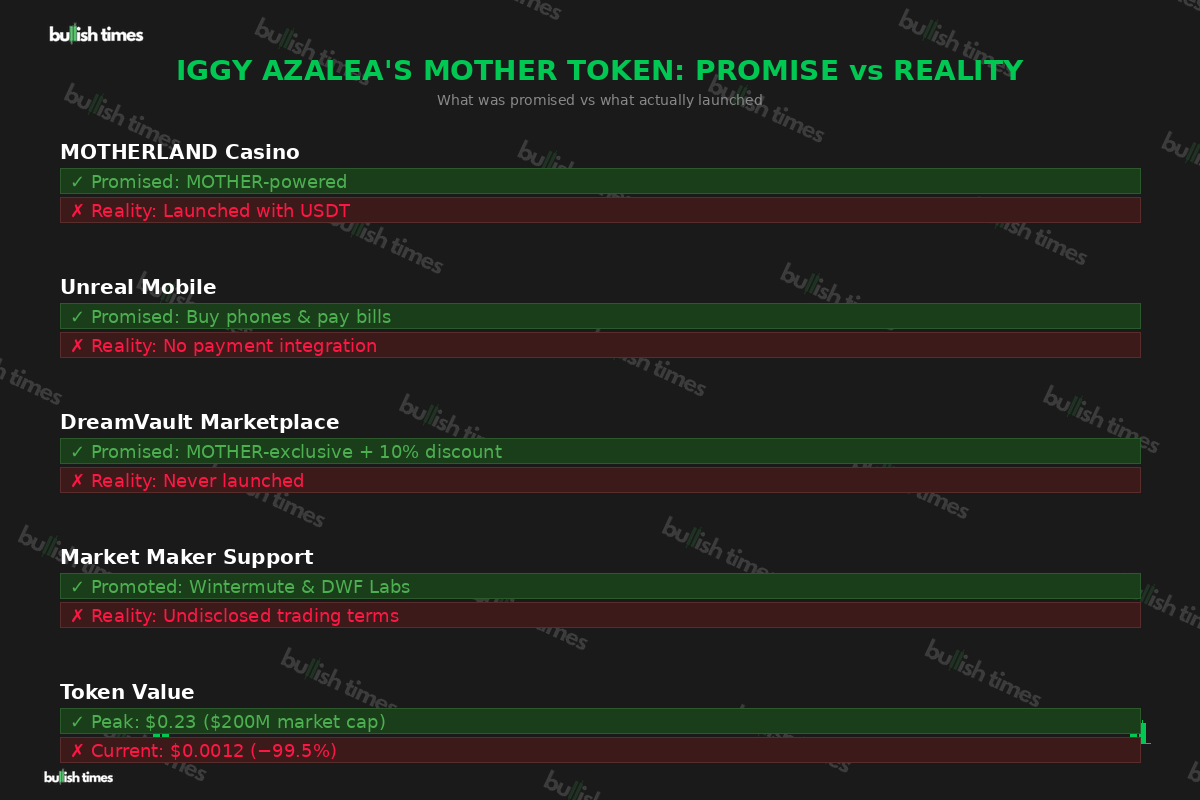
When Azalea launched MOTHER in May 2024, it was not marketed as just another celebrity joke coin. She positioned it as the native currency of an expanding ecosystem — a gambling platform called Motherland, a telecommunications service through Unreal Mobile, and a luxury marketplace dubbed DreamVault.
“I hope you held on to your $MOTHER. You’ll need it to get into MOTHERLAND,” she tweeted in September 2024, according to court filings.
The pitch worked. Within weeks, MOTHER surged to a $200 million market capitalisation, fuelled by Azalea’s active social media promotion and announcements of partnerships with institutional market makers Wintermute and DWF Labs.
But according to plaintiff Kenneth Kolbrak of Wisconsin, none of it held up. The complaint alleges that when Motherland finally launched in early 2025, its core operations ran on USDT — not MOTHER. The Unreal Mobile integration? “No durable, publicly observable MOTHER payment integration exists on the Unreal Mobile platform,” the filing states. DreamVault, the luxury marketplace promising MOTHER-exclusive purchases with a 10% discount? It never launched at all.
The Burwick Law Playbook — and Why It Matters
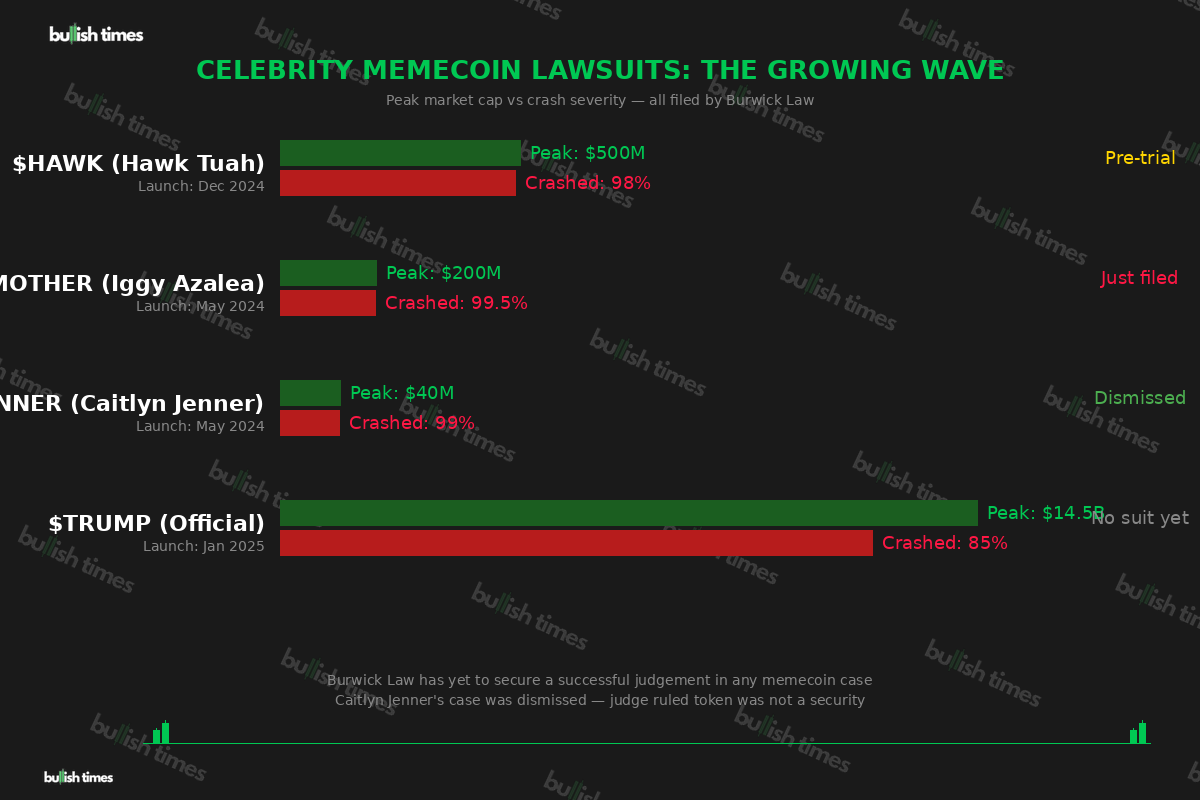
This is not Burwick Law’s first rodeo in the memecoin arena. The firm made its name filing the class action against Hailey “Hawk Tuah” Welch over her $HAWK token, which peaked at $500 million before cratering 98%. They also represent over 200 clients burned by various celebrity-backed crypto projects.
But here is the uncomfortable truth for investors hoping for justice: Burwick Law has yet to secure a single successful judgement in any memecoin case. Most remain stuck in pre-trial phases. And in a separate case, a federal judge dismissed claims against Caitlyn Jenner’s memecoin entirely, ruling the token was not a security.
That legal ambiguity is precisely what makes the MOTHER case fascinating. The complaint is deliberately not framed as a securities case. Instead, it targets consumer protection law — arguing that Azalea made specific commercial promises (casino integration, telecom payments, marketplace access) that constitute actionable misrepresentation regardless of whether MOTHER qualifies as a security.
“This case is not about ordinary volatility in a cryptocurrency,” the attorneys wrote. “It is about a celebrity-led promotional campaign that induced consumers to purchase and hold a digital token through specific, material representations about real-world utility.”
The Celebrity Memecoin Epidemic
MOTHER’s implosion is not an isolated incident. It sits within a growing wave of celebrity-backed crypto disasters that have collectively destroyed billions in retail investor capital.
The pattern is depressingly predictable: a famous name launches a token, social media hype drives a parabolic rise, promises of utility create the illusion of fundamental value, and then reality sets in. The celebrity walks away with profits and attention. The investors are left holding worthless tokens and screenshots of deleted tweets.
What makes MOTHER particularly egregious, according to the complaint, is the level of specificity in Azalea’s promises. This was not a rapper posting a rocket emoji and letting the community fill in the blanks. She named specific businesses, specific integrations, and specific partnerships. She described a functioning commercial ecosystem that would generate organic demand for the token. And then, allegedly, none of it materialised as described.
The involvement of market makers Wintermute and DWF Labs adds another layer of intrigue. While Azalea promoted these partnerships as evidence of institutional legitimacy, the complaint alleges that investors were never told how those firms could trade the token or how their arrangements might affect price dynamics. In an industry where market maker relationships have repeatedly been linked to artificial price inflation, the omission raises serious questions.
What Happens Next — and Why Courts Might Finally Care
The case lands at a peculiar moment for crypto regulation. The SEC has largely retreated from aggressive enforcement under its new leadership, and the CLARITY Act is still being fought over in Congress. Celebrity memecoins have, until now, existed in a legal grey area — too speculative for securities law, too novel for traditional consumer protection frameworks.
But Burwick Law’s consumer protection angle could change the game. If a court accepts that specific commercial promises attached to a token constitute actionable misrepresentation — regardless of whether the token itself is a security — it would open a floodgate of litigation against every influencer and celebrity who has ever attached utility claims to a memecoin launch.
Kolbrak is seeking up to triple damages plus attorney’s fees. The complaint also names “Doe Defendants,” a legal placeholder suggesting the legal team believes additional parties — possibly including market makers or behind-the-scenes promoters — may be drawn into the case.
For Azalea, the timing is brutal. She once told ABC’s Nightline that meme tokens “were central to virality, and that really interests me.” Virality, it turns out, cuts both ways. The same social media machine that pumped MOTHER to $200 million is now amplifying every broken promise, every deleted post, and every unfulfilled roadmap item.
This story is developing. Azalea and Burwick Law did not respond to requests for comment at the time of publication.