Someone bet $800 million that oil prices would crash — fifteen minutes before the President of the United States told the world Iran had agreed to peace talks. They walked away with an estimated $80 million. And nobody knows who they are.
The 60 Minutes investigation that aired last night has blown the lid off what may be the most brazen case of insider trading in prediction market history — and it stretches far beyond one platform, one trade, or one rogue soldier with a VPN.
Nine Accounts, 98% Win Rate, Zero Explanation
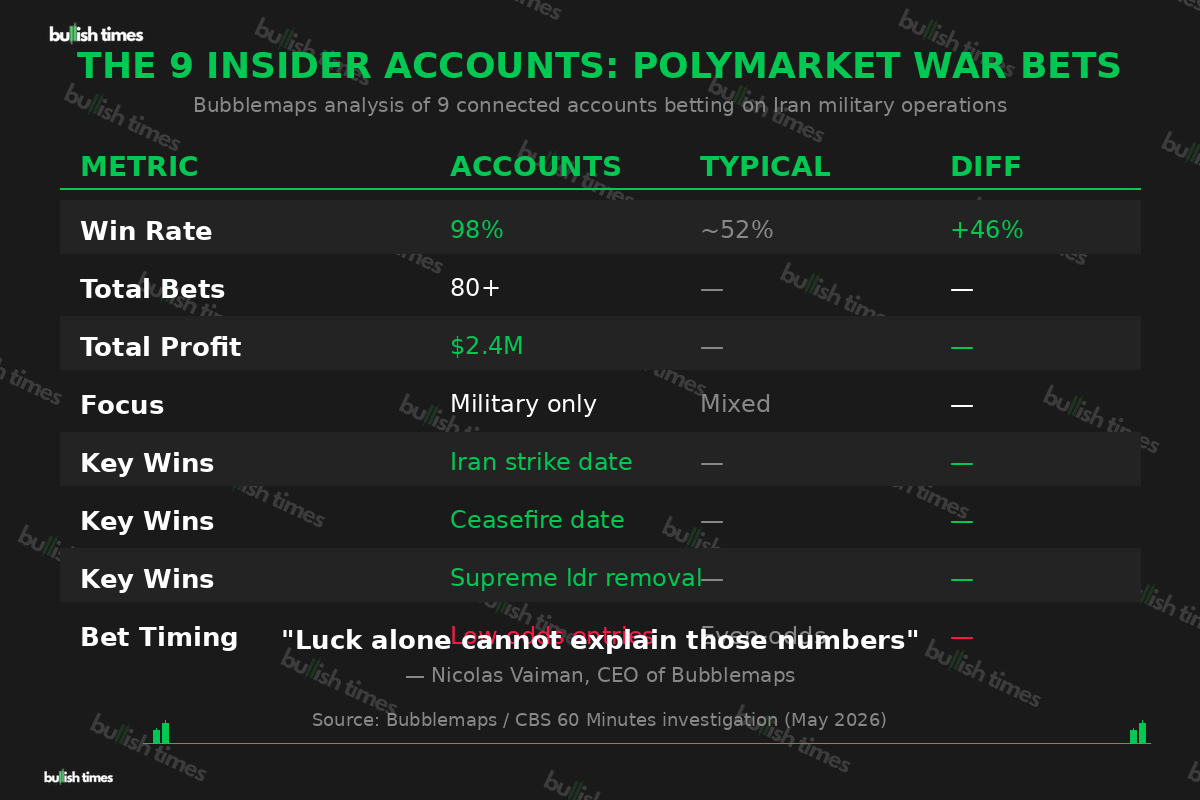
Digital forensics firm Bubblemaps has identified nine connected Polymarket accounts that have collectively extracted $2.4 million by betting almost exclusively on US military operations during the Iran conflict. Across more than 80 wagers, these accounts achieved a 98% win rate — a statistical impossibility under normal conditions.
The accounts correctly predicted the specific dates of the first US strikes on Iran, the removal of Iran’s supreme leader, and the announcement of a ceasefire. They consistently entered positions when odds were stacked against them, buying into long-shot bets that paid handsomely when classified military timelines played out exactly as their wagers suggested.
“This might be the most insane pattern we have found on Polymarket so far,” said Nicolas Vaiman, Bubblemaps’ co-founder and CEO. “Luck alone cannot explain those numbers.”
The $800 Million Oil Trade That Shook Regulators
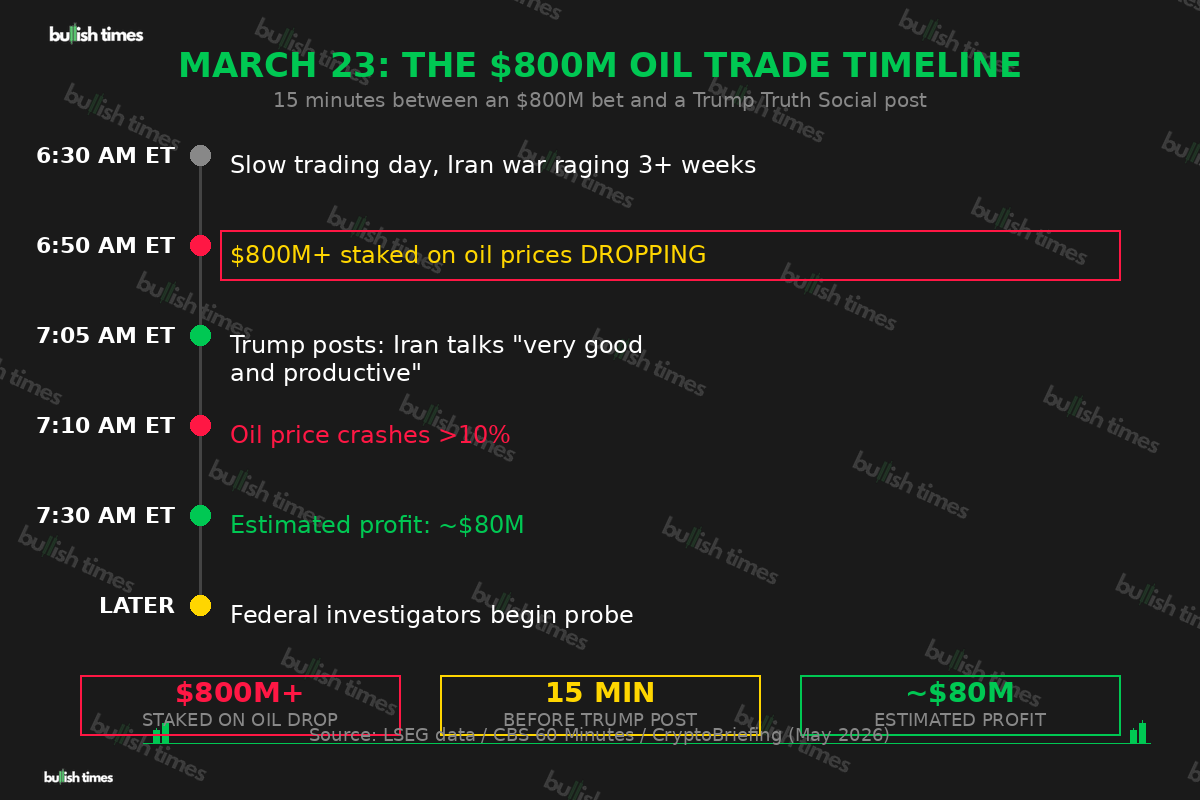
But the Polymarket accounts are merely the visible tip of a far larger iceberg. On 23 March, with the Iran conflict in its fourth week and oil markets trading slowly, something extraordinary happened at 6:50 AM Eastern Time.
According to LSEG financial data, more than $800 million was suddenly staked on oil prices dropping — a colossal, directionally aggressive bet placed in a sleepy pre-market window. Fifteen minutes later, at 7:05 AM, President Trump posted on Truth Social that the White House and Iran had held “very good and productive” conversations about ending hostilities.
Oil prices crashed more than 10%. The anonymous trader — or traders — pocketed an estimated $80 million in minutes.
“We’re talking tens of millions, could be $80 million,” said David Kovel, a former commodities trader turned fraud lawyer. “That’s a natural conclusion to draw — that this could be insider trading.”
Federal investigators are now probing the oil market trades. The CFTC, which polices commodities fraud, has separately opened an investigation into Polymarket over the $800 million in oil-related prediction markets. No charges have been filed.
Death Threats, VPNs, and a Regulator Running on Empty
The 60 Minutes report also revealed a chilling dimension to prediction market corruption: violence. Emanuel Fabian, military correspondent for the Times of Israel, received death threats after his reporting on an Iranian strike voided the winning side of a Polymarket bet.
“One of them was, ‘You’re going to make us lose $900,000. And we’ll invest even more than that to finish you,'” Fabian told CBS. “He also wrote details about my siblings.”
Meanwhile, the very agency tasked with policing these markets is operating at skeleton capacity. The CFTC, historically a five-commissioner body, currently has just one: Michael Selig, a Trump appointee. Both staffing and enforcement actions have dropped dramatically since 2024. Selig declined to be interviewed but said his office was “hiring more staff and using artificial intelligence to go after bad actors.”
This is the same CFTC that fined Polymarket $1.4 million in January 2022 for operating an unregistered swap facility. Polymarket responded by geofencing US users — a restriction easily circumvented with a $2-per-month VPN. The fact that $800 million flowed through oil-related markets strongly suggests either the geo-restriction is a fiction, or an awful lot of non-American traders care deeply about the US Iran strategy.
Polymarket CEO Shayne Coplan told 60 Minutes last year that insiders gaining an edge was “a good thing,” adding that “people will adapt.” He has since been rather quieter on the subject.
Prediction Markets’ Existential Moment
The regulatory stakes could not be higher. If the CFTC determines that prediction markets on geopolitical events constitute illegal derivatives, the entire $240 billion sector faces reclassification — forcing platforms to register as designated contract markets or abandon US-facing operations entirely.
The broader concern, articulated by Bubblemaps’ anonymous head of investigations, a former US military officer known as “Deebs,” is national security. If digital detectives can identify suspiciously timed trades, so can foreign intelligence services.
“Just to put it plainly, this could be putting people’s lives at risk,” Deebs told 60 Minutes. “Other adversaries may be using this information in order to plan their own strategy.”
More than $1 billion has been wagered on military outcomes on prediction markets this year alone. The Anti-Corruption Data Collective found “systemic insider-trading” in military outcome bets, with long-shot wagers of over $2,500 winning more often than they lost — the opposite of what probability dictates.
This is no longer about one soldier with a VPN or one anonymous whale with an $800 million oil play. This is an industry-wide integrity crisis playing out at the intersection of national security, financial regulation, and crypto’s persistent allergy to accountability. The CFTC, understaffed and outgunned, is being asked to police a global, pseudonymous, 24/7 betting market with tools designed for Chicago grain futures.
This story is developing. Federal investigators have not filed charges related to the March 23 oil trades. Polymarket says it cooperates with law enforcement and has referred suspicious accounts for investigation.