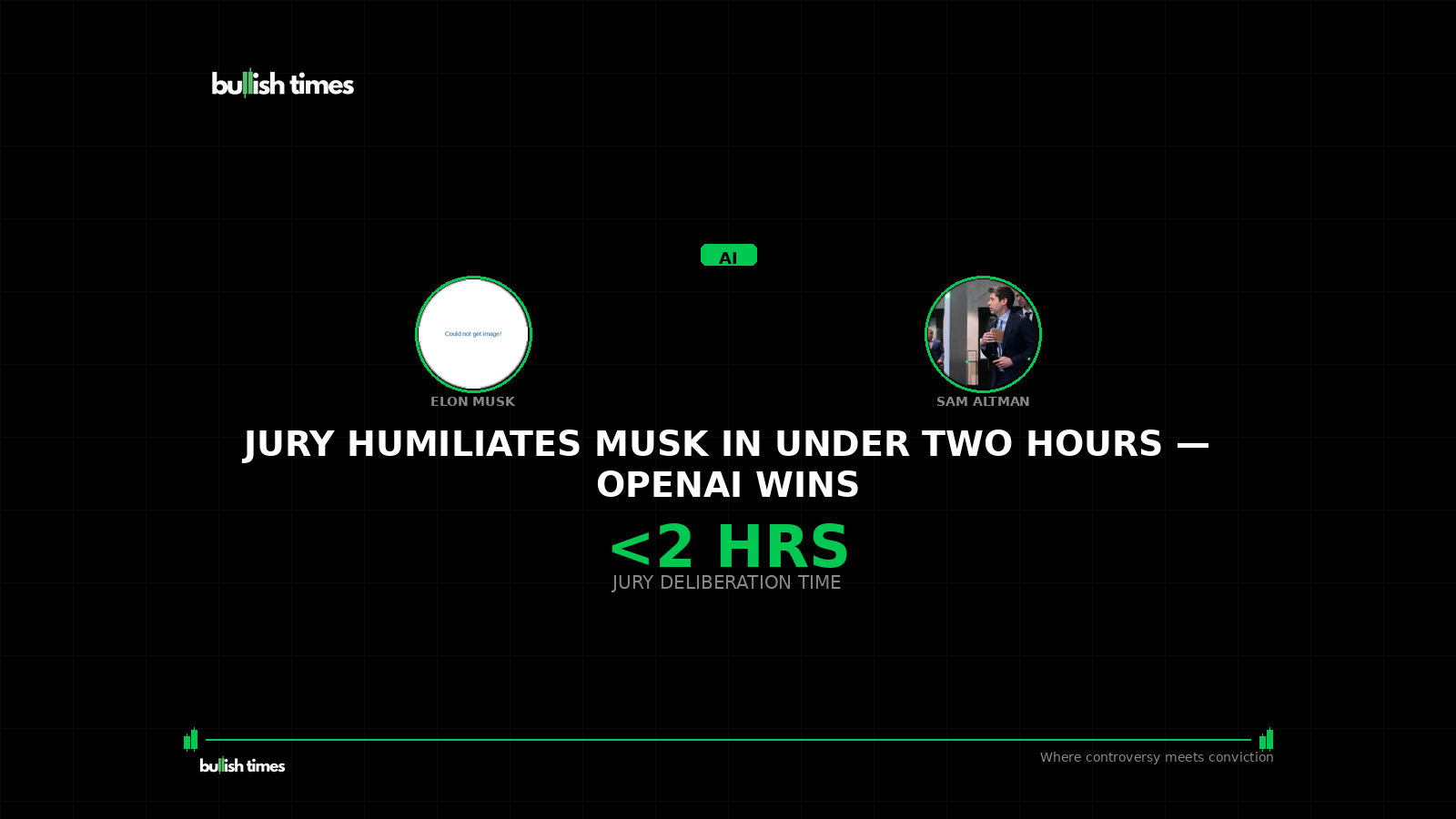
It took a jury less time to destroy Elon Musk’s lawsuit than it takes most people to watch a film. After three weeks of testimony, bombshell revelations, and some of the most personal attacks Silicon Valley has ever witnessed in open court, nine jurors needed just 113 minutes to unanimously decide that the world’s richest man had simply waited too long to sue.
The verdict, handed down on Monday at Oakland’s federal courthouse, doesn’t just end a legal battle — it clears the runway for OpenAI’s expected $1 trillion IPO, leaves Musk’s credibility in tatters, and raises uncomfortable questions about whether this was ever really about saving a charity at all.
The $38 Million Gamble That Became a $150 Billion Grudge
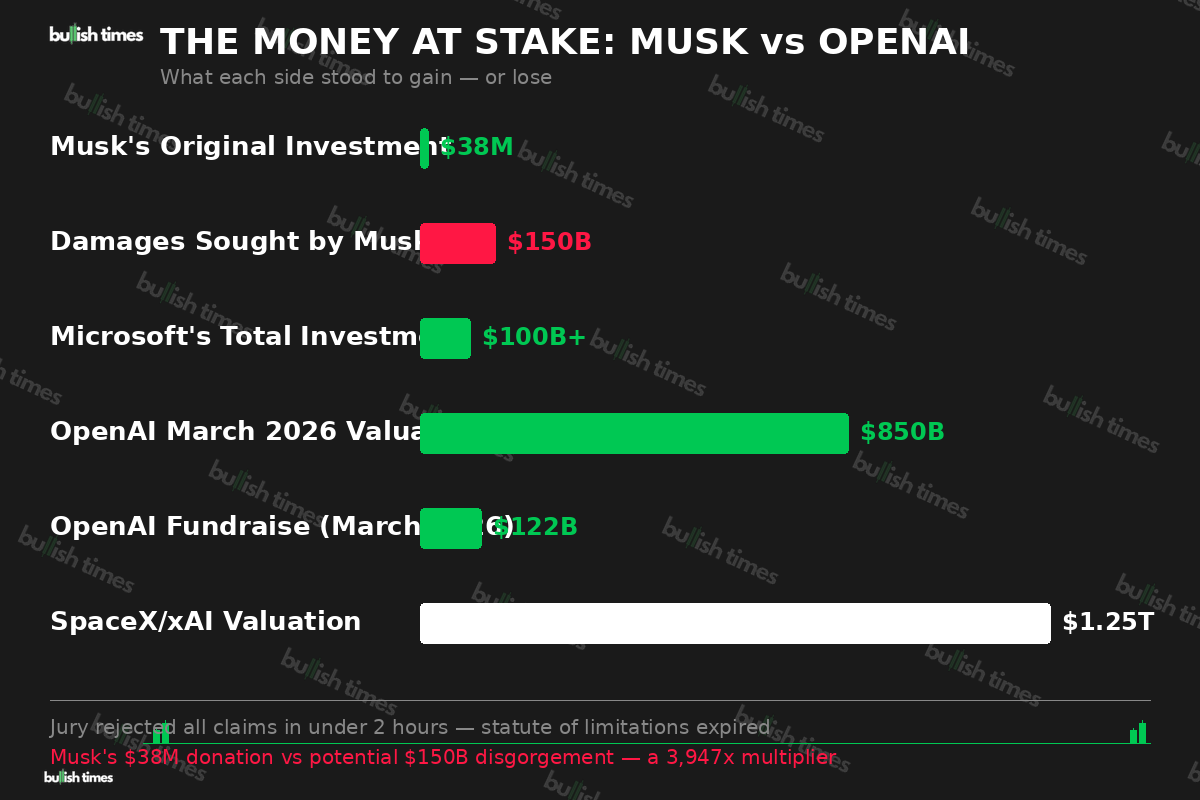
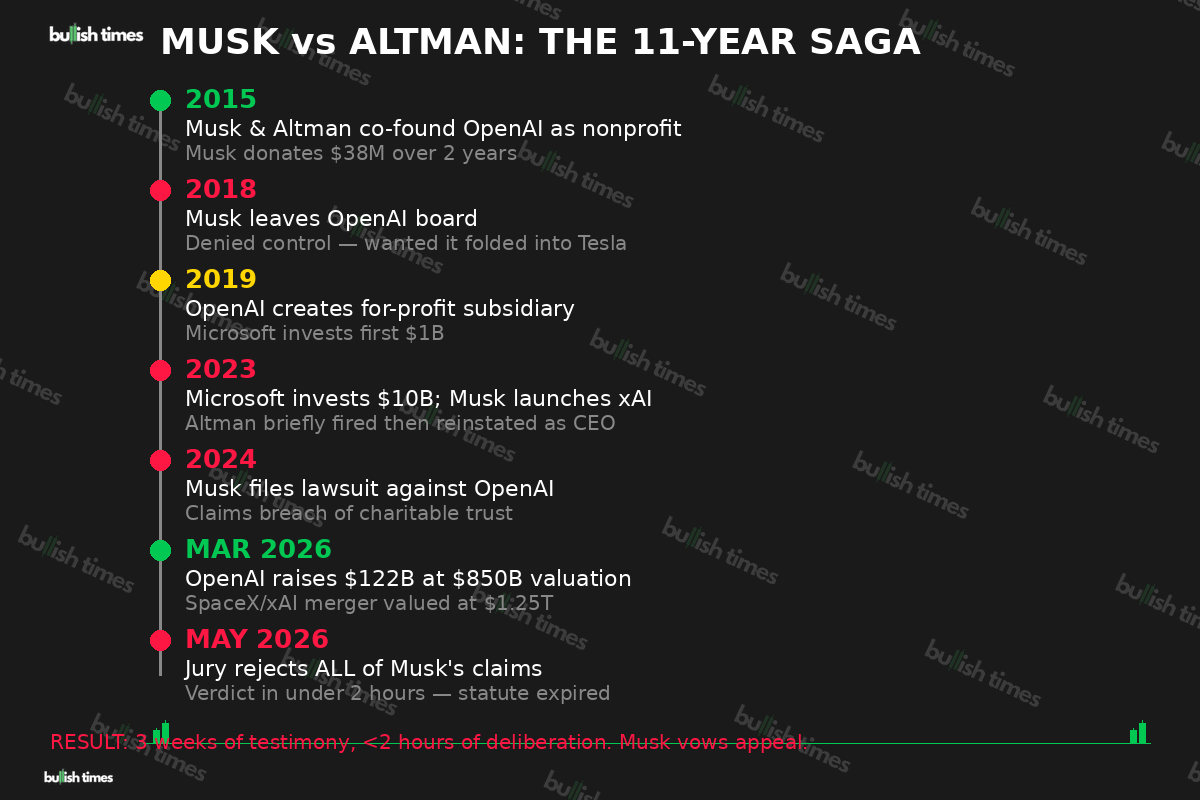
The facts, stripped of the courtroom theatre, are relatively straightforward. Musk co-founded OpenAI with Sam Altman in 2015, donating roughly $38 million over its first two years. The mission: develop artificial intelligence “for the benefit of humanity” as a nonprofit. Noble enough.
But by 2017, the founders had concluded they needed serious capital to compete with Google DeepMind. Musk wanted control — at one point suggesting the entire operation be folded into Tesla. When his co-founders refused, he left the board in 2018. OpenAI created a for-profit subsidiary in 2019 and never looked back.
Musk watched from the sidelines as Microsoft poured over $100 billion into the partnership, ChatGPT became the fastest-growing consumer application in history, and Altman transformed from a Y Combinator president into the most powerful figure in AI. By 2023, Musk had launched his own competing venture, xAI, before finally filing suit in August 2024.
That six-year gap proved fatal.
A Courthouse Bloodbath — For Both Sides
The three-week trial was supposed to be Musk’s moment of righteous reckoning. Instead, it became a mutual character assassination that left neither billionaire looking particularly heroic.
Multiple witnesses described Altman as a liar. When asked directly on the stand whether he was “completely trustworthy,” Altman notably failed to give an unqualified “yes.” Former OpenAI technology chief testified that Altman “sowed chaos and distrust” among top executives. One particularly damning moment came when Altman recalled Musk’s pitch for permanent control: “My co-founders asked, ‘If you have control, what happens when you die?’ He said something like, ‘Maybe it should pass to my children.’”
Not exactly the language of a man motivated purely by altruism.
Microsoft CEO Satya Nadella also took the stand, with testimony revealing the software giant has spent more than $100 billion on its OpenAI partnership — a figure that puts Musk’s $38 million in rather stark perspective. The aiding-and-abetting claim against Microsoft was dismissed alongside Musk’s primary claims.
The ‘Calendar Technicality’ That Wasn’t
Within hours of the verdict, Musk took to X to frame the loss as a mere procedural hiccup. “The judge & jury never actually ruled on the merits of the case, just on a calendar technicality,” he posted. He also called Judge Yvonne Gonzalez Rogers a “terrible activist” who used the jury “as a fig leaf” — a post he subsequently deleted.
But the judge herself had already pre-empted this narrative. “There’s a substantial amount of evidence to support the jury’s finding, which is why I was prepared to dismiss on the spot,” she said in court. The statute of limitations isn’t a technicality — it’s a fundamental legal principle. And nine jurors unanimously agreed Musk knew about OpenAI’s commercial transformation years before he filed suit.
OpenAI’s lead attorney, William Savitt, was characteristically blunt outside the courthouse: “This lawsuit was a hypocritical attempt to sabotage a competitor. The jury kicked it exactly where it belongs, which is to the side.”
Carl Tobias, a law professor at the University of Richmond, put it more diplomatically: “This case seemed kind of weird and crazy, but this is why we trust juries, because they bring the common sense of the community to resolve factual disputes.”
What This Means for AI’s Trillion-Dollar Future
The immediate winner is obvious: OpenAI. The verdict removes the single biggest legal cloud over the company’s path to an IPO that Wedbush analyst Dan Ives described as potentially valuing the business at $1 trillion. OpenAI raised $122 billion at an $850 billion valuation just two months ago. With the lawsuit gone, the only obstacle left is Altman’s battered but intact reputation.
Musk has vowed to appeal. His lawyer Marc Toberoff declared outside the courthouse: “This war is not over. I’d sum it up in one word: appeal.” But appellate lawyer Raffi Melkonian, who has argued before the US Supreme Court, was sceptical: “Appeals of jury verdicts are very hard to win.”
The deeper question is whether this case was ever about charity at all. Musk launched xAI in 2023 — a for-profit AI company now merged with SpaceX and valued at $1.25 trillion. He didn’t sue when OpenAI created its for-profit arm in 2019. He didn’t sue when Microsoft invested $1 billion that same year. He sued after OpenAI became the most valuable AI company on the planet and a direct threat to his own venture.
As Sarah Federman, a conflict resolution professor at the University of San Diego, observed: this was Godzilla versus King Kong. Neither emerged unscathed. But only one of them lost in court — and lost badly.
Musk has confirmed he will appeal to the 9th Circuit. OpenAI’s IPO preparations are expected to accelerate. This story is developing.