ACryptoS’s failure was not that its vaults lacked permission to move tokens. It was that the software granted an outsized claim on other people’s assets. Closing deposits is necessary containment, not a completed settlement with depositors.
The decentralised finance (DeFi) yield platform is being wound down after an exploit on 8 November. Its account offers a sharp test of DeFi’s promise: automated access is only useful when the rules governing ownership are sound, and someone remains capable of managing the consequences when they are not.
Count the losses without shrinking the caveats
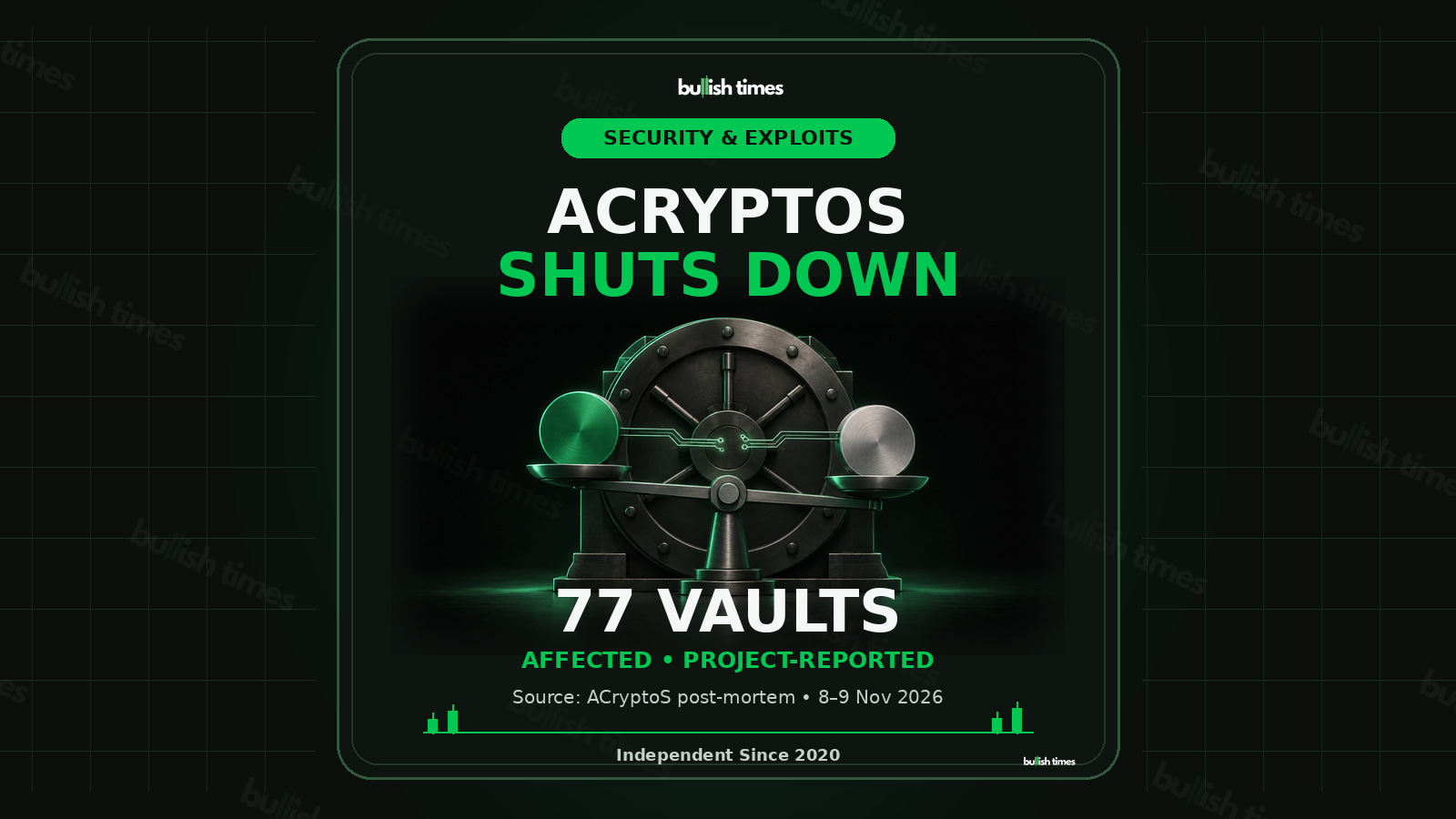
In its technical post-mortem, ACryptoS reports that 135 addresses exploited 77 of 126 vaults across five chains. A vault pools deposited assets under programmed management; shares represent each depositor’s claim on that pool.
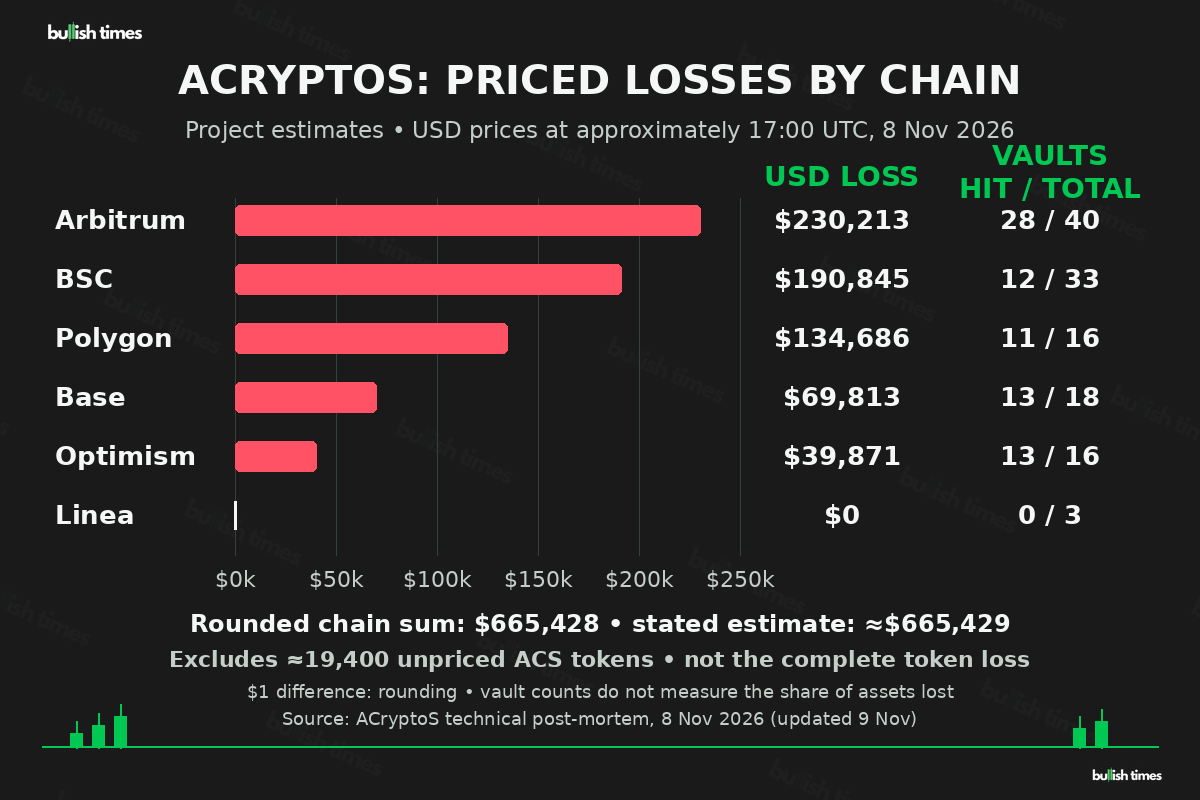
The project estimates approximately $665,429 in priced losses. That is not a complete valuation of every token taken: it excludes about 19,400 ACS tokens because they were not priced. The dollar figures use an approximately 17:00 UTC price snapshot on 8 November, not current market values or a guaranteed compensation amount.
The largest reported priced loss was on Arbitrum, at $230,213, followed by BSC at $190,845 and Polygon at $134,686. ACryptoS also lists losses on Base and Optimism, while Linea had no exploited vaults in its table.
The 77-vault count must not become a claim about the proportion of customer assets lost. Vaults need not hold equal balances. Nor are 135 addresses necessarily 135 separate people. These distinctions matter because a dramatic count can be accurate while the conclusion attached to it is not.
The ownership boundary failed inside the vault
According to ACryptoS, the flaw involved depositMulti, a function accepting a list of token amounts. It did not require that list to contain an entry for every token in the vault. In a two-token vault, a one-entry list could therefore pass through.
The crucial error was not merely accepting a deposit of one token. The project says the vault also valued its existing holdings using only that first token, ignoring the second. A small deposit could consequently receive most of the shares, even though the vault contained substantial value in the ignored asset.
Withdrawal then honoured those inflated shares against both tokens. Existing depositors’ claims were diluted, and their assets paid out to exploiters. The boundary between contributing value and acquiring ownership had failed.
This is why a narrow description such as “input validation” understates the economic consequence. The missing check affected who was entitled to the pool. ACryptoS says pool prices were not manipulated and the flaw existed from deployment, rather than being introduced by a recent upgrade. Those are the project’s technical findings, not an independent forensic certification.
Stopping deposits is not the end of the incident
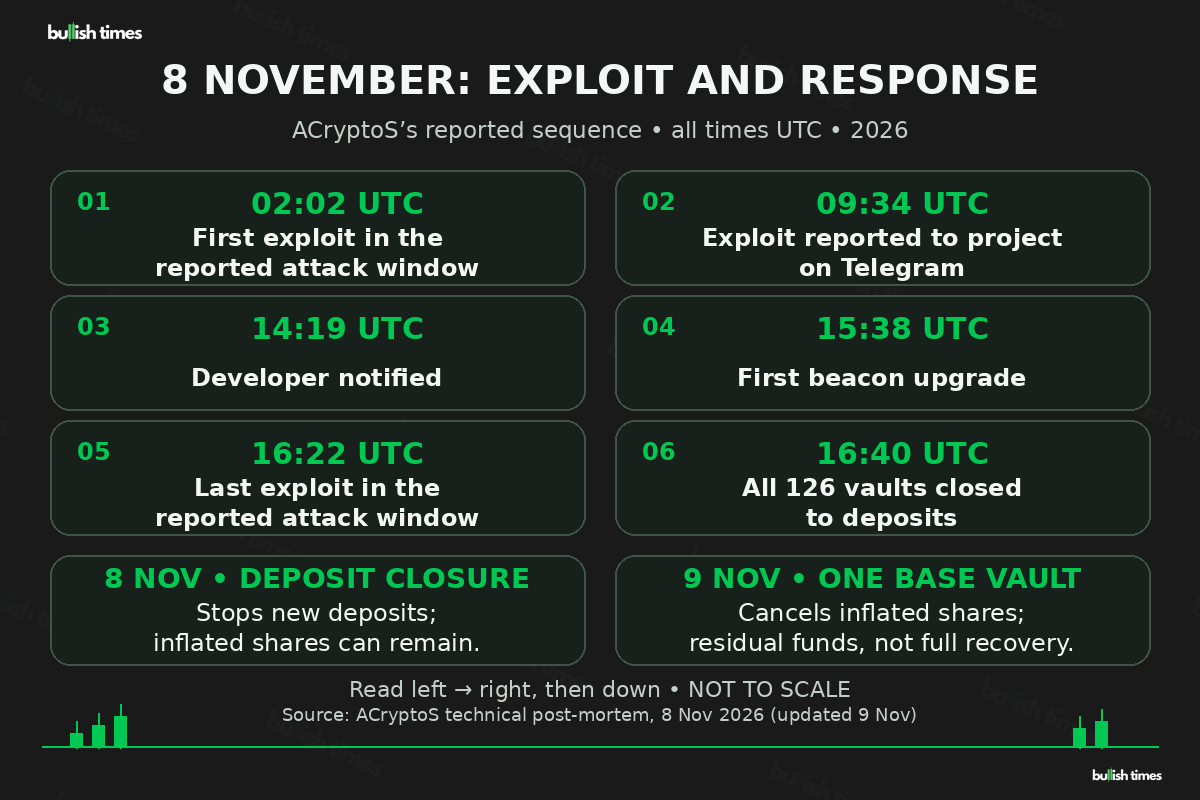
The project’s timeline places the first exploit at 02:02 UTC, the first Telegram report to the project at 09:34, and developer notification at 14:19. Deposit-disabling upgrades began at 15:38, with all 126 vaults closed to deposits by 16:40.
That chronology deserves scrutiny without inventing a reason for the notification gap. The post-mortem records when messages reached different points; it does not establish why the response took that path. What matters operationally is whether a warning can reach someone empowered to contain the damage.
There is a second distinction. Disabling new deposits did not automatically extinguish every inflated ownership claim. In a 9 November update, ACryptoS says an exploiter still held 99.99% of one Base vault and began draining it that day. The team then upgraded that vault and cancelled the exploiter’s shares and excess fee shares.
ACryptoS reports about 1,800 USDbC lost there before that intervention, leaving approximately 6,187 USDbC withdrawable by original depositors. That is a limited restoration of one vault’s remaining funds, not evidence that the platform’s entire loss was recovered.
A responsible wind-down needs more than an announcement
PANews reported that ACryptoS said it could no longer maintain the project. Its current post-mortem says withdrawals remain open and no reopening of deposits is planned. That describes the project’s stated position, not a guarantee that every withdrawal will succeed.
There is a defensible choice here: declining to reopen a service without resources to maintain it is more responsible than presenting another patch as a fresh start. But publication of a detailed post-mortem does not itself settle depositors’ losses or independently validate the accounting.
The appropriate standard is a documented wind-down: clear balances and limitations, intelligible updates, and an explanation of which administrative powers remain available. This incident shows those powers can protect residual funds after automated accounting has failed.
DeFi’s promise is not fulfilled by keeping the deposit button open. It is tested by whether ownership holds up when the code does not.