Wall Street’s $63bn AI headline is not $63bn in Anthropic’s bank account. The more revealing story is the machinery being built to finance the machines.
Bank of America, Blackstone, Citi and Morgan Stanley announced the Broadcom-linked transaction on 26 October. It is a substantial financing announcement, but confusing committed financing, a cash investment and delivered computing capacity would turn a complicated deal into a misleading victory lap.
The $63bn Broadcom–Anthropic compute financing deserves scrutiny precisely because it is more interesting than another funding-round headline. The public structure shows how equipment purchases and leases are being organised; it does not establish that every dollar has been drawn or every commercial risk resolved.
A financing vehicle, not a cash windfall
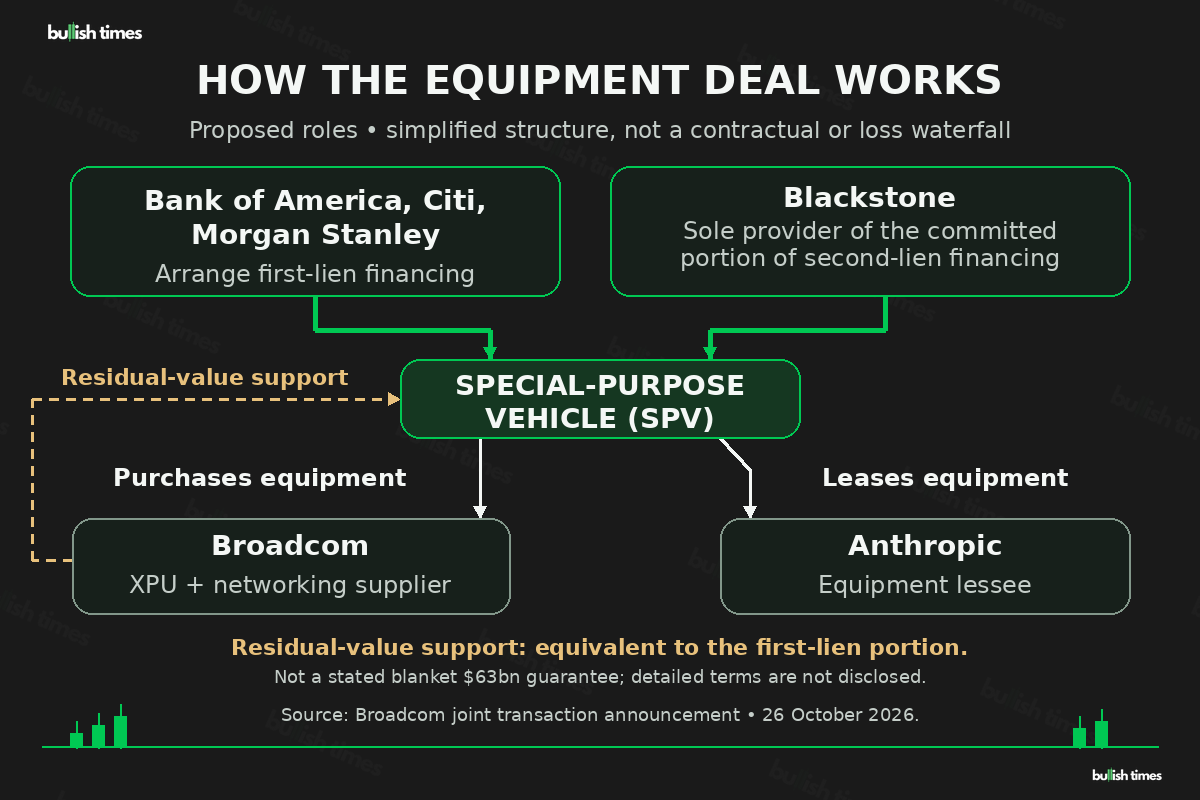
According to the joint transaction announcement, a newly formed special-purpose vehicle will use the committed financing to buy Broadcom XPU AI accelerators and networking solutions, then lease them to Anthropic.
An SPV is a separate legal entity established for a particular purpose. Here, that purpose is purchasing equipment and leasing it to the AI developer: the vehicle sits between the financing providers, the supplier and the equipment user.
That distinction matters commercially. This is not an announcement that the financial firms are buying $63bn of Anthropic shares, nor evidence that Anthropic has received that sum as unrestricted cash.
The companies expect equipment deliveries to begin in calendar 2027. A financing commitment today and usable computing capacity tomorrow are different milestones; the announcement does not prove either completed delivery or operating capacity.
The Wall Street Journal’s report also describes the purchase-and-lease arrangement. This is a story about financing Anthropic’s equipment, not evidence that the infrastructure is already online.
First lien means priority, not immunity
Bank of America, Citi and Morgan Stanley are arranging the first-lien financing. Blackstone is the sole provider of the committed portion of the second-lien financing, according to the announcement.
In plain English, a lien is a legal claim over collateral. First-lien financing generally has priority over second-lien financing against the relevant collateral; second lien sits behind it. Those labels describe relative security priority, not a promise that either lender will recover everything.
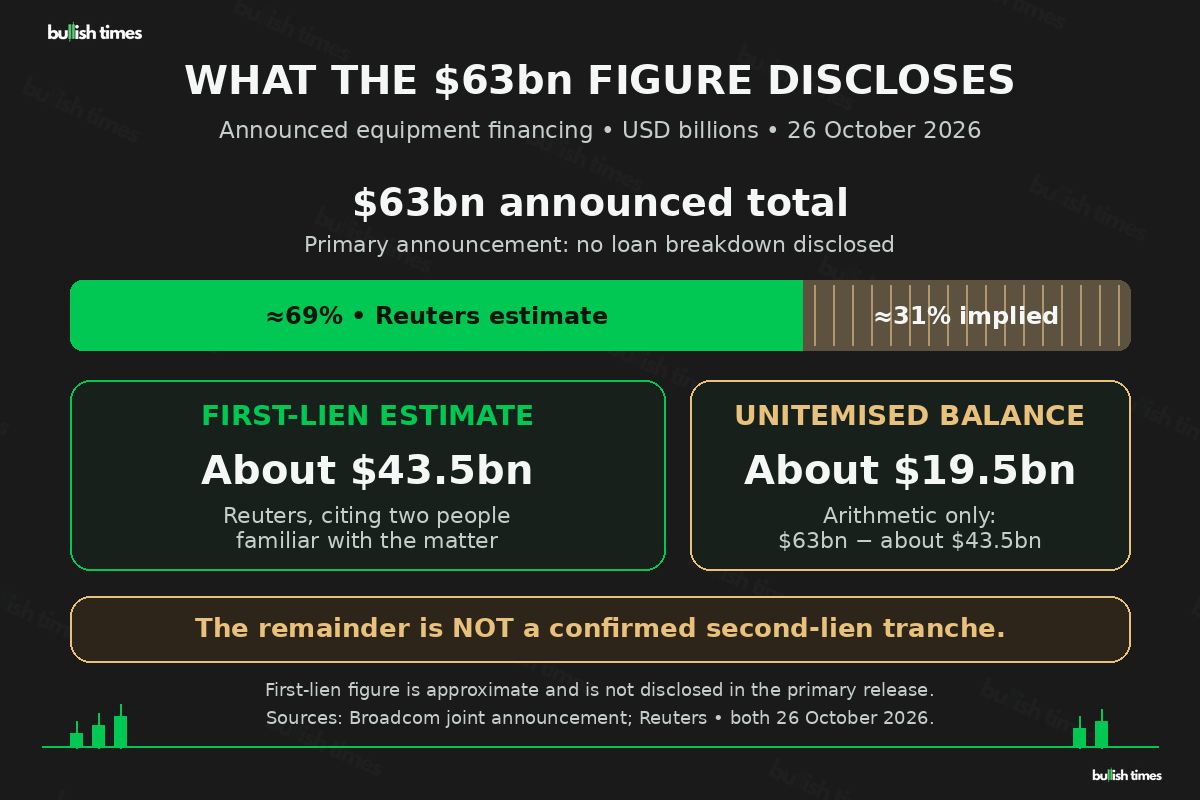
Reuters reports that the first-lien portion is about $43.5bn, or 69% of the total, citing two people familiar with the matter. The primary announcement does not disclose the loan breakdown.
Subtracting that approximate figure from $63bn leaves about $19.5bn. That is an unitemised arithmetic remainder, not a disclosed second-lien commitment. Treating it as Blackstone’s exact cheque would manufacture precision the public documents do not provide.
Residual-value support is not a blanket guarantee
Broadcom says it will provide “residual value support” to the vehicle in an amount equivalent to the first-lien portion of the financing. That is important: the supplier is offering support tied to a specified part of the structure.
Residual value means what equipment is worth later, rather than simply its purchase price today. Support relating to that value can matter to financing, but the announcement does not spell out the conditions, recourse or detailed legal scope of Broadcom’s obligation.
Calling this an unconditional Broadcom guarantee of the entire $63bn would therefore be wrong. Equally, naming the first-lien amount does not let outsiders reconstruct a complete loss waterfall or decide who ultimately absorbs a shortfall.
The structure’s appeal is understandable. Equipment financing can connect capital providers with a customer seeking access to hardware, rather than requiring the customer to purchase everything outright. Complexity is not, by itself, evidence of a defective deal.
But a supplier’s support is part of the commercial bargain, not independent proof that the bargain is safe. Readers need the contractual terms before turning a support headline into a conclusion about risk.
The real test comes after the announcement
Broadcom chief executive Hock Tan says: “Fundamentally, the need for AI compute continues to grow at an extraordinary pace.” That is the company’s demand assessment, not independently established evidence of this transaction’s future returns.
The public release supplies no interest rate, maturity, draw schedule, lease payment terms or asset-life assumptions. Without them, neither an enthusiastic profitability verdict nor a confident disaster prediction is justified.
The useful questions are concrete: when does committed financing become drawn funding, when does equipment arrive, and what do the lease obligations require? Deliveries in 2027 remain an expectation, not an accomplished fact.
The $63bn scale merits attention. So does the boundary between what has been announced and what remains undisclosed. Financial engineering can organise a build-out; it cannot, through headline size alone, demonstrate its economics.
The machines still have to arrive. The contracts, not the headline, determine what the financing really means.