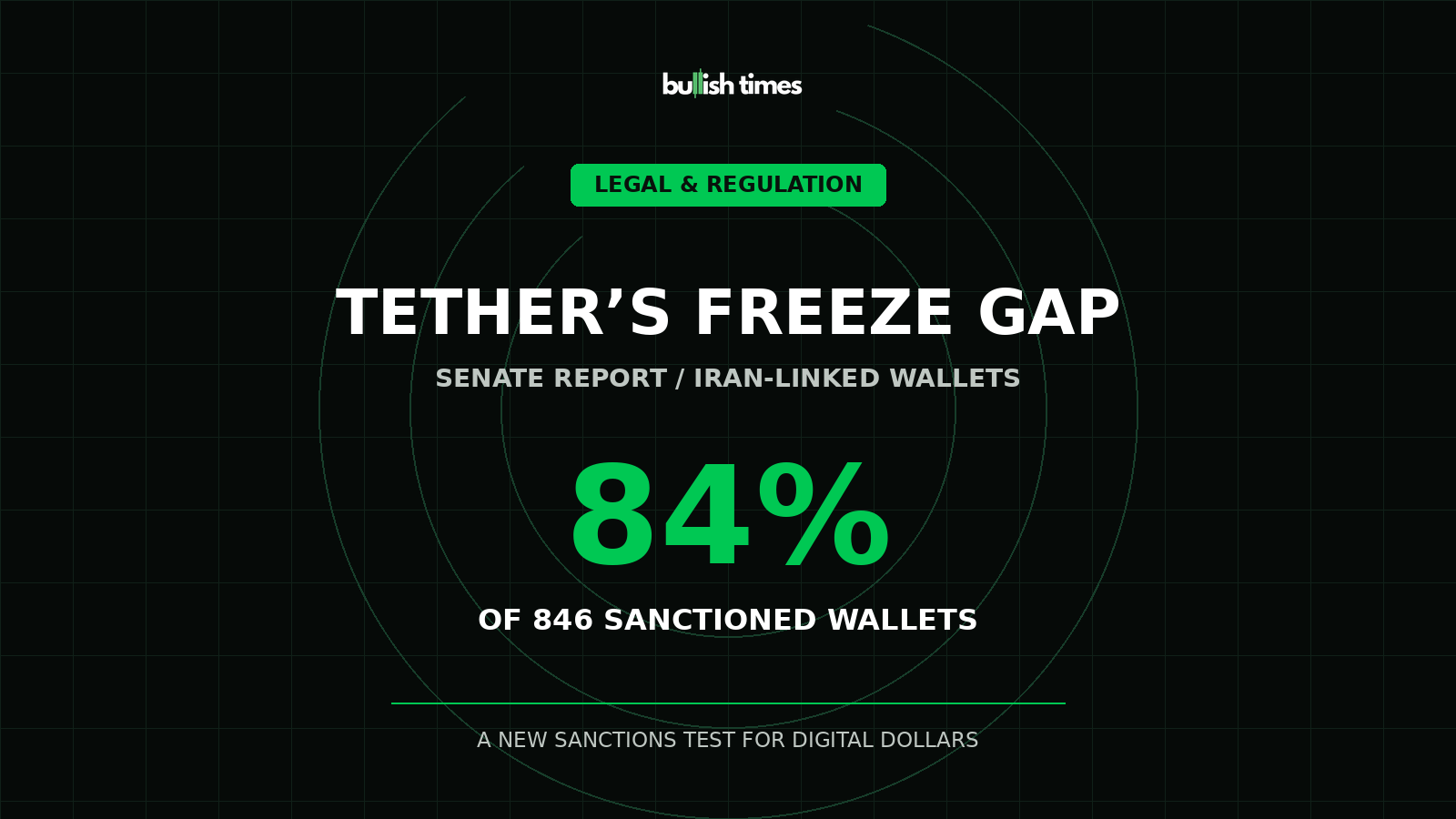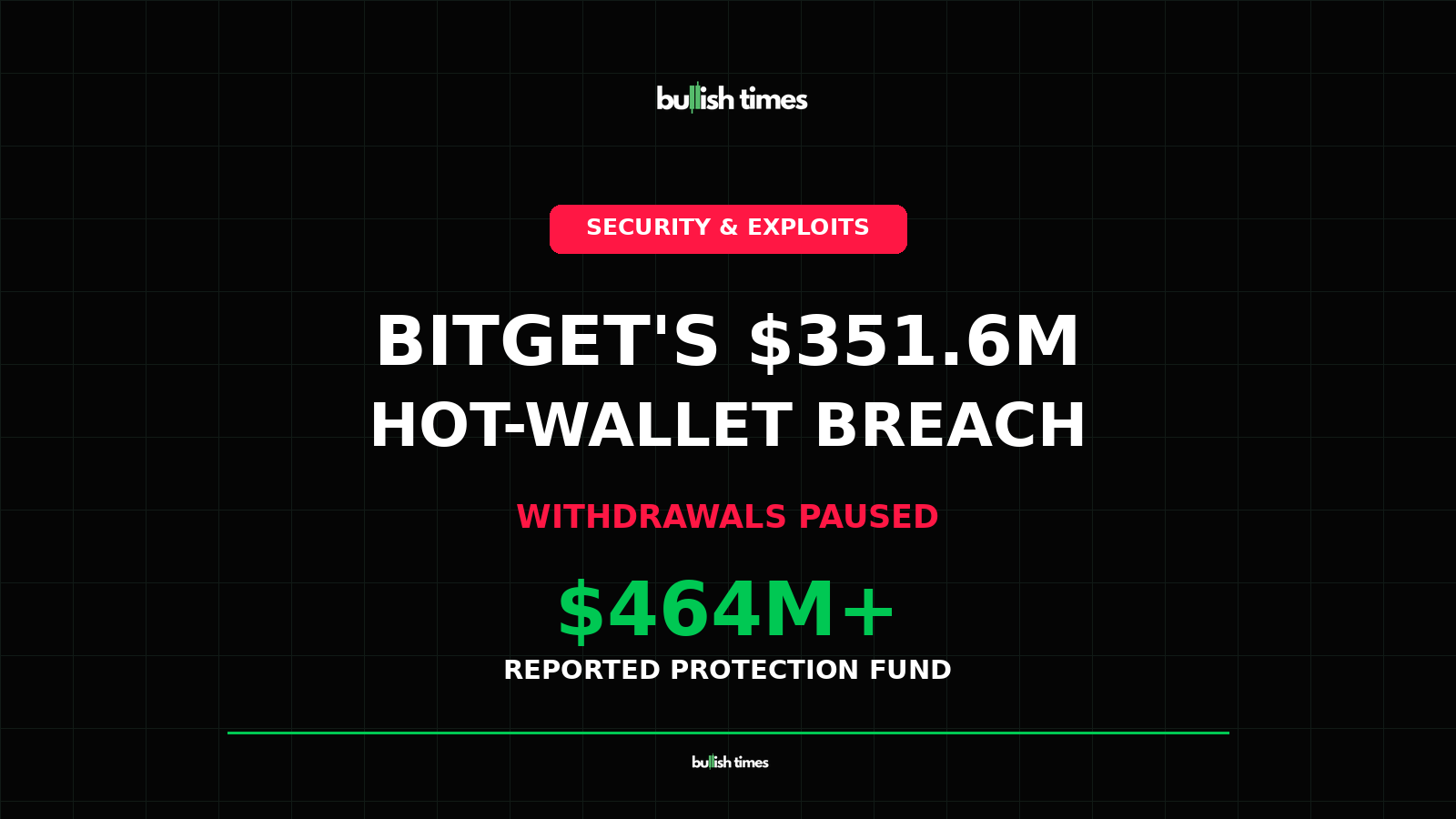
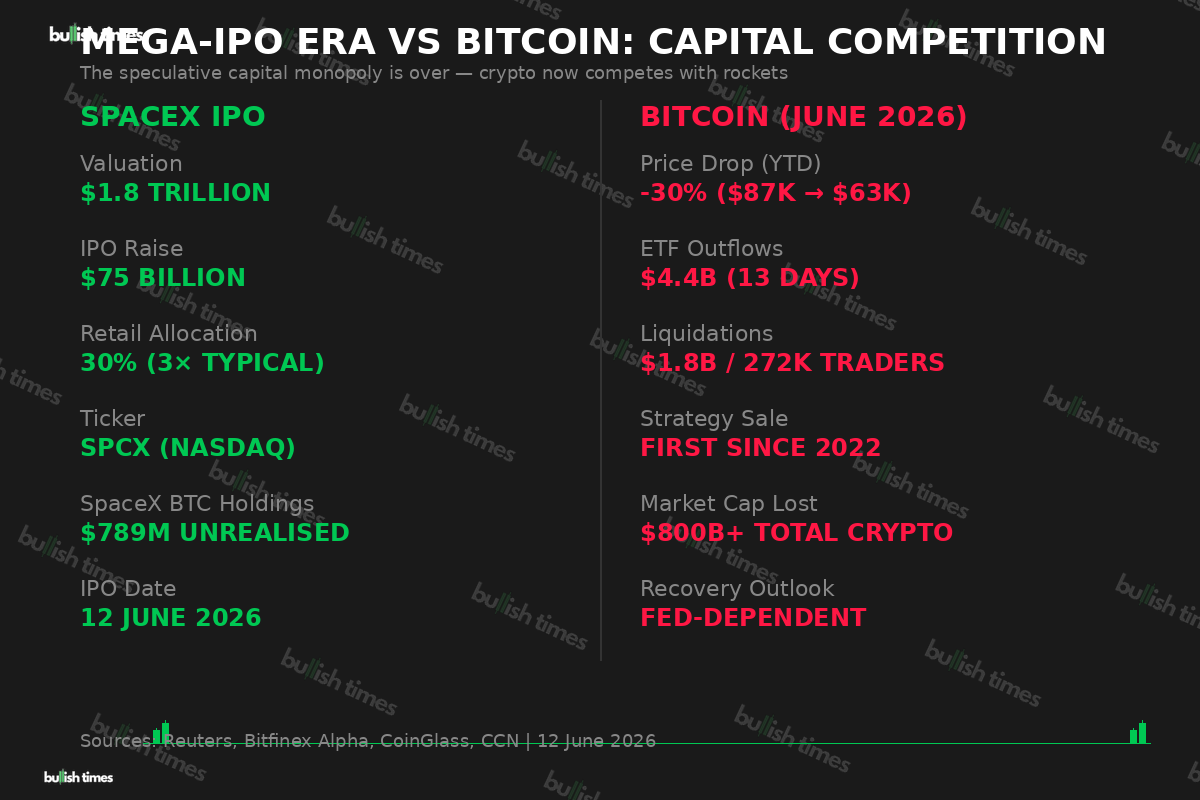
The world’s biggest IPO just launched — and it may have taken Bitcoin’s speculative crown with it. As SpaceX begins trading on Nasdaq under the ticker SPCX today, Bitcoin is nursing a 20% decline, $4.4 billion in ETF outflows, and the smouldering wreckage of 272,000 liquidated traders.
For years, crypto held a near-monopoly on high-upside, lottery-style speculation. That era is over. Elon Musk’s $1.8 trillion rocket company has vacuumed up the very capital — and the very dopamine — that once flowed exclusively into digital assets.
The Numbers Behind the Carnage
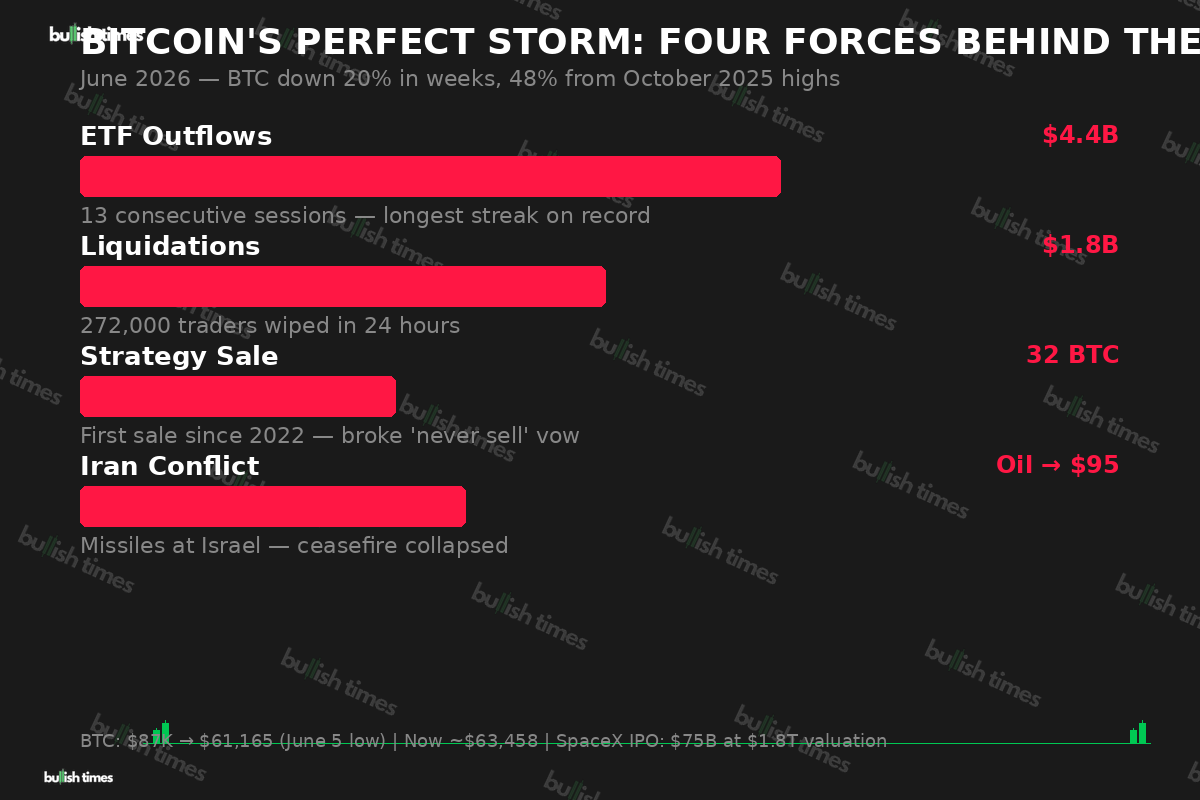
The scale of destruction is staggering. Between 2 and 5 June, Bitcoin plummeted from $87,000 to a low of $61,165 — its worst level since September 2024. United States spot Bitcoin ETFs bled for 13 consecutive sessions through 3 June, the longest outflow streak on record, shedding approximately $4.4 billion. Those redemptions are not sentiment — they are mechanical. When investors pull money, the issuer sells the underlying Bitcoin on the spot market, applying steady, automated downward pressure.
Then came the leverage flush. Crypto derivatives liquidations reached roughly $1.8 billion in a single 24-hour period, with one stretch force-closing $394 million in positions within a single hour. Close to 272,000 traders were wiped out, the overwhelming majority holding bullish positions that were caught leaning the wrong way. It was the largest deleveraging event since the October 2025 crash.
Saylor Blinked — And the Market Broke
If the ETF exodus was the engine, Michael Saylor’s Strategy was the spark that ignited the fuel. On 9 June, the world’s largest corporate Bitcoin holder announced it had sold 32 BTC for approximately $2.5 million — its first sale since 2022 and only the second in its history.
The dollar amount was minuscule: 0.004% of Strategy’s total holdings. The symbolic damage was devastating. Saylor had built a cult following around his “never sell” doctrine, backed by over $30 billion in corporate treasury allocations. Breaking that vow while sitting on roughly $11.7 billion in unrealised losses sent a message no amount of subsequent buying could unsend.
Within days, Saylor was back to buying — 1,550 BTC for $101 million — and posting cryptic “add more dots” signals on social media. But the whipsaw from selling to buying within 72 hours raised more questions than it answered. If even the most committed Bitcoin believer wavers, what conviction is left?
The SpaceX Factor: Real Threat or Convenient Scapegoat?
Here is where the narrative gets interesting. SpaceX filed to go public on 20 May, teasing a $75 billion raise — the largest IPO in history. Since that filing, Bitcoin has dropped roughly 20%. Two events, one timeline, an obvious villain.
The problem? SpaceX did not price until 11 June and does not begin trading until today, 12 June. The bulk of Bitcoin’s decline happened before a single share changed hands. You cannot fund a purchase that has not opened, which means the mechanical “sell Bitcoin, buy SPCX” trade could not have driven the early June plunge.
There is even a delicious irony the rotation theorists ignore: SpaceX itself holds Bitcoin, sitting on roughly $789 million in unrealised gains. The company being blamed for draining Bitcoin is one of its larger corporate holders.
The Macro Storm Nobody Wants to Talk About
Bitcoin did not fall in a vacuum. A hotter-than-expected US jobs report landed the same week, reviving fears the Federal Reserve’s next move could be a rate hike rather than a cut. Treasury yields surged. The Nasdaq dropped 4.2% on 5 June — its worst single day of 2026 — with Nvidia down roughly 6% as the AI trade wobbled.
Geopolitics piled on. Iran launched missiles at Israel, the first such attack since the April ceasefire. Brent crude surged back towards $95 a barrel, stoking precisely the inflation fears that keep the Fed hawkish. Bitcoin, which trades as a high-beta risk asset far more than as “digital gold,” did exactly what every speculative position did in that environment: it got sold.
The crypto market’s total capitalisation has contracted by over $800 billion since the beginning of June. Ethereum is down 35% from its 2026 highs. Altcoins have been gutted by 50% or more. The Crypto Fear & Greed Index has plummeted to “Extreme Fear” — a dramatic shift from the greed readings that prevailed for much of the year.
The Real Question: Has Crypto Lost Its Monopoly on Speculation?
None of this means the SpaceX story is pure fiction. There is a legitimate, slower version worth taking seriously. Mega IPOs like SpaceX — alongside the anticipated OpenAI and Anthropic listings and the broader AI equity boom — now offer the same dopamine hit to the same risk-hungry investors who once had nowhere to go but crypto.
SpaceX’s retail allocation of 30% — roughly three times the typical IPO — is explicitly designed to capture the exact demographic that drives crypto volume. Over time, that competition can pull speculative capital away from digital assets. It is not a one-day liquidity drain; it is a structural shift in where the world’s gamblers place their chips.
The path from here depends on ETF flows stabilising and the Fed picture clarifying — not on how many traders buy SPCX today. Liquidation cascades exhaust themselves. Funding rates have already flipped negative. Forced selling tends to overshoot.
But the monopoly is broken. Bitcoin no longer stands alone at the casino of high-risk, high-reward speculation. And that might be the most important chart no one is drawing.
This story is developing. SpaceX begins trading on Nasdaq at market open today — watch for whether crypto flows reverse or whether the capital drain is just getting started.